Skip to content

Join Today

Member portal

NSW Teachers Federation
  • Home
  • Courses
    • All Courses
    • All Conferences
    • Primary
    • Secondary
  • Journal
    • Journal Issue
    • For your Classroom
    • For your Staffroom
    • For your Future
    • For your Research
  • Podcast
  • About
    • Who we are
    • What we do
    • Our Presenters
    • FAQ
    • Contact Us
NSW Teachers Federation
  • Home
  • Courses
    • All Courses
    • All Conferences
    • Primary
    • Secondary
  • Journal
    • Journal Issue
    • For your Classroom
    • For your Staffroom
    • For your Future
    • For your Research
  • Podcast
  • About
    • Who we are
    • What we do
    • Our Presenters
    • FAQ
    • Contact Us

Subject: Secondary

Stay still, dive deep-approaches to read to write and the craft of writing

Jowen Hillyer and Rosemary Henzell give some practical advice on how to teach Reading to Write and Module C the Craft of Writing of HSC English Advanced and Standard syllabuses . . .

When we first encountered Module C there was a bit of confusion and in some cases trepidation. We found that reactions went a few ways:

  1. Hooray I get to work on the intricacies of refining writing with my kids!
  2. Oh great, a whole MODULE on writing with my kids (who barely pick up a pen)
  3. So, we annotate and look mainly at language techniques, right?
  4. If it’s not a close study then what is it?

Really the answer lay somewhere in between and was often context dependant. Due to Covid blocking our initial Centre for Professional Learning (CPL) conference plans, we had a whole year to actually apply what we presented. Despite our very different contexts, we decided to trial a uniform approach in both our schools to see if it would be effective.

From there we presented some approaches that worked.

Ultimately the philosophy behind both Read to Write and Craft of Writing did not change between courses or context:

Stay still, dive deep

READ TO WRITE

Some early approaches to this module, which worked brilliantly in many contexts, did not work for us. Many teachers created exciting units with a focus area and worked with texts centred on that concept- such as ‘Dystopian texts’ or ‘voices of protest’. While this helped us to tie things together in our minds it did not always work for students. Sometimes students saw the texts and the concept before they understood the module and their focus was diverted. Ultimately the module is not about a concept but about: incremental skill building, testing those skills and then expanding on them.

It was better to strip it back to the pure tools of writing where form is the focus. Asking students to consider the purpose of form was one of the most powerful things we uncovered.

In Read to Write we introduce students to “the writer’s toolbox/toolkit”- Vocabulary & grammar, elements of style, elements of composition and the often neglected one- fine tuning and refining.

The last tool was very important because, although it appears in our syllabus documents, the temptation for students to say ‘one and done’ is great. This module offers a chance at a retraining of PROCESS.

We devised a few steps to keep us on track too:

  • Read
  • Discuss
  • Zoom in
  • Create

The secret to success was to not skip any steps. It is so tempting last period Friday with a recalcitrant group to not bother discussing and just annotate and write silently but we tried that too and it led to incomplete writing and running out of things to say. Skipping steps means skipping process and that is what this module is training students for – the process and particulars of writing. It is called Read to Write so that the focus is on the students wide reading- a springboard into having something to say.

Kicking off reading to write

To begin the unit, we would start with letters to themselves on their last day of year 12- it acts as goal setting, introduces you to them and allows you to have a good idea of where they are at with discursive writing

Then we follow the process. An example might be Roald Dahl’s Lamb to the Slaughter:

  1. We read aloud, this helps students to hear the craft of the text and to understand performative aspects of text (as well as simply enjoying being read to)
  2. Discuss – this is not random ‘around the room with someone holding court’ It must be a guided discussion. Using the 4Cs routine was our chosen thinking organiser – often in group work .
  3. Zoom in on the text using different lenses go over it once for vocabulary and grammar, then for elements of style, then elements of composition
  4. Create Now that they understand how the text works and how they think and feel about it, they create a text which springboards from it- it could be an alternate version, a different context or even just an element of style or composition which was important in creating meaning in that text.
Table 1. The 4Cs Routine (Harvard Graduate School of Education, Project Zero)
Our reflections

Students enjoyed it more- there is safety in structure. It gave us an opportunity to purposefully choose texts to dive into and model excellent examples of discursive and persuasive texts.  Students reported seeing the practicality behind English, reading long form fiction for the first time in years and most importantly about why we read and write.

CRAFT OF WRITING – THE EVOLUTION FROM READ TO WRITE

In Read to Write students engage with other’s writing to build their own.

In Craft of Writing students focus on their own authorship. 

In Read to Write they are building a bicycle with an instruction manual (complete with scaffolded training wheels sometimes).

In Craft of Writing, they ride the bike.

In Read to Write we filled the toolkit.

In Craft of Writing, we build things- not well at first sometimes but practice is key with little bits of writing regularly.

In Module C the texts, on the prescriptions list, do not contribute to the pattern of study so it is a good opportunity to expose students to textual forms they are not as strong in or need development in. Not only does it assist with their crafting, but it helps strengthen the Paper 1 Section 1 muscle too.

Alongside the texts that teachers choose, students should be encouraged to read widely and in the 30 mandated hours for this course there can still be lots of other modelled texts to explore, alongside the prescribed ones selected.

Regardless of the course (Advanced or Standard), most Module C texts are hybrids.

The process doesn’t change much from Read to Write in the way we approach texts. This is not a close study and extreme annotation is not the aim of the game.

The steps are:

  1. Read & think- what emotions/idea does it raise, why did the author write this?
  2. Zoom in- with a layers routine (think of the text like a dish on MasterChef- look at the whole story, break it apart and look at the elements, look how it fits together so we understand the whole, evaluate).

  3. Springboard from layers- look at FORM, DYNAMICS, THEMES/IDEAS
  4. Create
  5. Reflect- This is a structured activity. – we are not defending our work but making direct connections between our own writing and the techniques chosen from the texts we have read. You are composer and critic in Module C.
Table 2. Layers routine 1 (Harvard Graduate School of Education, Project Zero) 
Table 2. Layers routine 2 (Harvard Graduate School of Education, Project Zero) 

Ultimately, both Read to Write, and The Craft of Writing are about skill development through creative exploration. Students and teachers will find in these modules a space to explore great writing from all genres, times and places. Most importantly it is a space to work with students as they discover the power and versatility of language.

Open All

Harvard Graduate School of Education. (n.d.). Project zero. http://www.pz.harvard.edu/ 

Jowen Hillyer

Jowen Hillyer is currently Head Teacher of English, HSIE and languages at Aurora College, the Department of Education’s first selective virtual school for rural and remote students (7-10) and remote students in Stage 6.

Jowen has been a teacher, head teacher and teacher educator for 26 years, with experience in both rural and disadvantaged public schools, as well as 3 years as an Associate Lecturer at The University of Sydney.

In her current role Jowen leads a large, diverse faculty situated all over the state in new approaches, innovation, and student engagement. Her research interests are centred on project-based learning, boy’s writing in the middle years and mentoring programs for beginning English teachers.

Jowen has also contributed to the Journal of Professional Learning and recently has had a peer reviewed article published on post pandemic teaching in the Journal of Adolescent and Adult Literacy.

Rosemary Henzell

Rosemary Henzell is an English and Drama Teacher at Willoughby Girls High School. Rosemary has a keen interest in project-based learning ranging from individual creative writing projects to building a whole-grade website exploring the modern relevance of Shakespeare.

As a senior member of her school’s Professional Learning Team, she is helping lead the school-wide implementation of Costa’s Habits of Mind, and Project Zero’s Cultures of Thinking Project.

Rosemary has also contributed to the Journal of Professional Learning and the Journal of Adolescent and Adult Literacy.

Supporting Students with Autism in 7-12

Supporting Students with Autism in 7-12

Overview

The Supporting Students with Autism in 7-12 course is designed to

  • develop an understanding of the wide range of characteristics of students with Autism;
  • explore a range of strategies which address the needs of students with Autism in the areas of language and cognitive development, communication skills and social behaviour;
  • develop specific strategies to help students with Autism access the curriculum, manage their own stressful reactions and modify their behaviours.

Participants will also develop an understanding of how to set up an effective learning environment for students with Autism.

25 March 2026, Surry Hills

27 May 2026, Online via Zoom

“I found it incredibly useful. I will definitely be implementing the strategies from today in my classroom.”

“Thank you for a fantastic day – really opened by eyes to the complexity of it all.”

“Loved the tips and useful resources. The opportunities to work in groups and share ideas.”

“Great information! Can take so much back to the staffroom.”

Members who have completed the course
Dr Rose Dixon

Dr Roselyn Dixon has been a special education teacher in both mainstream and special education settings in primary and secondary schools. Rose has been in academia and involved with Inclusive Education for more than 25 years. She has published research in the fields of social skills and behavioural interventions for people with a range of disabilities including students with Oppositional Defiance Disorders and Autism.

She has been actively involved in examining the relationship between digital technologies and pedagogy in special education and inclusive classrooms for students with Autism as well as the implications of the NDIS on people with disabilities in rural and remote communities. Rose is an Honorary Associate Professor at the School of Education, University of Wollongong, where she was previously the Academic Director of Inclusive and Special Education. She continues to support doctoral students in Inclusive and Special education with a focus on Autism. 

Completing Supporting Students with Autism in Years 7-12 will contribute 5 hours of NSW Education Standards Authority (NESA) Accredited PD in the priority area of Students/children with Disability addressing standard descriptors 1.1.2 & 4.1.2 from the Australian Professional Standards for Teachers towards maintaining Proficient Teacher Accreditation in NSW.

Teachers in 7-12

$220 (Federation members only)

Face-to-face

JPL Article

Supporting students with Autism: Strategies that really work in the classroom
Supporting Students with Autism: Strategies that Really Work in the Classroom

“Was tailored to perfection.”

“I wish I knew about the CPL as a Uni Student/earlier in my teaching.”

“An excellent workshop, practical, lots of good ideas.”

“Rose was a great teacher, thank you!”

“Up to date terminology, research. Loved hearing from other teachers/schools.”

A Guide to the New Stage 6 History Syllabuses

Margaret Vos introduces the new Stage 6 History syllabuses which are implemented for Year 11 in 2018… The new NSW Stage 6 History Syllabuses were endorsed in 2016. 2017 is a planning year with implementation for Year 11 in 2018 and Year 12 in 2019. These syllabuses aim to provide students with opportunities to further develop high order, core historical skills, knowledge and understanding which will assist them in the next stage of their lives.Whilst the syllabuses include some content, including skills and concepts, aligned with the Australian Curriculum they retain a uniquely NSW structure and useful parallels with the previous Stage 6 History syllabuses in terms of structure and content.Due to the online nature of the syllabus documents, teachers are encouraged to download and review each section, including the aim and rationale before moving to the course content.Initial information regarding assessment has been published by the NSW Education Standards Authority (NESA). The most significant change is the approach to the formal school-based assessment program for Year 11 and Year 12. Examination specifications are expected to be available in Term 3, 2017.Similarities between the Ancient History Stage 6 and the Modern History Stage 6 SyllabusesIntegrated historical skills and conceptsThis new approach enables teachers to plan for deeper analysis of the topics.The outcomesTeachers should carefully consider the outcomes in both Ancient History and Modern History. They are now organised into two categories: Knowledge and Understanding, and Skills. There are specific objectives attached to each category.Duplication and overlapThe important limitation to a teacher’s choice is the restriction that existed in the previous syllabus regarding topic choice in Year 11; Case studies must not overlap with or duplicate significantly any topic attempted in the Year 12 Ancient History, Modern History or History Extension courses. Structural organisationThere is some structural similarity between the Year 11 Courses in both Ancient History and Modern History which may be helpful.This also makes it easier for students to recognise that the two courses are similar in structure and in the amount of work involved. Teachers who transition from the teaching of Modern History to Ancient History (or vice versa) will find some commonality in the Year 11 Courses.Indicative hours in Year 11The breakdown of the 120 indicative hours into hours for each topic is also now identical in the two courses. Previously only the Modern History Year 11 Course had specified indicative hours for the Preliminary Course.Flexibility for teachers in the Year 11 coursesThe content of each case study and option is further developed within both syllabuses. This includes a list of possible examples that could be used to illustrate aspects of the content. The list of examples and content is not proscriptive. Teachers may develop their own examples and make choices about the sequence and emphasis of their teaching of the content. The Historical InvestigationThis important part of the previous syllabus has been retained in the Year 11 Course in both Ancient History and Modern History. This topic is also a crucial background and skill development for students who wish to go on to History Extension. The investigation provides all students with choice and opportunity to carry out the work as historians in areas of their own interest (either as an individual researcher or as part of a group investigation). It allows teachers to give their students a real choice about the topics they wish to study.Ancient HistoryThe Year 11 courseThe major changes in the new Ancient History Stage 6 Syllabus occur in Year 11. The breakdown of the specified indicative hours for each topic is below:Ancient HistoryYear 11 Course120 Indicative HoursIndicativeHoursInvestigating Ancient HistoryThe Nature of Ancient HistoryCase StudiesEach case study should be a minimum of 10 indicative hours.60Features of Ancient Societies40Historical Investigation20Investigating Ancient HistoryThis is the major section of the Year 11 Course (50% of the indicative hours).The Nature of Ancient HistoryWhat has changed?There are now six distinct areas and students must investigate at least ONE of the following options:The Investigation of Ancient Sites and SourcesHistorical Authentication and ReliabilityThe Representation of the Ancient PastPreservation, Conservation and/or Reconstruction of Ancient SitesCultural Heritage and The Role of MuseumsThe Treatment and Display of Human RemainsHow can this section be taught?A teacher can approach this section in various ways:Teach one of the options;Teach more than one option;Create an integrated study incorporating elements of two or more of the six areas.Case StudiesWhat has changed?TWO Case studies must now be completed –  ONE from List A (Egypt, Greece, Rome, Celtic Europe) and ONE from List B (the Near East, Asia, the Americas, Australia).The two case studies do not need to be of equal length. The only requirement is that “Each case study should be a minimum of 10 indicative hours.” Old Kingdom Egypt is now a Case Study option as it is no longer in the Year 12 Course. Similarly, Mycenae is one of the possible topics as it too no longer exists in the Year 12 Course. Ancient China in the Qin and Han Dynasties may no longer be taught in the Year 11 Course as this topic is now in the Year 12 Course. Some exciting new topics are included below:Ancient AustraliaThe Shang DynastyTeotihuacanPalmyra and the Silk RoadFeatures of Ancient SocietiesWhat is the structure?This section is a new way of approaching the study of Ancient Societies. A list of both Ancient Societies and Key Features is provided. Students study at least TWO ancient societies through an investigation of EITHER a different key feature for each society OR one key feature across the societies selected. How can this section be taught?The emphasis is on the interpretation of historical sources. The structure of this section allows for flexibility in a teacher’s choice of topics which could allow for a study of the interaction of TWO distinct societies. Another approach could involve ONE study of two or more societies.Students investigate a key feature of the society or societies chosen. A list of possible studies is provided but is not proscriptive. The addition of India and China may encourage a more thorough focus on Asian history.School-based assessment requirementsTeachers should refer to the NESA Assessment and Reporting in Ancient History Stage 6 document http://syllabus.bostes.nsw.edu.au/assets/global/files/assessment-and-reporting-in-ancient-history-stage-6.pdf . Teachers are encouraged to refer to the relevant NESA documents for updates. Some features for the new syllabus include:The Year 11 formal school-based assessment program is to reflect the following requirements:three assessment tasksthe minimum weighting for an individual task is 20%the maximum weighting for an individual task is 40%one task may be a formal written examinationone task must be an Historical Investigation with a weighting of 20–30%.The Year 12 courseThe structure – What is the same? What is different?The structure of each of the four topics is slightly different. Each topic has two sections – Survey (a maximum of 3 hours) and Focus of Study (a minimum of 27 hours). It is important to note that there is still a requirement that students study from at least TWO geographical areas. The list has been expanded to include China. The indicative hours are listed below:Ancient HitoryYear 12 course120 Indicative HoursIndicativeHoursCore Study – Cities of Vesuvius – Pompeii and Herculaneum30Ancient Societies30Personalities in their Times30Historical Periods30The Core Study – Cities of Vesuvius – Pompeii and HerculaneumContent – what is the same and what is different?The Core’s Content Focus (which replaces the Principal Focus of the previous syllabus) has been expanded to include a statement that: “Students will develop and apply their knowledge and skills to understand and use  different types of sources and relevant issues”.This is significant as this further clarifies the historiographical aspect of the core.There are three new terms specified to clarify the focus of the content relating to local political life (decuriones, magistrates, Comitium).Ancient SocietiesAlthough rearranged, the content for each Ancient Society will be familiar to teachers who have taught the previous syllabus and teachers will be able to use their resources to teach this topic. One new topic has been included: Society in China during the Han Dynasty 206 BC – AD 220.Personalities in their TimesWithin this section a new sub-topic exists – a close analysis of a source or type of source. This includes a study of the value of the source as well as an evaluation of the source in the context of other available sources (including the problems of evidence). This explicit addition is important. For, although teachers would have used sources when previously doing this topic, it is a reminder that there is an important historiographical aspect of this topic. One new topic has been included: China – Qin Shihuangdi.Historical PeriodThe new Survey looks at the chronological and geographical context as well as the key powers in the region and the nature of contact with other societies. This is to be completed in a maximum of 3 hours. One new option is included: Imperial China – the Qin and Han 247 – 87 BC. This was previously in Ancient Societies in the old Preliminary Course. School-based assessment requirementsTeachers should refer to the NESA Assessment and Reporting in Ancient History Stage 6 document for updates. The Year 12 formal school-based assessment program includes:a maximum of four assessment tasksthe minimum weighting for an individual task is 10%the maximum weighting for an individual task is 40%one task may be a formal written examination with a maximum weighting of 30%one task must be an Historical Analysis with a weighting of 20–30%.Information about the Historical Analysis in Ancient HistoryThe Historical Analysis provides students with the opportunity to focus on an historical question, issue or controversy of interest, and to develop a reasoned argument, supported by evidence. It may occur in or across any of the topics selected for study.The Historical Analysis may be presented in written, oral or multimodal form, and must:be completed individuallybe a maximum of 1200 words, 6 minutes duration or equivalent in multimodal formaddress relevant syllabus outcomesrelate to a topic or topics studied in the Ancient History Stage 6 Syllabus.Modern HistoryThe Year 11 courseThere are substantial changes to this course. The indicative hours are listed below:Modern HistoryYear 11 Course120 Indicative HoursIndicativeHoursInvestigating Modern HistoryThe Nature of Modern HistoryCase StudiesEach case study should be a minimum of 10 indicative hours.60Historical Investigation20The Shaping of the Modern World40Investigating Modern HistoryHow is this new section structured?Investigating Modern History is the major part of the Year 11 Course (50% of the indicative hours). This has been designed as an introduction to Modern History and its skills, historical concepts, relevant methods and issues. The topic has two distinct sections.The Nature of Modern HistoryWhat is its content?There are five distinct areas listed and students must investigate at least ONE of the following:1. The investigation of historic sites and sources2. The contestability of the past3. The construction of modern histories4. History and memory5. The representation and commemoration of the pastHow can this section be taught?A teacher can approach this section in various ways:Teach one of the options;Teach more than one option;Create an integrated study incorporating elements of two or more of the five areas.Case StudiesWhat has changed?Teachers can create their own case studies; old favourite topics can still be taught (except for those topics that now are part of the Year 12 Course). Some of the previous case studies are now part of the Year 12 Course. If these topics are not attempted in the Year 12 course teachers have the flexibility to develop their own case studies, including:The Civil Rights Movement in the USA in the 1950s and 1960s;Aung San Suu Kyi and the pro-democracy movement in Burma;The Chinese Government and Tiananmen Square.New Case StudiesThe new case studies are listed in the table below. There is a requirement that “each case study should be a minimum of 10 indicative hours.”  They do not need to be of equal length. Teachers will continue to teach a case study from List A and List B. Some new and modified case studies include:The American Civil WarThis topic will be familiar to those teachers who have been teaching Modern History for a long time.Making Change: Day of Mourning to MaboWomen’s MovementsA much more comprehensive and interesting topic than the previous Emmeline Pankhurst and the Suffragette Movement.The Rise of the Environment MovementThe Changing Nature of Anglo – Irish RelationsThis topic was moved from the old Year 12 course.The British In India and BurmaIncludes aspects of The Indian Mutiny 1857 (from previous syllabus).The Making of Modern South Africa 1890 – 1910This topic will serve as background to Apartheid in South Africa 1960 -1994 (an option in the new Year 12 topic – Change in The Modern World).How can this section be programmed?TWO case studies.ONE case study and ONE of the teacher’s own.TWO case studies of the teacher’s own.Where teachers develop their own case studies they need to use the framework provided in the syllabus.The Shaping of the Modern WorldThe purpose of this section is for students to examine a key historical development through the study of different types of sources. Students can develop an understanding of modernity.This topic provides for the study of topics from the late 17th Century and the 18th Century.What is the structure of this topic?Students study at least ONE of the following key historical periods:World War I (which retains some elements of the former Year 12 Core from the previous syllabus as well as new elements)The EnlightenmentThe French RevolutionThe Age of ImperialismThe Industrial AgeThe End of EmpireHow can this section be taught?For this section, there are 40 indicative hours.  A substantial part of the Year 11 Course should be spent on this topic. Teachers can, therefore, develop detailed and innovative studies. Only ONE topic is required to be taught. However, it is possible to create an option that integrates aspects of more than one of the topics listed. For example, an option could be developed that looked at the forces that existed in the late 17th Century and the 18th Century (such as industrialisation, imperialism, revolution and the Enlightenment) and trace the legacy of, and impact of, these forces on the modern world.School-based assessment requirementsTeachers should refer to the NESA Assessment and Reporting in Modern History Stage 6 document and other relevant NESA documents for updates http://syllabus.bostes.nsw.edu.au/assets/global/files/assessment-and-reporting-in-modern-history-stage-6.pdf  . Some features for the new syllabus include:The Year 11 formal school-based assessment program is to reflect the following requirements:three assessment tasksthe minimum weighting for an individual task is 20%the maximum weighting for an individual task is 40%one task may be a formal written examinationone task must be an Historical Investigation with a weighting of 20–30%.The Year 12 courseThere is a new requirement that at least ONE non-European / Western topic is studied in the Year 12 Modern History Course. These non-European / Western topics are clearly listed in the syllabus. As seen from the Course Structure and Requirements below, there are substantial changes to the Year 12 Course.Modern HistoryYear 12 Course120 Indicative HoursIndicative HoursCore Study – Power and Authority in the ModernWorld 1919-194630National Studies30Peace and Conflict30Change in the Modern World30 Core Study – Power and Authority in the Modern World 1919–1946The new Core provides a broader international focus within which Germany is situated and this may provide contextual background for subsequent topics such as Conflict in the Pacific and The Changing World Order.What are the challenges?This Core study will be new for some who have not previously taught Germany. The fact that Germany was always such a popular choice, however, means that there is a huge range of existing resources.What is the content?The Core Focus states that “students will develop and apply their knowledge and skills to understand and use different types of sources and relevant historiographical issues.” Thus, the historiographical nature of this core is emphasised.SurveyThis gives an overview of the peace treaties which ended World War One and is a maximum of 3 hours, 10% of the indicative hours for the Core.Focus of study includes three sections:The rise of dictatorships after World War IThe concept of and the nature of power and authority in the period of 1919–1946 is examined, including a study of the rise of fascist, totalitarian and militarist movements after World War I. This investigation into the growth in dictatorships in Europe (with the central focus on the events in Germany) in the period between the World Wars considers why such regimes became popular.The Nazi regime to 1939The nature of Nazi ideology and the role of individuals in the Nazi state are studied. The consequences of the emergence of totalitarianism and militarism within Germany as well as opposition to the regime are also investigated.The search for peace and security in the worldThe Core concludes with a look at the international consequences. An overview of the ambitions of Germany and Japan are studied as is the role of the League of Nations and the United Nations.National StudiesWhat is changed?It is essential that teachers check to see if the dates for their chosen National Study have changed. China, Japan, Russia and the Soviet Union and the USA are completely unchanged. One new topic exists: Iran 1945–1989. This includes a Survey (maximum of 3 indicative hours) of Iran from 1945 to 1953 and a Focus of Study (including The Rule of the Shah; The Revolution and Iran under Khomeini).Three of the countries to be studied are the same but require a study of a different chronological period. These include India 1942–1984, Indonesia 1945–2005 and Australia 1918–1949.Peace and ConflictConflict in the Gulf 1980–2011 is an exciting new study.Change in the Modern WorldThis is a new topic in the Year 12 Modern History course. Students are to investigate key features in the history of ONE of six topics. Some new case studies draw upon some content from previous Preliminary course studies, including:New OptionsThe Nuclear Age 1945–2011The Changing World Order 1945–2011From Previous SyllabusApartheid in South Africa 1960–1994 (previous National Study)Civil Rights in the USA 1945–1968 (previous Preliminary course)Pro-democracy movement in Burma 1945–2010 (previous Preliminary course)The Cultural Revolution to Tiananmen Square 1966–1989 (previous Preliminary course)School-based assessment requirementsTeachers should refer to the NESA Assessment and Reporting in Modern History Stage 6 document for updates. The Year 12 formal school-based assessment program includes:a maximum of four assessment tasksthe minimum weighting for an individual task is 10%the maximum weighting for an individual task is 40%one task may be a formal written examination with a maximum weighting of 30%one task must be an Historical Analysis with a weighting of 20–30%.Information about the Historical Analysis in Modern HistoryThe Historical Analysis provides students with the opportunity to focus on an historical question, issue or controversy of interest, and to develop a reasoned argument, supported by evidence. It may occur in or across any of the topics selected for study.The Historical Analysis may be presented in written, oral or multimodal form, and must:be completed individuallybe a maximum of 1200 words, 6 minutes duration or equivalent in multimodal formaddress relevant syllabus outcomesrelate to a topic or topics studied in the Modern History Stage 6 Syllabus.History ExtensionThe course outlineThere has been a reduction in indicative hours for the History Project (from 24 to 20) and a subsequent increase in the hours (a minimum of 40) for the topic Constructing History. History ExtensionYear 12 Course60 HoursIndicativeHoursConstructing HistoryKey QuestionsCase Studies40(minimum)History Project20(maximum)Constructing HistoryThis is the largest topic with two distinct parts: the Key Questions and the Case Studies.Key QuestionsThere are now four Key Questions:Who are historians? This question still allows for a study of those historians who have created history over time. The deletion of ‘the’ from the previous question (Who are the historians?) considerably widens the possibility for debate about who should be considered as an historianWhat are the purposes of history? ‘The aims’ has been removed from this question.How has history been constructed, recorded and presented over time? An additional word ‘presented’ has been added to this question.Why have approaches to history changed over time?What is different?The other previous question “What are the historical debates in the case study?” is to “be integrated within each case study”.“The Readings” – reference to ‘The Readings’ has been removed from the new syllabus. However, where appropriate, extracts from this document can still be used as a resource. If used judiciously, and not studied in its entirety, selected readings may be of value.Case StudiesWhat has changed about the content?There is a reduction in the content to better reflect the requirements of 1 unit subjects. The areas of historiographical debate in every case study have been reduced from five to three. A summary of key topic changes is listed below:AncientNewAthenian DemocracyCollapse of the Western Roman EmpireModifiedThe Origins of Christianity retains substantial elements of the previous case study – The Historicity of Jesus Christ.Cleopatra VII (Formerly a topic in the Ancient History course)Medieval and Early ModernNew1. Witch Hunt and Witch TrialsModernModifiedNapoleonWestern Imperialism in the 19th CenturyAppeasementJohn Fitzgerald KennedyA British Prime Minister: Winston Churchill OR Margaret ThatcherAsiaNewGenghis KhanThe Opium WarsPartition of India; although new to History Extension, it was one key feature of the previous Modern History National Study – India: 1919-1947. It will also complement the new National Study – India: 1942–1984 in the Year 12 Modern History course.AustraliaNewRepresentations of ANZACAn Australian Prime Minister: Robert Menzies OR Gough WhitlamModifiedThe Frontier in Australia is a previous Case StudyThe Arrival of the British in Australia. Although the content is very much the same there has been a change in terminology. The use of the term ‘frontier’ instead of ‘the arrival of the British’ allows for a broader study of the Aboriginal response to British intrusion in Australia.History ProjectThe essay length is the same and must not exceed 2500 words. The bibliography is still required and an evaluation of three sources. This must not exceed 600 words in total. The Project is still to be marked internally and it is recommended to arrange for some collaborative/team marking of this Project (either amongst History teachers in one school or across schools).What has changed?There have been some slight but significant changes to Part II Documenting the ProjectProposalAn extra dot point has been added to the instructions. It explicitly mentions that a proposal should include a focus question.SynopsisNo longer required.Process LogThe content of this section has been expanded to include:Explanation of the topic choice – this reflects the intention of the former synopsis;Draft responses – this will ensure that the work follows the principle of good scholarship (including the lack of plagiarism);Teacher Feedback – so teachers can continue to monitor the Project and give genuine feedback at various stages in the process. This can be achieved by viewing and commenting on the drafts as well as checking the use of sources.CertificationThere is not further information available at present. The syllabus refers to the HSC All My Own Work Program.School-based assessment requirementsTeachers should refer to the NESA Assessment and Reporting in History Extension Stage 6 document for updates http://syllabus.bostes.nsw.edu.au/assets/global/files/assessment-and-reporting-in-history-extension-stage-6.pdf  .The Year 12 formal school-based assessment program includes:three assessment tasksone task may be a formal written examination with a weighting of 30%one task must be the History Project – Historical Process (proposal, process log, annotated sources) with a weighting of 30%one task must be the History Project – Essay with a weighting of 40%.There are now two Life Skills coursesThere is now an authentic, stand-alone course for both Ancient History and Modern History Life Skills students. In the old HSIE Life Skills Syllabus, the study of Ancient History and Modern History were together with other subjects. For each subject, students will study the same topics as their peers.In implementing each of the new syllabuses for Stage 6 History, the importance of collaboration of History teachers between schools and within faculties will be essential. Professional learning opportunities such as those conducted by the Centre for Professional Learning will also be useful in supporting these processes. For more information visit: http://cpl.asn.au/Margaret Vos has 36 years’ experience as a high school History teacher in NSW Public Schools. In that time, she has regularly taught Ancient History, Modern History and History Extension. Margaret co – wrote Ancient Quest (a junior History textbook) and has been involved in the professional development of teachers (including helping teachers introduce History Extension as a subject in their schools). Margaret has also contributed to curriculum development processes throughout her career.

Helping Your Students to Become Better Writers

Joanne Rossbridge & Kathy Rushton share a framework for improved extended response writing…

Introduction

Teacher knowledge about language and how it works is critical for not only developing dialogue around texts but can make explicit for students the strategies used by effective writers across subject areas. This requires understanding of the grammatical features of the common genres students commonly are asked to write in the secondary school.

This article looks at the extended response to support teachers to analyse student writing and examine both the language and literacy demands related to writing extended responses in secondary settings. The following outlines the approach and principles that are drawn upon in both a one-day and three-day CPL course entitled Conversations about Text in the Secondary School and Developing Dialogue about Text in the Secondary Schools respectively.

Making appropriate choices – Field, Tenor and Mode Framework for writing

Texts can be discussed using a framework developed by Michael Halliday (Halliday & Hasan, 1985) in which the three critical aspects of the register of the text, field, tenor and mode are utilised to analyse and understand how successful texts are constructed to reflect their context and purpose:

  • Field refers to the subject matter of the text and this of course will differ across and within subjects;
  • Tenor is the relationship established between the reader and writer;
  • Mode addresses the nature of the text itself and the role language plays within it.

When viewed together, all students can be supported to understand the range of language choices which need to be made to successfully realise the purpose of a text for the audience it is addressing.

For further explanation see Halliday & Hasan, 1985 and Rossbridge & Rushton, 2015.

This helps students to realise that careful reading and note-taking may address field but to meet the challenges of engaging an audience and establishing a clear purpose for their text a range of other language choices need to be made.

The following framework provides teachers with a time-saving and focussed way to provide the support that developing writers may need at all levels of text from word, clause, group and sentence to paragraph and text levels (Derewianka, 2011).

Choices in context: a case study from the ancients

The context for writing in secondary schools is provided by the subject areas. Students may be involved in field building through the focus on teaching content around a topic such as an example of The Ancient World in History. In addition to acquiring the field knowledge we also need to be explicit about who the audience may be that they are writing for as well as the relationship between the writer and reader.

The following examples show how the field of the writing may be similar but the tenor and mode differ. This can be seen by the more personal connection with the audience in Text 1 while Text 2 seems to convey more authority on the topic. In addition, the mode of the texts may differ in that the writing may be more spoken or written-like as evident in Text 2, which sounds more written-like or academic in the way the ideas have been packaged and organised.

Text 1

Have you ever wondered what life was like for women in Ancient Sparta? They had lots of power and could think for themselves more than some of the other women in other places in Greece.

Text 2

Spartan women had a reputation for strength and independence. They enjoyed greater freedom and power than women in other city-states in Ancient Greece.

This framework for considering and talking about language choices in context can provide the basis of a strong scaffold (Hammond, 2001; Vygotsky, 1986) for adolescent writers.

Writing pedagogy

The genre based pedagogy known as the Teaching Learning Cycle was originally developed by Sydney School genre theorists… [it] has proved a powerful resource for scaffolding literacy development, with numerous published units of work documenting and/or guiding its implementation.                        (Humphrey & Macnaught, 2011, p. 99)

The Teaching Learning Cycle includes building the field, text deconstruction, joint construction and independent construction. Our focus is on supporting teachers to undertake the more challenging text deconstruction and joint construction.

We consider that the critical dialogue about text occurs during text deconstruction and joint construction (Rossbridge & Rushton, 2014). In many classrooms, texts are modelled but the rich language about language, metalanguage, can only be developed when the teacher and students talk together about the language features of the texts they are reading or writing (Lemke, 1989).

For this reason, one of the courses involves the conversations about text that teachers can develop to support writing development (Rossbridge & Rushton, 2010 & 2011). By using the field, tenor, mode framework for writing, not just the field (content) but also the tenor (relationship) and mode (nature) can easily be the focus of these conversations.

What a conversation might lead to

The following transcript provides an example of the conversations which might occur between a teacher and students. In this example from a whole class joint construction the notion of perspective in History texts is explored by considering the development of the noun group to name participants in events.

Student: Dan would say he’s like a visitor because he wouldn’t say he is trespassing or doing anything wrong. He’d say he’s visiting and helping out his country.

Student: You probably know that their settling there as a new country.

Teacher: So are you saying he’s a settler?

Student: Yeah. Like saying he would know he’s not really going to be going anywhere.

Teacher: So, is he a visitor or a settler?

Students: Settler.

Teacher: What have we built? Dan, who was a young British settler. What have we just built?

Student: Noun group.

Teacher: Yes, we’ve built a whole noun group with an adjectival clause.

(See Rossbridge & Rushton, 2014 & 2015)

Key principles for developing a critical dialogue about text

  • The key principles for developing the critical dialogue about text are, in our view, language, the learner and the support or scaffold provided for the student. The teacher needs to be very clear about the language needed to write target texts as well as having a clear view of the purpose of talk in the classroom.
  • The dialogue can be supported by questioning, Think Alouds (when the teacher verbalises their thinking as they read for meaning to model the thinking skills required for comprehension) and other strategies which provide opportunities for talk and substantive communication.
  • The learner needs to be both engaged and supported to undertake risks (Hammond, 2001) if they are to master the challenges of writing an extended response in an academic context. The support needed is not just modelling but the ability to hand over the tasks to the students (Gibbons, 2002 & 2006) at the right point, the Zone of Proximal Development (ZPD) (Hammond, 2001; Vygotsky, 1986). This may require both micro and macro scaffolding when programming and teaching.
  • One of the most important understandings about language development is that it can be viewed on a continuum from spoken-like to written-like language, the mode continuum. At one end of the continuum is oral language which differs from written language mainly in its density. Written language is lexically dense in the sense that more meaning is carried in fewer words (Halliday, 1985). The challenge teachers face is to support students to develop the lexically dense texts which are valued in our education system.Written language is lexically dense in the sense that more meaning is carried in fewer words

Nominalisation and theme

Using the framework of field, tenor and mode two very useful tools for writing can be drawn upon. These are the features of nominalisation and theme which can be identified in texts. Students can be taught how to use them to make their texts more effective.  Nominalisation is a resource that allows writers to change verbs, conjunctions and adjectives into nouns.

Making language more powerful

We should reduce mining near the coastline.

The reduction of mining near the coastline will result in greater preservation of coastal ecosystems.

In the example the verb group in the first clause has been turned into a noun group (nominalised) and placed at the front of the second clause in theme position. By doing this the main focus of the writing can be put up front, the writing sounds more written-like and by repackaging the first clause into a noun group the writer is able to add additional information.

Such conversation and dialogue around text enables students to take on knowledge about language in the context of texts and apply it to their own writing.

The use of these features relates to the genre of the target text (Macken & Slade, 1993; Martin & White, 2005; Martin & Rose, 2008).  While unfamiliarity may initially challenge students, when teachers become adept at deconstructing both modelled and student texts even very young students are able to grasp the concepts and begin to utilise them in their writing.

Our CPL courses demonstrate a range of strategies for developing extended responses which include the effective use of these features and support students to master them.

References:

Derewianka, B. (2011) A new grammar companion for primary teachers. Newtown: PETAA

Gibbons, P. (2006) Bridging discourses in the ESL classroom: Students, teachers and researchers (pp.59-70). London: Continuum

Gibbons, P. (2002) Scaffolding language, scaffolding learning: Teaching second language learners in the mainstream classroom (pp.77-101). Portsmouth: Heinemann:

Halliday, M.A.K.(1985) Spoken and written language (pp.61-67). Victoria: Deakin University Press

Halliday, M.A.K. & Hasan, R. (1976) Cohesion in English (pp.238-245). London: Longman

Halliday, M.A.K. & Hasan, R. (1985) Language, context, and text: Aspects of language in a social-semiotic perspective (pp.238-245). Victoria: Deakin University Press

Hammond, J. (Ed.) (2001) What is scaffolding?  Scaffolding teaching and learning in language and literacy education (pp.1-14). Newtown:PETAA

Humphrey S., Droga, L. & Feez, S. (2012) Grammar and meaning: New Edition.  Newtown: PETAA

Humphrey, S. &  Macnaught  S. (2011) Revisiting joint construction in the tertiary context. Australian Journal of Language and Literacy. 34(1), 98-116

Lemke, J. (1989) Making text talk: Theory into practice. Columbus, Ohio: College of Education Ohio State University

Macken, M. & Slade, D. (1993) Assessment: A foundation for effective learning in the school context. In Cope. B & Kalantzis, M. (1993) The powers of literacy: A genre approach to teaching writing. (pp.203-222)  Bristol, P.A.: The Falmer Press

Martin, J. & Rose, D. (2008) Genre relations: Mapping culture London: Equinox Publishing

Martin, J. & White, R. (2005) The language of evaluation: Appraisal in English. (pp.26-38) Basingstoke: Palgrave Macmillan

Rossbridge, J. & Rushton, K. (2015) Put it in writing. Newtown: PETAA

Rossbridge, J. & Rushton, K. (2014) PETAA Paper 196 The critical conversation about text: Joint construction. Newtown: PETAA http://www.petaa.edu.au/imis_prod/w/Teaching_Resources/PETAA_Papers/w/Teaching_Resources/PPs/PETAA_Paper_196___The_critical_conversation_.aspx

Rossbridge, J. & Rushton, K. (2010) Conversations about text: Teaching grammar with literary texts. Newtown: PETAA

Rossbridge, J. & Rushton, K. (2011) Conversations about text: Teaching grammar with factual texts. Newtown: PETAA

Vygotsky, L. (1986) Thought and Language. Cambridge, Massachusetts: MIT Press pp.xi-xliii

About the authors

Dr Kathy Rushton is interested in the development of literacy, especially in socio-economically disadvantaged communities with students learning English as an additional language or dialect. She has worked as a literacy consultant, EAL/D and classroom teacher with the DOE (NSW), and in a range of other educational institutions. Kathy is a lecturer in the Faculty of Education and Social Work at the University of Sydney.

Joanne Rossbridge is an independent English, language, literacy and EAL/D consultant working in both primary and secondary schools across Sydney and Australia. She has worked as a classroom and ESL teacher, literacy consultant and lecturer in universities. Much of her experience has involved working with students with language backgrounds other than English. Joanne is particularly interested in student and teacher talk and how talk about language can assist in the development of language and literacy skills.

Critical Literacy in English and History: Stages 3 & 4

Kathy Rushton and Joanne Rossbridge explore the important concept of Critical Literacy. They explain why it is essential for teachers (in both primary and secondary classrooms) to use critical literacy to ensure student engagement, to teach our students how to properly analyse all text and to allow them to develop a wider view of, and critical understanding of, the world . . .

The aim of critical literacy is a classroom environment where students and teachers together work to (a) see how the worlds of texts work to construct their worlds, their cultures, and their identities in powerful, often overtly ideological ways; and (b) use texts as social tools in ways that allow for a reconstruction of these same worlds.

Luke (2000) Critical Literacy in Australia: A matter of context and standpoint. Journal of Adolescent and Adult literacy. Vol. 43/5 448-461 p.453

Teachers in the middle years, Stages 3 & 4, are supporting students in their transition from the primary to secondary years. This transition often requires students to interrogate more challenging texts and respond to and compose more sophisticated texts of their own. Teachers, therefore, need to develop their own critical analysis and curation of texts for use in the classroom and to develop a range of appropriate teaching and learning strategies to support the development of critical literacy for their students. The theoretical perspectives that inform this perspective relate to issues of race, gender and ethnicity and also how these issues impact on language choices.

Designing learning with a critical literacy perspective

Defining critical literacy can be facilitated by reviewing the four reading resources (Freebody & Luke, 1990) particularly the Text Analyst role which supports students to question and analyse texts. Students can be supported in the development of critical literacy if teachers are able to identify links to critical literacy in English and History Syllabus documents. These links can then be exemplified for students by, for instance, elaborating on cross curriculum priorities and general capabilities.

In practice teachers can analyse features such as context, author background, date and place of publication and then support their students to discuss different perspectives and contestability. This is most easily done in a modelled reading lesson accompanied by strategies to support students before, during and after reading. Before reading, viewing and analysing images can support the development of field knowledge and provide a starting point for developing vocabulary related to the subject. Strategies such as verbal ping pong, which is often used to develop debating skills, can engage students in developing arguments for or against a topic as an initial strategy for developing field knowledge or following a modelled reading to elaborate on aspects of the topic. Similarly, a drama strategy such as conscience alley can be used before, during or after reading to help develop empathy for a character, historical or imaginary, when they face a critical event. (Dutton et al, 2018; Rossbridge & Rushton, 2011 & 2015)

By encouraging a focus on language choices, students are also supported in their analysis of perspectives. Some students may find that they are excluded from the texts which they are required to read or produce in the school (Bishop, 2003). Alton-Lee (2000) exemplifies this by reporting an incident in which a teacher in New Zealand accidentally excluded an Indigenous student “from the ‘we’ of the classroom” (p.26). It is easy to see how this situation could be replicated in any English or History classroom if the texts that are used do not analyse the “we” and identify the perspective from which they are written. For instance, texts written from the perspective of Aboriginal Australians may position non-Aboriginal readers as visitors to sites or ceremonies or as outsiders or invaders in events from the past rather than as actors ‘discovering’, ‘describing’ or ‘evaluating’ the same sites and events.

Selecting texts to develop critical literacy

If texts are viewed from a critical literacy perspective, a range of texts can be selected to represent a variety of perspectives in contemporary Australian society. Especially in History, texts should be considered in terms of contestability and empathetic understanding as well as how they develop and challenge understandings about contemporary issues and the past. To support students to engage critically in response to texts, teachers can identify, deconstruct and analyse language features to support critical analysis. In particular questioning perspectives based on context, author background, date and place of publication will support this process. In this way students will be supported to describe and assess the motives of individuals and groups within historical contexts and in literary texts. Supporting students to develop the ability to interpret, explain and identify perspectives in a range of texts in both English and History will support the understanding of subject matter and literacy. Intercultural understanding will also be supported through comparison of texts especially those written from an Aboriginal and Torres Strait Islander perspective. The table below suggests some questions which could be used to interrogate and analyse a text and to develop the role of the Text Analyst.

Table 1. (click here to view table)

Guiding questions for selecting and curating texts: Developing the Text analyst role

How do you interpret the perspective of this text?

How does the context of the text differ from your own context?

What assumptions does the author make about the audience?

What perspective is assumed by the author?

Who do you think might disagree with the author’s stance? Why?

Is the text relevant to contemporary Australia? Why?

Is the text authoritative or does it explore the subject and allow you to think critically about it?

Whose voices are silent or whose interests absent?

 Working with texts to develop critical literacy

Developing a critical literacy approach to teaching is truly dependent on the curation of a range of texts that define perspectives such as Aboriginal and Torres Strait Islander or Asian perspectives and texts which also promote intercultural understanding. To develop empathetic understanding, teachers can identify and compare features from a range of texts. A sequence of teaching and learning strategies to support critical responses to texts can also be developed by critically analysing perspectives and making connections. Reading and writing in the subject area will also be supported if the critical literacy practices outlined in the English and History Syllabus documents and the cross-curriculum priorities and general capabilities are properly considered.

Writing from a critical literacy perspective

Writing is a way of investigating perspective and interpretations of History and responding to ideas and representations in texts in English. After exploring multiple texts across the English and History subject areas with a focus on historical events and perspectives, students can then be supported in writing. Of great importance is the establishment of a context for writing. As when reading form a critical literacy perspective, writers will also need to consider the identity or role of the writer, the audience, the mode of publication, the time of writing and the values and beliefs of the time. This will determine whether the writing is to be imaginative or more informative or argumentative as well as the overall purpose of the text. A focus on historical content might be based on significant historical events or significant individuals. Consider the contextual choices below and how they might construct different perspectives and empathetic understanding regarding the subject matter.

(click here to view table)

Subject matterTime of publicationAuthorAudienceMode of publication
early contact between Indigenous people and the colonisers1788journalistcolonisers in the Sydney areanewspaper article
daily life of a free settler1795female free settlerwriter/family discovering diary 125 years laterdiary
friendship between an Indigenous British child2020Australian authorchildren in contemporary Australiacomic or picture book

These contextual features will influence the language choices of a text. Any shift in these features will impact on the text features. Consider how a newspaper article about early contact between the Indigenous people and the colonisers would differ when published in 1788 compared to 2020.

Once a clear context for independent writing is established, teachers will need to think about similar texts to use as models to show students how to develop a critical literacy response through written language. Models for writing may be selected from those texts that students have already investigated from a critical literacy perspective or models can be written by teachers. Students will need to see such models and be guided through how text choices create or challenge a particular perspective. This will involve an explicit focus on language choices. For example, if writing an historical narrative, a focus could be placed on choices related to whose voice is included, how people are named and described and who is constructed as an actor or sensor (Rossbridge & Rushton, 2015). After modelling students could then participate in a joint construction where the writing process, development of ideas and talk of language choices is handed over to students with the teacher taking on the role of facilitator. The teacher will need to continue to support students in thinking about how their choices construct a particular perspective often through thinking aloud during the text construction. Once students are confident with discussing texts using modelled metalanguage they may move in to independent construction. The provision of clear criteria around perspectives and empathetic understanding will support them in drafting and reviewing their texts with a critical literacy approach.

References:

Alton-Lee, A. (2003). Quality teaching for diverse students in schooling: Best evidence synthesis.
Wellington: Ministry of Education. Retrieved from http://www.educationcounts.govt.nz/publications/series/2515/5959

Bishop, R. (2003) Changing Power Relations in Education: Kaupapa Māori Messages for “Mainstream” Education in Aotearoa/New Zealand. Comparative Education, 39, 2, (27), 221-238Retrieved from  http://www.jstor.org/stable/3099882.

Dutton, J., D’warte, J., Rossbridge, J. & Rushton, K. (2018) Tell me your Story. PETAA: Sydney

Freebody, P. & Luke, A. (1990) Literacies programs: Debates and demands in cultural context. Prospect,5.pp /7-16

Luke, A. (2000) Mediating Adolescent Literacies. Journal of Adolescent and Adult Literacy 43:5,448-461

Rossbridge, J. & Rushton, K. (2015) Put it in Writing. PETAA: Sydney.

Rossbridge, J. & Rushton, K. (2011) Conversations about text 2: Teaching grammar using factual texts.

Newtown: PETAA

Kathy Rushton has worked as a literacy consultant, ESL and classroom teacher with the DoE (NSW), and in a range of other educational institutions. She is interested in the development of literacy, especially in socio-economically disadvantaged communities with students learning English as an additional language or dialect. Kathy is currently a lecturer in the Faculty of Education and Social Work at the University of Sydney.

Joanne Rossbridge is an independent literacy consultant working in both primary and secondary schools and with teachers across Sydney. She has worked as a classroom and ESL teacher and literacy consultant with the DoE (NSW). Much of her experience has involved working with students from non-English speaking backgrounds. Joanne is particularly interested in student and teacher talk and how talk about language can assist the development of language and literacy skills.

Uncertainty, Error and Confidence in Data

Jim Sturgiss provides a straightforward guide to teaching some scientific concepts that are now part of the new Science syllabuses…

Uncertainty is a statistical concept found in the Assessing data and information outcome of the new Science syllabuses:.

WS 5.2 assess error, uncertainty and limitations in data (ACSBL004, ACSBL005, ACSBL033, ACSBL099)
This concept is not found in the previous syllabuses.
This paper addresses uncertainty as a means of describing the accuracy of a series of measurements or as a means of comparing two sets of data. Uncertainty, or confidence, is described in terms of mean and standard deviation of a dataset. Standard deviation is a concept encountered by students in Stage 5.3 Mathematics and Stage 6 Standard 2 Mathematics.
Not explored in this paper is the use of Microsoft Excel or Google Sheets which can calculate uncertainty of datasets with ease (=STDEV.S(number1, number2,…).

Figure 1 Karl Pearson
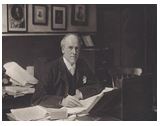
Karl Pearson (Figure 1), the great 19th-century biostatistician and eugenist, first described mathematical methods for determining the probability distributions of scientific measurements, and these methods form the basis of statistical applications in scientific research. Statistical techniques allow us to estimate uncertainty and report the error surrounding a value after repeated measurement of that value.

1. Accuracy, Precision and Error

Accuracy is how close a measurement is to the correct value for that measurement. The precision of a measurement system refers to how close the agreement is between repeated measurements (which are repeated under the same conditions). Measurements can be both accurate and precise, accurate but not precise, precise but not accurate, or neither.

Precision and Imprecision

Precision (see Figure 2) refers to how well measurements agree with each other in multiple tests. Random error, or Imprecision, is usually quantified by calculating the coefficient of variation from the results of a set of duplicate measurements.
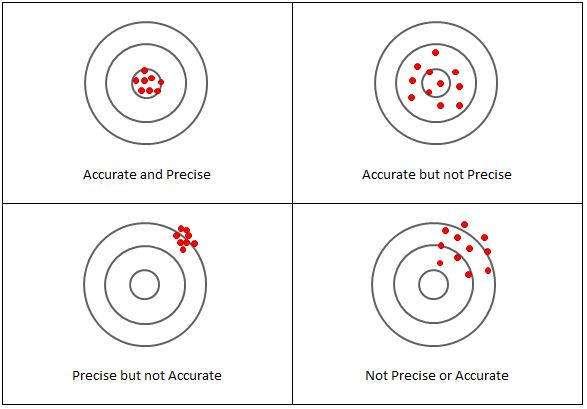
Figure 2 Accuracy and precision

The accuracy of a measurement is how close a result comes to the true value.

Error

When randomness is attributed to errors, they are “errors” in the sense in which that term is used in statistics.

  • Systematic error (bias) occurs with the same value, when we use the instrument in the same way (eg calibration error) and in the same case. This is sometimes called statistical bias.

It may often be reduced with standardized procedures. Part of the learning process in the various sciences is learning how to use standard instruments and protocols so as to minimize systematic error.

  • Random error, which may vary from one observation to another. Random error (or random variation) is due to factors which cannot, or will not, be controlled. Random error often occurs when instruments are pushed to the extremes of their operating limits. For example, it is common for digital balances to exhibit random error in their least significant digit. Three measurements of a single object might read something like 0.9111g, 0.9110g, and 0.9112g.

Systematic error or Inaccuracy (see Figure 3) is quantified by the average difference (bias) between a set of measurements obtained with the test method with a reference value or values obtained with a reference method.
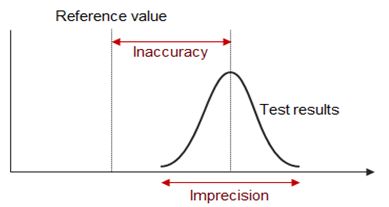


Figure 3 Imprecision and in accuracy

2. Uncertainty

There is uncertainty in all scientific data. Uncertainty is reported in terms of confidence.

  • Uncertainty is the quantitative estimation of error present in data; all measurements contain some uncertainty generated through systematic error and/or random error.
  • Acknowledging the uncertainty of data is an important component of reporting the results of scientific investigation.
  • Careful methodology can reduce uncertainty by correcting for systematic error and minimizing random error. However, uncertainty can never be reduced to zero.

Estimating the Experimental Uncertainty For a Single Measurement

Any measurement made will have some uncertainty associated with it, no matter the precision of the measuring tool. So how is this uncertainty determined and reported?

The uncertainty of a single measurement is limited by the precision and accuracy of the measuring instrument, along with any other factors that might affect the ability of the experimenter to make the measurement.

For example, if you are trying to use a ruler to measure the diameter of a tennis ball, the uncertainty might be ± 5 mm, but if you used a Vernier caliper, the uncertainty could be reduced to maybe ± 2 mm. The limiting factor with the ruler is parallax, while the second case is limited by ambiguity in the definition of the tennis ball’s diameter (it’s fuzzy!). In both of these cases, the uncertainty is greater than the smallest divisions marked on the measuring tool (likely 1 mm and 0.05 mm respectively).

Unfortunately, there is no general rule for determining the uncertainty in all measurements. The experimenter is the one who can best evaluate and quantify the uncertainty of a measurement based on all the possible factors that affect the result. Therefore, the person making the measurement has the obligation to make the best judgment possible and to report the uncertainty in a way that clearly explains what the uncertainty represents:

Measurement = (measured value ± standard uncertainty) unit of measurement.
For example, where the ± standard uncertainty indicates approximately a 68% confidence interval, the diameter of the tennis ball may be written as 6.7 ± 0.2 cm.
Alternatively, where the ± standard uncertainty indicates approximately a 95% confidence interval, the diameter of the tennis ball may be written as 6.7 ± 0.4 cm.

Estimating the Experimental Uncertainty For a Repeated Measure (Standard Deviation).

Suppose you time the period of oscillation of a pendulum using a digital instrument (that you assume is measuring accurately) and find: T = 0.44 seconds. This single measurement of the period suggests a precision of ±0.005 s, but this instrument precision may not give a complete sense of the uncertainty. If you repeat the measurement several times and examine the variation among the measured values, you can get a better idea of the uncertainty in the period.

For example, here are the results of 5 measurements, in seconds: 0.46, 0.44, 0.45, 0.44, 0.41.

For this situation, the best estimate of the period is the average, or mean.

Whenever possible, repeat a measurement several times and average the results. This average is generally the best estimate of the “true” value (unless the data set is skewed by one or more outliers). These outliers should be examined to determine if they are bad data points, which should be omitted from the average, or valid measurements that require further investigation.

Generally, the more repetitions you make of a measurement, the better this estimate will be, but be careful to avoid wasting time taking more measurements than is necessary for the precision required.

Consider, as another example, the measurement of the thickness of a piece of paper using a micrometer. The thickness of the paper is measured at a number of points on the sheet, and the values obtained are entered in a data table.
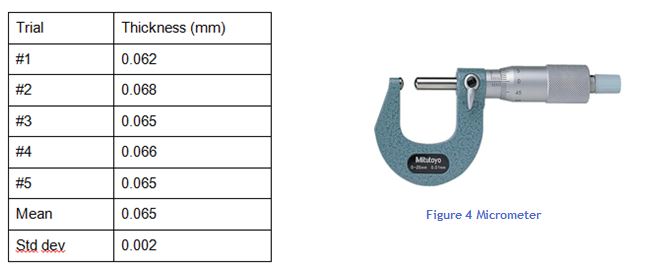
This average is the best available estimate of the thickness of the piece of paper, but it is certainly not exact. We would have to average an infinite number of measurements to approach the true mean value, and even then, we are not guaranteed that the mean value is accurate because there is still some systematic error from the measuring tool, which can never be calibrated perfectly. So how do we express the uncertainty in our average value?

The most common way to describe the spread or uncertainty of the data is the standard deviation

Figure 5 Standard deviations of a normal distribution
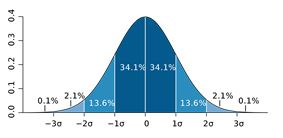
The significance of the standard deviation is this:

if you now make one more measurement using the same micrometer, you can reasonably expect (with about 68% confidence) that the new measurement will be within 0.002 mm of the estimated average of 0.065 mm. In fact, it is reasonable to use the standard deviation as the uncertainty associated with this single new measurement.

This is written:
The thickness of 80 gsm paper (n=5) averaged 0.065 (s = 0.002mm)
           s = standard deviation
OR
The thickness of 80 gsm paper (n=5) averaged 0.065 ± 0.004 mm to a 95% confidence level.
(0.004 mm represents 2 standard deviations, 2s)

Standard Deviation of the Means (Standard Error of Mean (SEM))

The standard error is a measure of the accuracy of the estimate of the mean from the true or reference value. The main use of the standard error of the mean is to give confidence intervals around the estimated means for normally distributed data, not for the data itself but for the mean.
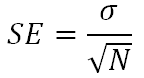
If measured values are averaged, then the mean measurement value has a much smaller uncertainty, equal to the standard error of the mean, which is the standard deviation divided by the square root of the number of measurements.

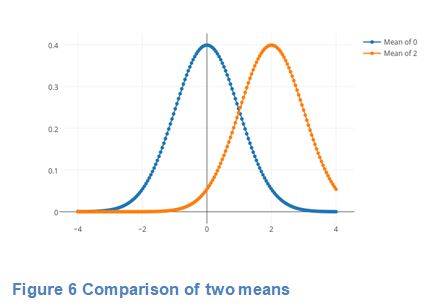
Standard error is often used to test (in terms of null hypothesis testing) differences between means.
For example, two populations of salmon fed on two different diets may be considered significantly different if the 95% confidence intervals (two std errors) around the estimated fish sizes under Diet A do not cross the estimated mean fish size under Diet B.

Note that the standard error of the mean depends on the sample size, as the standard error of the mean shrinks to 0 as sample size increases to infinity.

Figure 7 Salmon

Standard Error of Mean (SEM) Versus Standard Deviation

In scientific and technical literature, experimental data are often summarized either using the mean and standard deviation of the sample data or the mean with the standard error. This often leads to confusion about their interchangeability. However, the mean and standard deviation are descriptive statistics, whereas the standard error of the mean is descriptive of the random sampling process.

The standard deviation of the sample data is a description of the variation in measurements, whereas, the standard error of the mean is a probabilistic statement about how the sample size will provide a better bound on estimates of the population mean, in light of the central limit theorem.

Put simply, the standard error of the sample mean is an estimate of how far the sample mean is likely to be from the population mean, whereas the standard deviation of the sample is the degree to which individuals within the sample differ from the sample mean. If the population standard deviation is finite, the standard error of the mean of the sample will tend to zero with increasing sample size. This is because the estimate of the population mean will improve, while the standard deviation of the sample will tend to approximate the population standard deviation as the sample size increases.

Confidence Levels

The confidence level represents the frequency (i.e. the proportion) of possible confidence intervals that contain the true value of the unknown population parameter. Most commonly, the 95.4% (“two sigma”) confidence level is used. However, other confidence levels can be used, for example, 68.3% (“one sigma”) and 99.7% (“three sigma”).

Conclusion

Knowledge of normally distributed data and standard deviation are key to understanding the notions of statistical uncercertainty and confidence. These concepts are extended to the standard error of mean so that the significance of differences between two related datasets can be determined.

Glossary

Absolute error The absolute error of a measurement is half of the smallest unit on the measuring device. The smallest unit is called the precision of the device.

Array An array is an ordered collection of objects or numbers arranged in rows and columns.

Bias This generally refers to a systematic favouring of certain outcomes more than others, due to unfair influence (knowingly or otherwise).

Confidence level The probability that the value of a parameter falls within a specified range of values. For example 2s = 95% confidence level.

Data cleansing Detecting and removing errors and inconsistencies from data in order to improve the quality of data (also known as data scrubbing).

Data set An organised collection of data.

Descriptive statistics These are statistics that quantitatively describe or summarise features of a collection of information.

Large data sets Data sets that must be of a size to be statistically reliable and require computational analysis to reveal patterns, trends and associations.

Limits of accuracy The limits of accuracy for a recorded measurement are the possible upper and lower bounds for the actual measurement.

Measures of central tendency Measures of central tendency are the values about which the set of data values for a particular variable are scattered. They are a measure of the centre or location of the data. The two most common measures of central tendency are the mean and the median.

Measures of spread Measures of spread describe how similar or varied the set of data values are for a particular variable. Common measures of spread include the range, combinations of quantiles (deciles, quartiles, percentiles), the interquartile range, variance and standard deviation.
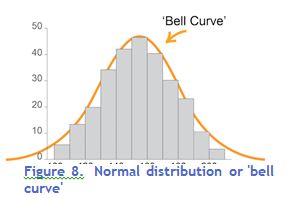
Normal distribution The normal distribution is a type of continuous distribution whose graph looks like this:

The mean, median and mode are equal and the scores are symmetrically arranged either side of the mean.

The graph of a normal distribution is often called a ‘bell curve’ due to its shape.

Reliability An extent to which repeated observations and/or measurements taken under identical circumstances will yield similar results.

Sampling This is the selection of a subset of data from a statistical population. Methods of sampling include:

  • systematic sampling – sample data is selected from a random starting point, using a fixed periodic interval
  • self-selecting sampling – non-probability sampling where individuals volunteer themselves to be part of a sample
  • simple random sampling – sample data is chosen at random; each member has an equal probability of being chosen
  • stratified sampling – after dividing the population into separate groups or strata, a random sample is then taken from each group/strata in an equivalent proportion to the size of that group/strata in the population
  • A sample can be used to estimate the characteristics of the statistical population.

Standard deviation This is a measure of the spread of a data set. It gives an indication of how far, on average, individual data values are spread from the mean.

Standard error The standard error of the mean (SEM) is the standard deviation of the sampling distribution of the mean.

Uncertainty Any single value has an uncertainty equal to the standard deviation. However, if the

values are averaged, then the mean measurement value has a much smaller uncertainty, equal to the standard error of the mean, which is the standard deviation divided by the square root of the number of measurements.

Works Cited

Measurements and Error Analysis, www.webassign.net/question_assets/unccolphysmechl1/measurements/manual.html.

Altman, Douglas G, and J Martin Bland. “Standard Deviations and Standard Errors.” BMJ (Clinical Research Ed.), BMJ Publishing Group Ltd., 15 Oct. 2005, www.ncbi.nlm.nih.gov/pmc/articles/PMC1255808/.

Hertzog, Lionel. “Standard Deviation vs Standard Error.” DataScience , 28 Apr. 2017, https://datascienceplus.com/standard-deviation-vs-standard-error/

Mott, Vallerie. “Introduction to Chemistry.”
https://courses.lumenlearning.com/introchem/chapter/accuracy-precision-and-error/

Schoonjans, Frank. “Definition of Accuracy and Precision.” MedCalc, MedCalc Software, 9 Nov. 2018, www.medcalc.org/manual/accuracy_precision.php.

“Standard Error.” Wikipedia, Wikimedia Foundation, 7 Mar. 2019,
https://en.wikipedia.org/wiki/Standard_error

2336 | NSW Education Standards, 
https://educationstandards.nsw.edu.au/wps/portal/nesa/11-12/stage-6-learning-areas/stage-6-science/biology-2017/content/2336

1319 | NSW Education Standards, https://educationstandards.nsw.edu.au/wps/portal/nesa/11-12/stage-6-learning-areas/stage-6-mathematics/mathematics-standard-2017/content/1319

Jim is an educational researcher and independent educational consultant. His M.Ed (Hons) thesis used an experimental design to evaluate the effectiveness of a literacy and learning program (1997). A recipient of the NSW Professional Teaching Council’s Distinguished Service Award for leadership in delivering targeted professional learning to teachers, he works with schools to align assessment, reporting and learning practice. He has been a head teacher of Science in two large Sydney high schools, as well as HSC Chemistry Senior Marker and Judge. For many years he served as a DoE Senior Assessment Advisor where he developed many statewide assessments, (ESSA, SNAP, ELLA, BST) and as Coordinator: Analytics where he developed reports to schools for statewide assessments and NAPLAN. He is a contributing author to the new Pearson Chemistry for NSW and to Macquarie University’s HSC Study Lab for Physics.

Why Exercise for Cognitive and Mental Health is Especially Important in the Senior Years

David Lubans, Angus Leahy, Jordan Smith and Narelle Eather make the case for continuing physical activity into the senior school years…

Introduction

You may not be surprised to read that physical activity declines dramatically during adolescence (Dumith et al., 2011) and less than 10% of senior school students are sufficiently active (Schranz et al., 2014). However, you may not know that evidence suggests low levels of physical activity among senior school students may contribute to poor mental health (North, 2015; Suetani et al., 2017).

These findings are particularly relevant to schools as 43% of young Australians report at least moderate levels of psychological distress (15% report high to very high levels of distress) (Australian Bureau of Statistics, 2018), and some suggest increasing time demands and pressure to excel in senior years as a reason for sacrificing time usually spent being active.

We conclude that there is a need for effective physical activity programs that are also time efficient. This is important because, although the NSW Department of Education policy recommends that students in Year 11 and 12 are provided with weekly access to a minimum of 150 minutes of physical activity each week (New South Wales Department of Education, 2017), very few senior school students actually receive this dose.

This is partly due to the misconception that allocating more time for study skills or revision over physical activity will improve academic performance. We argue that this view is ill-informed as there is a growing body of evidence that suggests students with higher levels of physical activity and aerobic fitness perform better on standardised academic tests and measures of cognitive function (Donnelly et al., 2016; Álvarez-Bueno et al., 2017).

What might we do?

Many teachers may be experiencing the benefits of high intensity interval training (HIIT) exercise through their out-of-school lives. Such approaches to exercise at school could also benefit your students at school and would fit within existing Departmental guidelines.

HIIT is a potent and time efficient method for improving physical health and mental health (Costigan et al., 2015; Logan et al., 2014) which typically consists of short, but intense bouts of activity interspersed with brief periods of rest or light activity. The main appeal of HIIT is that it can be completed in a shorter period of time in comparison to traditional moderate intensity aerobic exercise, whilst achieving similar and in some cases superior results. In our recent systematic review and meta-analysis (Costigan et al., 2015), we demonstrated that HIIT can improve cardio-respiratory fitness and reduce body mass index (BMI) in adolescents.

Although few studies have been conducted with adolescents, there is some evidence to suggest participation in HIIT can improve young people’s cognitive and mental health (Costigan et al., 2016; Moreau et al., 2017; Leahy et al., 2019). For example, in one of our earlier studies (Costigan et al., 2016), we demonstrated that engaging in weekly HIIT sessions had a consistently positive effect on students’ mood (Figure 1).

Figure 1: Mean feeling state scores reported by students before and after participating in HIIT (higher values represent better mood and the graphic represents difference in mood responses over 24 sessions)

Less than 100% effort can be good too

Many people associate HIIT with the ‘all out’ maximal (such as 100% of heart rate maximum) type of exercise tested by Michael Mosley in the BBC documentary ‘The Truth About Exercise’. This type of activity is unlikely to be palatable for adolescents or appropriate for delivery in the school setting. Alternatively, there is emerging evidence for the efficacy of less demanding HIIT protocols (for instance, 85% of heart rate maximum) that are still relatively brief (for example, 10 minutes) (Costigan et al., 2015).

Our Burn 2 Learn program

In partnership with the NSW Department of Education School Sport Unit, we developed the Burn 2 Learn (B2L) program for senior school students. Unlike previous HIIT programs that require complicated equipment, facilities and expert instructors, B2L has been designed to be ‘student-directed’ under the supervision of secondary school teachers using minimal resources. Our team has developed a full day professional learning workshop for teachers, which is accredited with the NSW Education Standards Authority at the ‘Highly Accomplished’ level. We have also designed curricular materials for teachers, HIIT task (Figure 2) and technique cards and a smartphone app to enhance participation among students.

To promote variety and enjoyment, we designed 11 different styles of HIIT workouts for students to choose from: Gym, Sport, Class, Quick, Hip-Hop, Combat, Brain, Rumble, Custom, Beach and Park.

Figure 2: Example Burn 2 Learn HIIT task card

The B2L program was designed using self-determination theory and is focused on enhancing students’ autonomous motivation for vigorous physical activity by satisfying their basic psychological needs for autonomy (feeling in control), competence (feeling capable) and relatedness (feeling connected with others) (Deci and Ryan, 1985). Teachers learn to facilitate the delivery of the B2L sessions using the SAAFE (Supportive, Active, Autonomous, Fair and Enjoyable) principles (Lubans et al., 2017) (Figure 3). Students’ need for autonomy is satisfied by providing them with opportunities for choice within sessions (e.g., type of activity, music playing, and training partner) and explaining the rationale for the program in an information seminar.

The introductory seminar reinforces the importance of exercise for cognitive health and academic performance. Competence is satisfied using positive and specific feedback from teachers, an explicit focus on effort over absolute performance (via heart rate feedback) and through the provision of resources designed to support the development of exercise skills. Finally, teachers are encouraged to adopt practices that support relatedness and group cohesion during HIIT sessions (for example, encouraging supportive behaviour among students such as ‘high fives’ and partner work) (Owen et al., 2014).

Figure 3: SAAFE principles for Burn 2 Learn session delivery

Positive results for teachers and students

In 2017, we conducted a pilot study to evaluate the B2L program in two high schools in the Hunter region (Leahy et al., 2019). We found that 2-3 HIIT sessions/week, each lasting ~10 minutes, increased students’ fitness and improved their well-being. Overall satisfaction of the program was high among students (4.0/5) and teachers (4.0/5). Students enjoyed the practical HIIT sessions, with ‘Sport HIIT’, ‘Class HIIT’ and ‘Gym HIIT’ the most popular types.

Teachers also expressed high levels of satisfaction with the professional development workshop (5.0/5) and were highly confident in their ability to facilitate the delivery of the program (5.0/5). Anecdotal discussions with teachers involved in B2L also highlighted the potential impact of HIIT on students’ behaviour in the classroom.

Today we had our best B2L session where all the students got in and had a go and that translated into the classroom immediately after, where I had my best theory lesson with that class. We were doing a textbook heavy lesson and the students appeared to be more focused providing me with quality answers. Even the students who normally muck up a bit were more on task today.

(Teacher responsible for delivering B2L)

Although our pilot study results were promising, it is important to replicate our findings in a larger cohort of students before making the B2L program available to all schools in NSW. We are currently conducting a cluster randomised controlled trial evaluation of the program in 20 secondary schools in NSW (~800 Grade 11 students). In this study we will test the effects of the B2L program on students’ cardiorespiratory fitness, muscular fitness, cognition and mental health. In addition, a subsample of students will: (i) provide hair samples to determine their accumulated exposure to chronic stress using cortisol testing and (ii) undergo multi-modal functional magnetic resonance imaging (fMRI) to examine changes in brain structure and function.

Next steps

A common criticism of school-based physical activity interventions is that they are rarely adopted and implemented by schools (Milat et al., 2013). With this in mind, we have designed the B2L program in partnership with the NSW Department of Education School Sport Unit and see support for ongoing provision of professional learning as essential to the success of such a statewide program.

Conclusions

Driven by pressures to perform well academically, students may choose to sacrifice physical activity for additional study time. Unfortunately, this may be having the opposite effect to that which they intended, as physical activity supports cognitive functioning and is a useful strategy for coping with stress generally.

Further, chronic stress undermines learning and can impair performance in high stakes examinations. Consequently, the senior school years would appear to be a particularly important time for adolescents to stay physically active. Programs such as B2L have the potential to bring physical and mental health benefits for young Australians. Importantly, such programs are achievable and can be delivered within existing school structures in the interests of all of your students’ health, well-being and learning.

References:

Álvarez-Bueno C, Pesce C, Cavero-Redondo I, et al. (2017) Academic achievement and physical activity: A meta-analysis. Pediatrics 140: e20171498.
Australian Bureau of Statistics. (2018) National health survey: First results, 2017–18, Catelogue No. 4364.0.55.001. Canberra: Australian Bureau of Statistics.
Costigan SA, Eather N, Plotnikoff RC, et al. (2015) High intensity interval training for improving health-related fitness in adolescents: A systematic review and meta-analysis. British Journal of Sports Medicine 49: 1253-1261.
Costigan SA, Eather N, Plotnikoff RC, et al. (2016) High intensity interval training for cognitive and mental health in adolescents. Medicine & Science in Sports & Exercise 48: 1985-1993.
Deci EL and Ryan RM. (1985) Intrinsic motivation and self-determination in human behaviour, New York: Plenum.
Donnelly JE, Hillman CH, Castelli D, et al. (2016) Physical activity, fitness, cognitive function, and academic achievement in children: A systematic review. Medicine & Science in Sports & Exercise 48: 1223-1224.
Dumith SC, Gigante DP, Domingues MR, et al. (2011) Physical activity change during adolescence: A systematic review and a pooled analysis. International Journal of Epidemiology 40: 685-698.
Leahy AA, Eather N, Smith JJ, et al. (2019) Feasibility and preliminary efficacy of a teacher-facilitated high-intensity interval training intervention for older adolescents. Pediatric Exercise Science 31: 107-117.
Logan GR, Harris N, Duncan S, et al. (2014) A review of adolescent high-intensity interval training. Sports Medicine 44: 1071-1085.
Lubans DR, Lonsdale C, Cohen K, et al. (2017) Framework for the design and delivery of organized physical activity sessions for children and adolescents: Rationale and description of the ‘SAAFE’ teaching principles. International Journal of Behavioral Nutrition and Physical Activity 14.
Milat AJ, King L, Bauman AE, et al. (2013) The concept of scalability: Increasing the scale and potential adoption of health promotion interventions into policy and practice. Health Promotion International 28: 285-298.
Moreau D, Kirk IJ and Waldie KE. (2017) High-intensity training enhances executive function in children in a randomized, placebo-controlled trial. Elife 6: e25062.
New South Wales Department of Education. (2017) Sport and Physical Activity Policy. Available at:https://education.nsw.gov.au/policy-library/policies/sport-and-physical-activity-policy.
North BW. (2015) Under pressure: Senior students in high stakes assessment. School of Education, Faculty of Education and Arts. Sydney: University of New South Wales.
Owen KB, Smith J, Lubans DR, et al. (2014) Self-determined motivation and physical activity in children and adolescents: A systematic review and meta-analysis. Preventive Medicine 67: 270-279.
Schranz N, Olds T, Cliff D, et al. (2014) Results from Australia’s 2014 report card on physical activity for children and youth. Journal of Physical Activity and Health 11: S21-S25.
Suetani S, Mamun A, Williams GM, et al. (2017) Longitudinal association between physical activity engagement during adolescence and mental health outcomes in young adults: A 21-year birth cohort study. Journal of Psychiatric Research 94: 116-123.

David Lubans is a National Health and Medical Research Council Senior Research Fellow, Professor in the School of Education, and leads the ‘School-based Research’ theme within the Priority Research Centre for Physical Activity and Nutrition at the University of Newcastle. He is internationally recognised for his expertise in school-based physical activity research.

Angus Leahy is a PhD student in the School of Education and Priority Research Centre for Physical Activity and Nutrition at the University of Newcastle. His research focus is on physical activity, fitness, mental health, and cognition in the school setting.

Jordan Smith is a Lecturer in the School of Education, and co-deputy lead of the ‘School-based Research’ theme within the Priority Research Centre for Physical Activity and Nutrition at the University of Newcastle.

Narelle Eather is a Senior Lecturer and researcher in the School of Education, Priority Research Centre for Physical Activity and Nutrition at the University of Newcastle. Narelle’s research primary focuses on the development, implementation and evaluation of physical activity, fitness and sport interventions in school and community settings.

The Burn 2 Learn study is funded by the NHMRC and the NSW Department of Education. We would like to acknowledge Ross Morrison and James Boyer from the School Sport Unit and the other chief investigators on this study: Charles Hillman, Philip Morgan, Ronald Plotnikoff, Michael Nilsson and Chris Lonsdale.

Practical Creativity with Tangible Outcomes

Graham Sattler suggests an approach to combining music, emotion, language and technology in your classroom using the NSW Music Syllabus…

It is widely accepted that music pre-dates speech (Botha, 2009; Mithen, Morley, Wray, Tallerman & Gamble, 2006; Storr, 1993). Investigations of all cultures that have ever existed, and have been documented, indicate that music played and plays an essential part in cultural, individual and group (community) human development (Harvey, 2017).

While human speech developed, and continues to develop, to impart information, music exists to communicate emotion. Music acts as a social and emotional glue, connecting and comforting, inspiring, motivating, uniting and enthusing people. Even motivational speeches, whether to small groups of people or whole populations, rely on prosody; that is, the discipline of emphasising and exploiting the proto-musical elements of speech (rhythm, phrasing and intonation), to achieve a compelling and impactful result. Think of significant speeches throughout history, expressions such as hanging on every word and music to my ears exist for a reason.

The arts (and specifically, creativity) as a learning area is becoming compromised. The requirement of teachers to engage students in the understanding of (and expression through) artistic concepts, brings with it a need to develop tools, resources and strategies to facilitate student creativity and confidence in their capacity to create, appreciate and connect creative capacity and experience to their lives, their learning, community and cultural meaning. The good news is that tools and resources are easily, and in many cases freely, available. This article proposes a practical solution, called Music Emotion Language & Technology (MELT), to the third element of the equation; it offers a strategy, by way of a project plan for students to engage in the creative process, satisfy syllabus outcomes, and integrate with other Key Learning Areas while affording awareness and appreciation of cultural and language diversity.

Although the plan proposed herein for stages 4-6, it is both practical and scalable for students of any age and stage from early stage 1 upwards. For a list of NSW 7-12 syllabus outcomes integrated through this process please see Attachment 1.

While the project can be tailored to run across any number of sessions, here we consider an eight-week or session ‘course’. The number of sessions, however, is not a critical consideration; it is the staging of the process across the course that is important.

Outline

Across the (say, 8) class sessions, students identify and explore the musicality and emotional impact of everyday language and transform information-weighted text into emotion-weighted music.

To do this, students bringing a line of text to the session, and using music notation apps (ScoreCloud or similar), chart the expressive inflection in their own vernacular, language, or dialect (elements of pitch, emphasis and rhythm) and transform the inherent intonation of speech into musical patterns, creating a musical composition or compositions.

The melody, melodies, or sets of melodic fragments that result can be interwoven, creating counterpoint (separate melodies played in conjunction with each other). Harmonies and instrumentation (both acoustic and electronic, and potentially including the use of tablet and/or smartphone technology) can be explored and applied in relation to the emotional and dramatic meaning that emerges from the melodies and the texts.

Using available music technology programs or apps, such as Garageband or Logic, the composition(s) can be assembled and recorded with all participants having contributed to the development and performance outcome. While this sounds complicated, it need not be. Simple compositions can ‘emerge’ from one simple line of text from the youngest student. Two simple lines, or more, from as few or many students in the class as desired can be woven into original compositions and recorded on whatever devices (smartphones/mp3 recorders) are available. The music notation app or program comes into play in notating the pitches and rhythms inherent in the intonation of the recited text.

This is the point at which students’ emotions present as music!

There may or may not be a lyrics component in the final work or works. To some degree, outcomes demonstrate the primacy of music in expressing emotional meaning and drama over ‘language’ as a medium for communicating information. Shared ownership of the compositions means that the pieces, or sections/fragments thereof, would be available for students to incorporate into other workshops and learning activities across animation, game development, filmmaking and so on.

Initiating the process

Students would only be required to bring one or two lines of text to the process. The text(s) should not be from existing song repertoire, and should ideally be of the student’s devising. There is no requirement for rhyme, sophistication or poetic quality, and the inclusion of texts in more than one language, reflecting the cultural and language diversity of the school or class, is encouraged. The line(s) of text should be in some way meaningful to the student, and the student should be able to articulate, in simple terms, what that meaning is. Click here to view or download table.

The plan

Creating musicians

Through the process outlined above, students will create, record and perform a composition that is meaningful to them, is culturally relevant and, that explores both awareness and appreciation of diversity. Through thoughtful investment and engagement in the creative process from the first step, you can lead them to participate in making their own music, regardless of their age and stage, while developing facilitated collaborative practice and identity. Placing students in control and supporting them to use existing, found, and developed materials, also develops the skills to be creative, innovative, thoughtful, confident and informed musicians. Through our lessons, we can encourage our students to express themselves and their cultures; and consider and engage with the cultures, cultural values and practices of others.

And, isn’t that what a comprehensive public education is all about?

References:

Australian Curriculum, Assessment and Reporting Authority (2019), The Australian
Curriculum, F-10 Curriculum, The Arts, Music
 
https://www.australiancurriculum.edu.au/f-10-curriculum/the-arts/music/

Botha, R. (2009). On musilanguage/“Hmmmmm” as an evolutionary precursor to language.
Language & Communication, 29(1), 61-76.
Harvey, A. (2017). Music, evolution, and the harmony of the souls. Oxford University Press, UK: Oxford.
Mithen, S., Morley, I., Wray, A., Tallerman, M., & Gamble, C. (2006). The singing neanderthals:  The origins of music, language, mind and body. Cambridge Archaeological Journal,16(1), 97-112.
NSW Education Standards Authority. (2003). Music 7-10 Syllabus. Sydney: NSW Government. http://educationstandards.nsw.edu.au/wps/portal/nesa/k-10/learning-areas/creative-arts/music-7-10
NSW Education Standards Authority. (2009). Music 1 Stage 6 Syllabus. Sydney: NSW Government.   http://educationstandards.nsw.edu.au/wps/portal/nesa/11-12/stage-6-learning-areas/stage-6-creative-arts/music-1-syllabus
NSW Education Standards Authority. (2009). Music 2 Stage 6 Syllabus. Sydney: NSW Government. http://educationstandards.nsw.edu.au/wps/portal/nesa/11-12/stage-6-learning-areas/stage-6-creative-arts/music-2-syllabus
NSW Education Standards Authority. (2018). Australian professional standards for teachers. Sydney.
Storr, A. (1993). Music and the mind. New York: Ballantine.

Dr Graham Sattler has extensive music teaching experience in primary, secondary and adult education settings. He has been involved in course design and delivery around concepts and strategies for both pre-service and existing teachers, writing and delivering K-6 and secondary Music courses in partnership with the NSWTF CPL since 2014, and is committed to the principles of access and equity and student-focused learning experiences. Graham presents regularly at international music education conferences, drawing on his PhD research in the field of socio-cultural development through group music activity in marginalised communities. He is currently Executive Director, Mitchell Conservatorium and Casual Academic, Central Queensland University.

Building Confidence and Success in Stage 6

Khya Brooks suggests an approach to the HSC which can reduce everyone’s anxiety…

On the day my first HSC classes’ results were released, I was nervous and excited. However, I did not expect the reactions that I witnessed.

Many people turned to me and said “Congratulations. You did so well”, as though I had just sat the tests myself. Meanwhile, some of my colleagues were sitting with their head in their hands saying “I didn’t even get one band 6. What happened?” The rest of the day was spent listening to colleagues criticise their own practice and try to justify their classes’ outcomes to themselves; “Oh, I should have focused more on this area in the syllabus…” and “If only I had thought to revise this case study more thoroughly”.

What I learnt that day was to internalise the HSC results as though they were my own. I learned that my classes’ success somehow translated into how valuable I was as a teacher. The day was not spent celebrating, it was spent critically reflecting. Sure, this is great practice for long-term improvement, but what I have found is that it has also increased the pressure experienced by teachers. I have noticed that this pressure is then often transferred onto students, resulting in unnecessarily increased anxiety throughout the school.

I argue that this approach is reflective of a growing individualistic and negative culture within society and therefore teaching; which positions individual teachers rather than school systems or society more widely as solely responsible for student outcomes. This anxiety is reinforced by constant questions from the school executive, such as “Did you differentiate enough?”, “Are you providing enough scaffolds?”, “How many band 6s will you get this year?”

There is often too much pressure on many of the adults and, subsequently, many of the children at school.

I thought school was supposed to be joyful!

What to do?

So, I decided to actively address this cultural shift. I wanted students to own their own learning, rather than assuming it was all my responsibility. I began to reshape my programs, assessments and my overall practice. The more confident and successful my students became with their skills, the more confident and successful I felt within my practice. Our collective anxiety melted away and school days became more positive.

I found this new approach enabled me to have a better range of measures to gauge my success as a teacher. Rather than relying on quantitative numbers at the end of the HSC, I established a clearer set of procedures that allowed me, and the students themselves, to better measure our progress.

Below are some practical strategies that have helped me in achieving this cultural shift in my classroom, with a view to empower learners and improve their confidence, and ultimately, their success. I will focus prominently on the strategies utilised with my Society and Culture classes, but they are strategies that are easily transferrable to other subjects.

Please note, I work in a partially-selective public school in South-West Sydney. This means I have a large range of students; from high to lower ability, from advantaged to disadvantaged backgrounds, and from the disengaged through to some ‘over workers’. I have found that these strategies have assisted all of my students. For this reason, they should be applicable in almost any school context.

Strategies to develop a culture of student-driven learning

No summary, no marks

A strategy I have implemented is to withhold marks from students after they initially receive their assessments back. I encourage students to read through their feedback, and write a summary outlining what they need to work on, and how they intend to improve a particular skill in future assessments.

Once they do this, I provide them with their mark. This is a way to maximise student engagement with feedback. Also, students tend to keep these summaries and read over them before submitting future drafts.

Specific student-led feedback

I no longer accept copies of drafts from students seeking copious feedback. I found that quite often I would have read a draft several times before it came to marking it, and it was exhausting, time consuming and students generally still made similar mistakes in later assessments (indicating it was not as effective as I wanted it to be).

As a result, I developed a feedback matrix to use with my classes. The matrix outlines a three-step feedback system where I give specific feedback at set times and students are required to actively engage with it. The steps are outlined in Image below or click here to view.

                           Image 1 – Feebdack Matrix

There can be many benefits to using the matrix. As students use the marking criteria to develop specific questions for their feedback, they self-identify areas they thought they were not as strong in. For teachers, this means no longer spending copious time fixing tiny issues. Instead, we are able to provide wider feedback that students then identify in their own work. Also, students can easily see if their ‘limitation’ was someone else’s strength, and they can seek more help from one another.

Grouped feedback activities

Following the submission of a formal assessment task, I allocate each student a shape based on the marking criteria. Each shape is representative of a skill they should aim to actively improve. I then dedicate a lesson to improving those skills by grouping students by shape around the room, and each ‘shape group’ completes an activity dedicated to improving that skill. For example, I gave a student a triangle to indicate that they needed to better synthesise their research. I then had a triangle station, where all students that received the triangle worked on an activity where they ‘blended’ primary and secondary information together to identify conclusions. Students then practised writing these conclusions into paragraphs, to improve this skill further.

Strategies to develop specific skills

Writing

To improve student writing, I developed an acronym (shown in Image 2 below) focussed on sentence starters. Whilst there are many popular paragraph structures around, this approach focusses on the sentence level and students tend to find this more visible. Over the course, students begin using different sentence starters, eventually utilising the acronym as an editing checklist rather than a structure. It has been hugely successful across all stages and courses and has also been adopted by various other faculties and schools.

               Image 2 – Writing Acronym

Once this acronym is introduced, I often develop an activity where students read various responses and highlight the different elements using different colours. The responses are usually related to course content, so that students actively learn relevant information through the process. We then discuss which responses were better and why, and students rewrite one of the poorer examples using the structure themselves. Often, I will then have students ‘highlight’ one another’s responses to begin to foster a peer marking culture.

I also use the highlighting activity as self-guided feedback through the course. Students learn to highlight their responses and identify whether they have used too much description, or if they need to embed more examples.

Applying concepts

In many subjects, applying concepts is integral. I scaffold this skill in a multitude of ways.

  1. The concepts are colour coded in my classroom, and are all displayed on the wall.
     
  2. Each lesson, I have students identify the various concepts that were discussed in class. Through this, students learn that a lesson can cover elements of a concept without the teacher explicitly stating it, and so they begin to look for opportunities to make these connections themselves.
     
  3. I provide students with paragraphs from previous responses. Students identify two concepts that would enhance the paragraph, and rewrite the paragraphs with the concepts applied. They then peer mark one another’s responses.
     
  4. Randomly, I will pass each student three cards, one with a ‘fundamental’ concept, one with an ‘additional’ concept and one with a ‘related’ concept. Students are then given one minute to prepare, and then discuss a key point of the case study using all three concepts. It helps to revise content, and enhances students’ ability to apply concepts appropriately.

Strategies to build a culture of success in the subject

One of my biggest successes has been developing a good rapport between cohorts. This has enhanced the mentorship my Year 11 students receive each year, and has also contributed to the growing profile and number of Stage 6 classes in my school.

Year 11 markers

Each year, one week before the Personal Interest Project (PIP) major work is due, I spend a day with my Year 11 students deconstructing exemplar PIPs and marking them collectively. This is a positive and voluntary experience, and the focus is about building up each other rather than putting pressure on Year 11 to produce Year 12 level work, or, of criticising older students.

Once students feel more confident in their understanding of the requirements of each section in the PIP, I then have them ‘mark’ draft Year 12 PIPs. This provides an array of advantages, such as my Year 12 students are provided with additional feedback, my Year 11 students have a better understanding of the skills required of them to achieve higher results, and I use the opportunity as a checkpoint to ensure all students have finalised their PIP at least a week prior to submission day.

Q&As

Each year I ask a number of my previous Year 12 students to come and speak to my new Year 12 students. The new group develop questions they want answered and my older group provide hints, tips and pieces of advice. Often, the older students offer to assist with PIP topics or research too.

Student developed questions

Lastly, following each topic, I have students map past HSC questions to the syllabus dot points and concepts. Students then develop a question for the topic, by mixing two dot points and adding a verb or integrating a concept. Finally, students add their question to a shared document and everyone selects three questions to respond to for practise.

This empowers students to develop their own resources for revision (I also get a bank of new question ideas). Often students will then show the question designer their response, and this suggests more collegiality between the students, as the class becomes more focussed on achieving great marks for everyone rather than personal or individual success alone.

Building up each other

It is important to note that I am very explicit with my students about the skills they learn, and how each of these strategies empowers them as learners. What I have noticed after integrating the strategies listed above is that students become less reliant on me to feed them information and are much more active about their own development. This allows each of them to feel confident and ultimately enables them to succeed as a class. It also makes it easier for me to measure how well they develop essential skills. It is this development that I value most in my teaching, knowing my students have come so far, and guiding them to continue to learn and grow more confident even when they are no longer in my classroom.

Khya Brooks currently teaches in Social Sciences at Elizabeth Macarthur High School. She has conducted workshops at the Australian Geography Annual Conference, worked in collaboration with local schools to develop higher-order-programs for the Australian Geography Curriculum, conducted research and had it published on behalf of the Western Sydney University EPIC (Educational Pathways in the 21st Century) program and contributed to educational podcasts. Khya’s students have received awards from the Society and Culture Association​ for their outstanding accomplishments in examination and PIP components of the HSC course. She has also contributed to the sustained growth and success of Stage 6 classes in her school. Khya is currently refining her approach to higher-order-learning strategies, and is guiding a research cycle of inquiry within her school.


Preparing for the Impact of Artificial Intelligence on Education in Australia

Kalervo Gulson, Sam Sellar, Andrew Murphie and Simon Taylor argue we can act now to ensure the Australian experience of artificial intelligence in schools can be positive…

Artificial Intelligence (AI) is rapidly becoming a central part of contemporary life. However, AI is being introduced into education policy areas, specifically K-12 systems and schools, much faster than either research on its effects or regulation on its use.

In this article we will highlight some key areas relevant to education[i] including the connection between skills and AI, and possible ways to respond to, and prepare for, AI not only in schools but in broader society. We conclude with recommendations and links for helping students and citizens to learn more about AI.

AI broadly refers to autonomous computer systems that employ algorithmic networks to learn from patterns in large data sets in order to improve predictive abilities (Russell & Norvig, 2016; Walsh, 2016). The application of AI in combination with ‘big data’ promises new opportunities to solve complex and intractable social and political problems (Elish & boyd, 2017), but along with the opportunities AI brings there is a need for caution.

Education, skills and AI

There is consensus that automation that is part of Artificial Intelligence will substitute for some tasks and workers, although the nature and extent of this substitution varies. Furthermore, Hajkowicz et al. (2016) argue that to meet future workforce challenges Australian society will need to provide young people with the right skills for current and future demands, as well as providing workplace and lifelong learning to facilitate re-training.

In one of the first reports on AI in education, Luckin et al. (2016) warn against being seduced by new technology and argue for sustaining a strong focus on pedagogy. When it comes to what have been termed ‘21st century’ skills, Heckman (2011) emphasises the need for focus on ‘attentiveness, perseverance, impulse control, and sociability’ (p. 33).

Many frameworks of skills have been identified in the research literature and in national curricula. However, there appears to be some agreement regarding the broad categories of skills that are important, which include the kinds of cognitive skills that have traditionally been emphasised in formal education along with non-cognitive skills (both inter- and intrapersonal) and skills that enable people to interact effectively with information and communication technologies (ICT).

As Campolo et al. (2017) observe, the ‘[e]thical questions surrounding AI systems are wide-ranging, spanning creation, uses and outcomes’ (p. 30). In what follows we focus on: the ethical development and use of AI; preparing citizens for an AI world, which in this article can include students of all ages; and the application of AI in public policy areas like education.

Ethics and AI

It is important to broaden the types of professionals involved in developing AI (Campolo et al., 2017). Lack of diversity among developers will need to be addressed through strategies for improving the gender imbalance in STEM education (OECD, 2018). Luckin (2017) has also called for educationalists to work with AI developers, writing that ‘everyone needs to be involved in a discussion about what AI should and should not be designed to do’ (p. 121). As Campolo et al. (2017) observe, ‘training data, algorithms, and other design choices that shape AI systems may reflect and amplify existing cultural assumptions and inequalities’ (p. 4).

Education, health and other social policy areas are ‘high stakes’ domains for the implementation of AI and it will be important to take measures to avoid biases in decision-making in relation to determining capacity to learn, risk of disease, medical diagnoses and so on.

Regulation and data privacy

As machine learning and algorithms are increasingly embedded in the mediated infrastructure of everyday life, we will need mechanisms to increase transparency, regulation and algorithmic literacy, and also ways to monitor what algorithms are doing in practice and create effective accountability mechanisms (Ananny, 2016). This will include identifying areas of regulation that either need revising or creating.

As corporations provide and manage data systems in education (Williamson, 2017), key questions are: what happens to student, parent and other forms of data when it is used in systems, including who owns data?; and who has access (Zeide, 2017)?

Some suggestions point to the importance of individual ownership of data and opt-in rather than opt-out programs (Tene & Polonetsky, 2012). We might look at the use of Google Mail in schools as one example where opt-in could be trialled.

Use of AI in public agencies like schools

Much of the provision of automated systems is done under the proprietary knowledge of corporations and there has been a call for core public agencies, such as those responsible for criminal justice, healthcare, welfare, and education (for example, “high stakes” domains) ‘…[to] no longer use “black box” AI and algorithmic systems’ (Campolo et al., 2017, p. 1). What is meant by ‘black-box’ is that the workings of these systems is either secret (due to proprietary knowledge) or cannot be known, due to the ways in which calculations are made by some forms of Artificial Intelligence.

It is clear that as some decision-making becomes automated, there needs to be an acknowledgement of the narrowness that can emerge from automation if it lacks context. That is, system and school-based administrators ‘will need to rethink how they formulate goals and use data, while acknowledging the limits and risks of automated systems’ (Campolo et al., 2017, p. 13), especially the possibility of missing important contextual details that go into making complex social areas like education.

Additionally, educators have expressed concerns about the de-humanising effects of introducing robots into classrooms, as well as potentially encouraging authoritarian or dependent attitudes among children. There will be a need to consider whether new forms of AI-driven pedagogies may work at cross-purposes to curricula focused on human values, including the question of ethical uses of AI itself (Serholt et al., 2017).

Conclusion: What should we learn in an AI society?

Debate about how AI will reshape society in the next few decades focuses upon the question of whether technological change will be different this time, as compared to previous periods of significant disruption.

One of the most important things for those who work, teach and learn in schools is to become aware of how AI works, and what it can do and just as importantly cannot do. In the absence of all people becoming computer scientists, there are already attempts by national governments to provide avenues for citizens to become informed not just about what AI might mean for society, but to become informed about how AI works.

While anyone could do some of the well-known Coursera courses on AI, the Finnish government has provided an online course with the aim of teaching the basics of AI to 1% of the population, approximately 55,000 people[ii]. Anyone with access to the internet can enrol and complete this course, available here. In Australia, the NSW Department of Education has begun to commission reports, hold events and provide relevant resources, including an interesting free collection available here.

For educators and regulators alike, it is important to examine issues such as those outlined above whenever new proposals for automation and AI are put forward. It should not be assumed that AI providers or the creators of algorithms will do this work. The teaching profession and education authorities will need to invest resources and time into learning about, understanding and developing these new technologies together, preferably before they become too widespread in our education systems and schools.

References

Adamson, F., & Darling-Hammond, L. (2015). Policy pathways for twenty-first century skills. In P. Griffin & E. Care (Eds.), Assessment and teaching of 21st century skills: Methods and approach (pp. 293-310). Dordrecht: Springer Netherlands.

Ananny, M. (2016). Toward an ethics of algorithms: Convening, observation, probability, and timeliness. Science, Technology, & Human Values, 41(1), 93-117.

Campolo, A., Sanfilippo, M., Whittaker, R., & Crawford, K. (2017). AI Now 2017 report. New York: AI Now. Retrieved from https://ainowinstitute.org/AI_Now_2017_Report.pdf

Elish, M. C., & boyd, d. (2017). Situating methods in the magic of Big Data and AI. Communication Monographs, 1-24.

Hajkowicz, S., Reeson, A., Rudd, L., Bratanova, A., Hodgers, L., Mason, C., & Boughen, N. (2016). Tomorrow’s digitally enabled workforce: Megatrends and scenarios for jobs and employment in Australia over the coming twenty years. Brisbane: CSIRO. Retrieved from https://www.acs.org.au/content/dam/acs/acs-documents/16-0026_DATA61_REPORT_TomorrowsDigiallyEnabledWorkforce_WEB_160128.pdf

Heckman, J. J. (2011). The economics of inequality: The value of early childhood education. American Educator, 35, 31-47.

Luckin, R. (2017). The implications of Artificial Intelligence for teachers and schooling. In L. Loble, T. Creenaune, & J. Hayes (Eds.), Future frontiers: Education for an AI world (pp. 109-125). Melbourne: Melbourne University Press/ NSW Department of Education.

Luckin, R., Holmes, W., Griffiths, M., & Forcier, L. B. (2016). Intelligence unleashed: An argument for AI in education. Retrieved from https://www.pearson.com/content/dam/corporate/global/pearson-dot-com/files/innovation/Intelligence-Unleashed-Publication.pdf

OECD (2018). PISA 2015: Results in focus. Paris: OECD Publishing.

Russell, S., & Norvig, P. (2016). Artificial Intelligence: A modern approach (3rd ed.). Harlow, Essex: Pearson Education Limited.

Serholt, S., Barendregt, W., Vasalou, A., Alves-Oliveira, P., Jones, A., Petisca, S., & Paiva, A. (2017). The case of classroom robots: teachers’ deliberations on the ethical tensions. AI & Society, 32(4), 613-631.

Tene, O., & Polonetsky, J. (2012). Big data for all: Privacy and user control in the age of analytics. Northwestern Journal of Technology, 11(5), 239-273.

Walsh, T. (2016). The singularity may never be near. arXiv preprint arXiv:1602.06462.

Williamson, B. (2017). Big data in education: The digital future of learning, policy and practice. London: SAGE Publishers.

Zeide, E. (2017). The structural consequences of big data-driven education. Big Data, 5(2), 164-172.


Kalervo N. Gulson is Professor of Education Policy in the School of Education, University of New South Wales.

Sam Sellar is Reader in Education Studies in the School of Childhood, Youth and Education Studies, Manchester Metropolitan University.

Andrew Murphie is Associate Professor in Media Studies in the School of Arts and Media, University of New South Wales.

Simon Taylor is a PhD candidate in Media Studies in the School of Arts and Media, University of New South Wales.


[i] This article is based on a report provided for the Gonski Institute of Education. 
ttps://education.arts.unsw.edu.au/media/EDUCFile/Gonski_AIEd_Final_Aug2018_Formatted.pdf

[ii] https://www.technologyreview.com/the-download/612762/a-countrys-ambitious-plan-to-teach-anyone-the-basics-of-ai/?utm_medium=tr_social&utm_source=twitter&utm_campaign=site_visitor.unpaid.engagement


Posts navigation

Older posts
Newer posts

Recent Posts

    Recent Comments

    No comments to show.

    Archives

    No archives to show.

    Categories

    • No categories

    QUICK LINKS

    QUICK LINKS

    Join The Union

    Courses

    Journal

    Podcast

    Contact Us

    Share this page

    About

    Who we are

    What we do

    Presenters

    FAQ

    Professional Learning

    Courses

    Journal

    Podcast

    Policy and Guidelines

    Privacy Policy

    Social Media Guidelines

    Our Ethics

    Useful Links

    About

    Head Office Details

    Member Portal

    Media Releases

    Become a member today

    NSW Teachers Federation

    Connect with us

    © 2025 New South Wales Teachers Federation. All Rights Reserved. Authorised by Maxine Sharkey, General Secretary, NSW Teachers Federation, 23-33 Mary St. Surry Hills NSW 2010.