

Jen Sonter, in the last of the 2025 In Focus articles on Women in History, explores how teachers can include more of the history of women into their teaching. Her analysis of the history syllabuses shows that women (and their complete stories) are underrepresented in the content…
Historically, on average, women have made up 50% of the population. In coeducational public schools, this statistic will continue to impact our decisions as teachers as we aim to design meaningful lessons to engage classes that are at least half female. Currently in 2025, women represent a significantly higher percentage of the public school teaching profession, with 81.8% in primary schools and 61% in secondary schools. Additionally, within the New South Wales Teachers Federation in 2025, 73.7% of members are also women, with 52.1% holding Executive positions and 55.8% of Associations electing female Presidents.
Unfortunately, these statistics are in stark contrast to the representation of women in the NSW secondary schools History Syllabi. A content analysis of the current History Syllabi found that, in my context, for a student who studies mandatory junior History and chooses Stage 5 Elective History from 7-10, as well as all three possible senior History subjects (Ancient, Modern and Extension), only 11.49% of the content dot points they will learn are explicitly about women. Interestingly, for this student, only 3% of the Modern History Years 11-12 syllabus specifically references women, whereas the Ancient History Years 11-12 syllabus has 25% more specific female content.
The new secondary History Syllabi, to be implemented in 2027, sees an improvement in the inclusion of women’s history in my teaching context, with a 12% increase in female content from 7-10, and an 8% increase for 11-12, for a combined total increase of almost 10% from 7-12.
The most significant improvement for women in the new syllabus is the inclusion of a Depth Study Option, titled ‘Rights and Freedoms of Australian Women (c. 1945 – c. 2012)’. This gives students an exciting opportunity to learn about the impact of women’s suffrage, their changing roles in politics and the workplace, as well as the ongoing impact of inequality and discrimination against women.
However, this data still demonstrates an alarming disparity between the number of female students in our classes and the amount of female content that we teach. That is why, as History teachers, we must read between the lines of the syllabus to reclaim women’s rightful place as equal contributors to the past.
Reading Between the Lines of the Syllabus
“There are brilliantly feisty women from history who have made an impact, and whose stories need to be told. For historians it’s our job to fill in the gaps in history. We need to actively look for women’s stories, and put them back into the historical narrative. There are so many women that should be household names but just aren’t.” (Bettany Hughes, Interview with English Heritage, 2016)
What teachers must do to more accurately reflect the contributions of women throughout History is to read between the lines of the syllabus. That is, as historian and presenter Bettany Hughes puts it, to “fill in the gaps” of the syllabus with our own expert and specialised knowledge of the people and times that we teach.
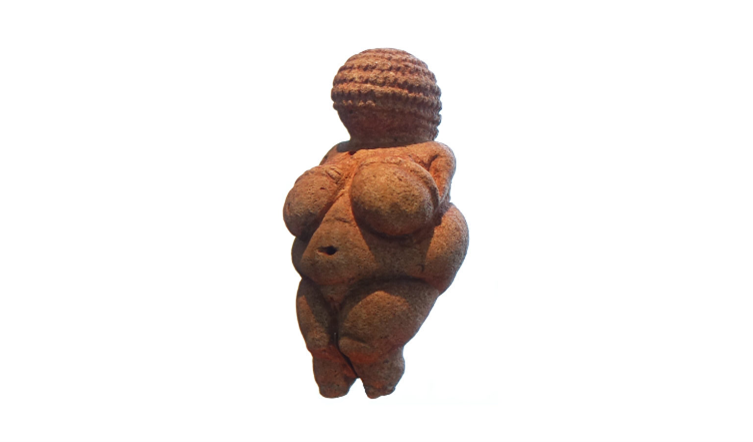
Hughes also acknowledges the statistical inconsistencies of female representation of History, stating that despite being 50% of the population they “only occupy around 0.5% of recorded history”. Although, things have not always been this way. Hughes cites that between 40 000 BCE to 5000 BCE the archaeological record demonstrates that 90% of figurines made during this period are of women (such as the Venus of Willendorf, pictured below). These remains give evidence for the high status of women in religion, property ownership and the arts; however, expansion of civilisations through increased militarisation shifted the story of history from women to men, who were traditionally the arbiters of war and politics in most ancient societies. Consequently, the stories of men, war and power became the focus of the early written histories of figures such as Herodotus, Thucydides and Livy, which have been perpetuated in the written record ever since. This is a significant problem that historians and teachers alike face today when trying to increase the visibility of women in History. For example, the World Wars still dominate the Stage 5 and Stage 6 Modern History Syllabi, with women remaining as footnotes as either nurses, homefront workers or grieving mothers and widows. Reading between the lines of the syllabus aims to reclaim the real women at all levels of power and to attempt to mitigate the bias which has forced most women out of the written historical record.
In doing this, teachers must look at the syllabus content dot points that relate to women even if they don’t explicitly reference them. An example of this is the content dot point of ‘Local political life, including magistrates and elections’ in the Ancient History 11-12 Core topic of Cities of Vesuvius: Pompeii and Herculaneum.
By teaching aspects of this dot point through the Building of Eumachia, a public priestess of the city, demonstrates the integral role elite women played in promoting the political careers of their male relatives. This is what is meant by reading between the lines of the syllabus. In applying this approach again to my own teaching context, teachers can reclaim a higher percentage of women’s history in the following areas:
- An additional 27% of the syllabus for Stage 4, 28% for Stage 5 for a total increase of almost 24% across the junior school
- Almost an additional 10% in the Stage 6 Modern History
- 16% increase in Stage 6 Ancient History
- Some interesting changes for History Extension, with more dot points explicit about the role of gender on historiography for an increase of over 20% of within the topic of Constructing History
- Overall, for Stage 6, this means that there is almost a 15% increase.
And, if we are reading between the lines of the syllabus from 7-10, we can increase and reclaim over 18% for a total of over 40% of syllabus content dot points connected to women’s history. Reading between the lines of the syllabus in this way is getting us closer to the 50% mark!
Reading Between the Sources: Historiographical Rethinking
“Roman women – no cause about them or without them. To me they are an integral part of the story. Absence of evidence is not evidence of absence.” (Kathryn Welch)
As historians, sources are our greatest weapon and one of the most effective teaching tools in the classroom. However, the interpretation of these sources often read the social values and historical context of historians into the past thus creating problematic anachronisms for our students to unpack. This process of historiography is an essential part of History as an academic discipline, and is also identified at the top of all topics in the current Year 12 Ancient History Syllabus, providing teachers with the responsibility to teach this fundamental concept to our students.
The reinterpretation of sources is the focus of historian, academic and former secondary school teacher, Kathryn Welch She wasalso a former Associate Professor in the Department of Classics and Ancient History at the University of Sydney. Welch advocates for a rethinking of how women are understood in History, specifically in the context of ancient Imperial Rome. Her work questions the accuracy of historical heavyweight Theodor Mommsen’s (German classicist, 1917 – 1903) belief that Roman women held only positions of domestic subjection, which clearly does not align with the available archaeological evidence. Welch believes that Mommsen removes women from history even more so than ancient writers such as Livy did. Whilst she acknowledges that much of Mommsen’s work is influential, it is his social and historical context’s attitudes towards women which either exaggerate or downplay their historical roles Their own cultural norms and values thus influence their writings of History
Welch’s specific rethinking of women asks where are women absent in the sources, and why? Was it men’s place to talk about women? Perhaps not. Are women always being belittled or ignored in the sources, or was it seen as improper for men to talk about women in this way? Perhaps. Her work reminds us that the silences in the sources are critical, but we should not be reductive about them. This approach teaches students to reconfigure their ideas of existing evidence and to factor women in, even when they initially appear invisible. It encourages them to read between the sources.
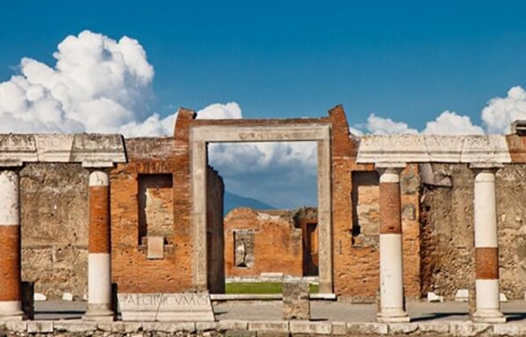
An example of this rethinking is best illustrated through the archaeological remains of the Building of Eumachia in Pompeii, Italy. Eumachia was a public priestess of Venus who commissioned the most imposing building on the eastern side of the Forum in Pompeii. Many houses and streets had to be demolished to make way for its immense construction.
It was originally interpreted to have functioned as the warehouse or headquarters of the wool and fuller’s (laundry) guild, then later as an auction house for slaves. But how could this be considering its grand size, prize location and inscription?
The inscription reads:
Eumachia, daughter of Lucius, a public priestess, in her own name, and in the name of her son, Marcus Numistrius Fronto, made the chalcidicum [portico/vestibule], the crypta [vault/underground chamber] and the porticus [covered walkway] with her own money and dedicated the same to Concordia Augusta and to Pietas.

Welch’s rethinking recontextualises this building into the era it was constructed (the early First Century CE), understanding that Concordia (harmony/concord) and Pietas (piety/devotion) are foundational elements of the new and highly experimental Augustan principate, or empire with which Eumachia is very clearly keen to be associated – as evidenced by both the visual and written elements of this building. The Latin grammar of this inscription is very specific – ‘in her own name’ – Eumachia is in the nominative case, she is active as the dedicator and financier, and her name is in much larger letters than her son’s. And perhaps most tellingly, her husband is never mentioned.
Confusion sets in with the interpretation of another inscription at the base of a statue dedicated to Eumachia within the complex by the fuller’s guild:
To Eumachia, daughter of Lucius, public priestess of Pompeian Venus, from the fullers.
Welch’s rethinking reads this as evidence of her patronage of the fullers and not the fact that any fullery or textile work occurred in the building. Here is a clear example of men being inserted into a building where they historically were not. This then opens the question for your students – what was the building used for? Ongoing analysis and historiographical debate will only tell.
In the meantime, in the case of Eumachia, reading between the sources in this way gives us evidence of the significant economic, social, and therefore, political power that elite women occupied in imperial Rome.
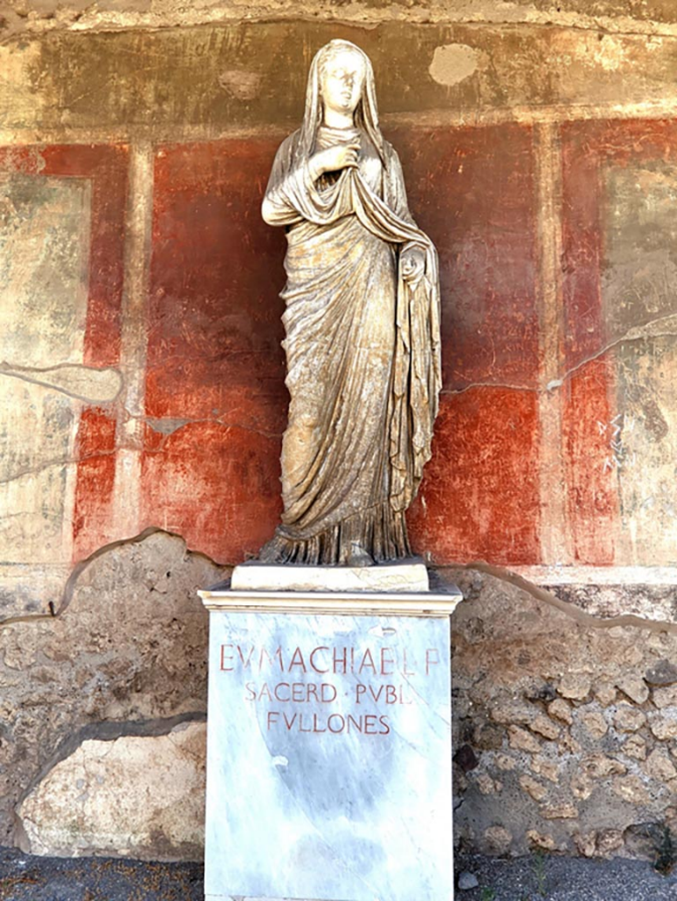
Broad niche 13 with the statue of Eumachia. Photo courtesy of Giuseppe Ciaramella.
Source – https://www.pompeiiinpictures.com/pompeiiinpictures/r7/7%2009%2001%20p4.htm
Welch’s developing historiography of this one building reminds us that even though women could not vote or be elected to political office, they could still wield immense political influence. They just had to find more ingenious ways of accessing it. Eumachia is a far cry from the domestic sphere to which Mommsen, and others like him, attempt to confine the women of history. This is an essential source to give students in the Core study: Cities of Vesuvius – Pompeii and Herculaneum to guide them on how to read between the sources, whilst simultaneously enhancing the syllabus content dot point on women within the social structure.
Other interesting sources being reinterpreted for women in both Pompeii and Herculaneum:
- Julia Felix and her praedia (estate) which took up an entire insulae (block) in Pompeii, including a revealing inscription about her ability to rent out different parts of her estate
- Eva Jakab’s work on wax tablets detailing the legal and economic agency of women in both Pompeii and Herculaneum
- Vibidia Saturnina, a public priestess who began her life as a slave but eventually rose to a position able to erect a large marble inscription and donate large sums to the cult of Venus.
Making Women Visible in the New History Syllabi
As you and your colleagues plan for the new syllabus, consider the following to better incorporate women’s history into your classrooms and the lives of your students:
- Choose women! In optional depth studies, case studies and site studies.
- Take opportunities given by the syllabus – ‘Social impacts’, ‘differing perspectives’, ‘differing interpretation/experiences’… This equals women!
- Women are already in (some of) the sources – ‘Nature/range of sources’, ‘limitations/gaps of sources’ – so take these opportunities to teach through female focused sources
- Technological developments in archaeology – How can scientific developments reveal more detail about women’s lives? Especially those of the slaves and the lower classes.
- Historiographical developments – How are women being reinterpreted by each new generation of historians and writers? How have early modern values of women impacted how ancient and/or medieval sources were interpreted? How is this currently being revised?
Further Reading
Other interesting authors who also write about reclaiming women’s history, with a particular focus on the ancient world, are:
- Sarah B. Pomeroy – Goddesses, Whores, Wives and Slaves: Women in Classical Antiquity (1975); Spartan Women (2002)
- Joyce Tyldersley – Hatshepsut: The Female Pharoah (1996)
- Judith Ginsburg – Representing Agrippina: Constructions of Female Power in the Early Roman Empire (2005)
- Mary Beard – Women and Power (2017)
- Kara Cooney – When Women Ruled the World: Six Queens of Egypt (2018)
- Bettany Hughes – Helen of Troy (2005); Venus and Aphrodite (2020)
- Emma Southon – Agrippina: Empire, Exile, Hustler, Whore (2018); A History of the Empire in 21 Women (2023)
References
English Heritage. (2016, February 29). Why were women written out of history? An interview with Bettany Hughes. English Heritage. https://www.english-heritage.org.uk/visit/inspire-me/blog/blog-posts/why-were-women-written-out-of-history-an-interview-with-bettany-hughes/
Jakab, E. (2017, January 21). Sale and Community from the Roman World. Academia.edu. https://www.academia.edu/31024546/Sale_and_Community_from_the_Roman_World
NESA. (2021). History Elective 7–10 NEW | NSW Education Standards. Nsw.edu.au. https://educationstandards.nsw.edu.au/wps/portal/nesa/k-10/learning-areas/hsie/history-elective-7-10-2019
NSW Education Standards Authority. (2012). History K–10 | NSW education standards. NSW.edu.au. https://educationstandards.nsw.edu.au/wps/portal/nesa/k-10/learning-areas/hsie/history-k-10
NSW Education Standards Authority. (2024, October 28). Ancient History Stage 6 Syllabus (2017). NSW Government. https://educationstandards.nsw.edu.au/wps/portal/nesa/11-12/stage-6-learning-areas/hsie/ancient-history-2017/
NSW Education Standards Authority. (2025a, March 10). Modern History Stage 6 Syllabus (2017). NSW Government. https://educationstandards.nsw.edu.au/wps/portal/nesa/11-12/stage-6-learning-areas/hsie/modern-history-2017/
NSW Education Standards Authority. (2025b, March 11). History Extension Stage 6 Syllabus (2017). NSW Government. https://www.nsw.gov.au/education-and-training/nesa/curriculum/hsie/history-extension-stage-6-2017
Planet Pompeii. (2019). The Building of Eumachia – Planet Pompeii. Www.planetpompeii.com. https://www.planetpompeii.com/en/map/the-building-of-eumachia.html
Rollinson, D. S. (2017). Latin Inscriptions – Dr. Rollinson’s courses and resources. Drshirley.org. https://www.drshirley.org/latin/inscription.html
Smith, L. (2025). ANNUAL REPORT 2025 CONTENTS. https://conference.nswtf.org.au/wp-content/uploads/sites/5/2025/07/25053-AR25-Book_DigitalV3.pdf
Welch, K. (2022). Roman Women. Roman Women.
Zygmont, Dr. Bryan. (2015, November 21). Venus of Willendorf. Smarthistory.org. https://smarthistory.org/venus-of-willendorf/
(2014). Pompeiiinpictures.com. https://www.pompeiiinpictures.com/pompeiiinpictures/R7/7%2009%2001%20p4.htm
About the author
Jen Sonter began teaching in 2016 around the Central Coast, eventually landing at Terrigal High School in 2018. She has since been working full time at Pittwater High School on the Northern Beaches of Sydney, finally achieving permanent employment there in 2022. She has predominantly worked in mainstream classroom settings throughout this time, but has also worked in wellbeing roles such as Year Advisor. She is a passionate history teacher and takes up any opportunity to travel and experience historical sites from far and wide. She brings this passion into the classroom in the hopes of passing it on to her students.