

Julie McMullen and John Skene reflect on the changing social and political realms in the LGBTIQA+ space, the impact on schools and positive ways to be inclusive…
Historical Context
The policies and strategic direction of the NSW Teachers Federation are determined by Council, making Federation one of the most democratic unions in Australia. These policies are reflective of the cultural landscape in which they are made and as such, Federation has often been a driving force for progressive change. This is especially apparent in the work Federation has undertaken in LGBTIQA+ advocacy.
As described in Education Quarterly Issue 5 article, Progress to be proud of, by Kerri Carr: “1975 Annual Conference delegates reiterated an aim of Federation’s Constitution: to guard members against ‘any hardship, oppression or injustice in connection with their employment … If such hardship, oppression or injustice in their employment results from discrimination on racial, political, religious or social grounds in employment or training, this Federation commits itself unequivocally to the support of such members.’”
Federation’s 1978 Sexual Discrimination policy made a powerful contribution towards communicating their standpoint and goals in this policy area.
The policy:
- affirmed “the right of staff and students to enter and remain in educational institutions regardless of sex, sexuality or marital status. It will support any member who is victimised, disadvantaged or denied employment on these grounds”
- declared: “Family and personal relationships, including non-marital relationships, must be respected in postings, promotions and transfers, in accordance with Federation policy” and “Teachers, the Federation and the Department of Education all have a responsibility to combat sexual discrimination in the schools”
- called for “the reform of laws which prescribe or permit discrimination on the grounds of sex, sexuality or marital status.”
Member advocacy in Federation led early opposition to discrimination against same-sex attracted people, formalised in the 1978 Sexual Discrimination Policy. Members continued to shape this work over time, contributing to the Sexual Orientation and Gender Preferred Identity Policy in 1996, followed by the Gender, Sexuality and Identity Policy in 2011. This policy was updated in 2022 to reflect more inclusive language and practice. The union also established a Gay and Lesbian Special Interest Group (SIG) in the 1980s, which would later be renamed the LGBTIQA+ SIG The LGBTIQA+ Restricted Committee was formed in 2011 to work on LGBTIQA+ policy and to put a LGBTIQA+ lens on broader union policy. This committee, along with the Officer with carriage of LGBTIQA+ matters, is responsible for enacting the motions and decisions of the SIG.
Federation has also played a role in various movements within this space. Notable examples include the Yes to Marriage Equality campaign (2017) and education during the AIDS/HIV epidemic. The Education newspaper helped counter disinformation and fear that was being spread around AIDS/HIV. Education Quarterly has also published articles with strategies on how to be better allies in workplaces and the wider community. Along with this Federation has continued to create resources and advice leaflets, which are available to members through the membership portal.
Visibility and representation are important aspects to help remove stigma and, in turn, create inclusion. This visibility can best be seen through public events such as Sydney Gay and Lesbian Mardi Gras, as well as similar regional events. While Federation members participated in Mardi Gras as part of union floats previously, 2010 was the first time Federation engaged with the Mardi Festival — first with Fair Day and then with a float in the parade in 2015. Federation has continued to march each year, often with a political message or theme. Federation has also maintained involvement in Fair Day stalls.
Federation has hosted events that have helped lead to change. This has included a symposium in 1980 to support gay teachers and students, and the Diversity in Education Conference — held during World Pride Sydney (2023) — which hosted participants from around the world and interstate. LGBTIQA+ members and Officers also regularly run workshops at conferences as well as courses for contacts and association seminars.
Whilst a lot of Federation’s advocacy has been documented throughout the years, this is still just a fraction of our work in LGBTIQA+ spaces, much of which happens behind the scenes. Progress often ebbs and flows as the cultural landscape changes particularly when working with/against right wing and conservative political parties and groups. This work is not always obvious to a classroom context but creates the necessary foundations to empower change within our classroom spaces.
Policies. Schools. Resources.
“Creating schools and workplaces where people belong is central to a world-leading education system”
Murat Dizdar (NSW Department of Education, 2024a, p.7)
Public schools are a haven for diversity, accepting of all marginalised groups, supporting growth and development for those that come through the front office. Sadly, acceptance and safety are not always a guarantee.
Students often feel isolated and disconnected from their peers. Teachers can be silent and avoidant for their own safety, due to uncertainty. From Cronulla, Newtown, Albury, the Tweed to Broken Hill – both students and teachers should feel empowered to always be their true selves.
The Department has developed policies to promote a safe and secure environment for all staff and students. The Gender Diverse Students in Schools legal issues bulletin, reads “The Department of Education is committed to providing safe and supportive learning environments…” and “Research shows the supportive environment schools provide can have a lasting impact on both the educational and lifelong outcomes for students.” (NSW Department of Education, 2026a).
Other current policies state:
“1.4 Schools are required to support students on health and wellbeing issues in a way that does not discriminate unlawfully against any student.” (NSW Department of Education, 2025)
“2.3 All students and staff have the right to be treated fairly and with dignity, both online and offline, in an environment free from intimidation, violence, harassment, victimisation and discrimination, including that based on sex, race, religion, disability or sexual orientation” (NSW Department of Education, 2024b)
The policies are in place but are they working in practice? The NSW People Matter Employee Survey (2025) shows that more work is needed to support individuals (staff in the survey, but can extrapolate to students) to feel fully accepted and safe in schools across different settings and locations.
The NSW Department of Education (2026c) has created a toolkit: Supporting LGBTIQA+ Inclusive Communities which is designed to help principals and school leaders take positive action to respond to sentiment that may compromise safe, inclusive and respectful environments for all students and staff.
Schools can feel empowered to celebrate and acknowledge days of significance such as Wear it Purple Day, which is a Tier 1 event in the NSW Department of Education calendar. In doing so, it shows LGBTIQA+ individuals and allies that the school is a safe space for students and staff to be themselves.
Many schools are encouraging and support student led Gender and Sexuality Alliances (GSAs) or Rainbow Clubs, that create a safe space for students to connect and support one another. A collaborative resource that was made possible to support the discussions, creation and organisation of GSA groups is available through Twenty10 (2026).
Classroom inclusion
For both students and teachers, it’s important to create a space that is accepting, and safe to the diversity of our communities and schools. This can be done through allowing inclusive language within the classroom to show all students that they are seen and valued for who they are.
Have you ever stood in front of a class and said “OK, guys, eyes to the front” or something similar? While most teachers have moved away from saying phrases like “OK, boys and girls,” there are times when we may accidentally be addressing whole classes or groups using gendered language.
This can be an incredibly hard habit to break as teachers have been using some version of this in one way or another for as long as teaching has existed.
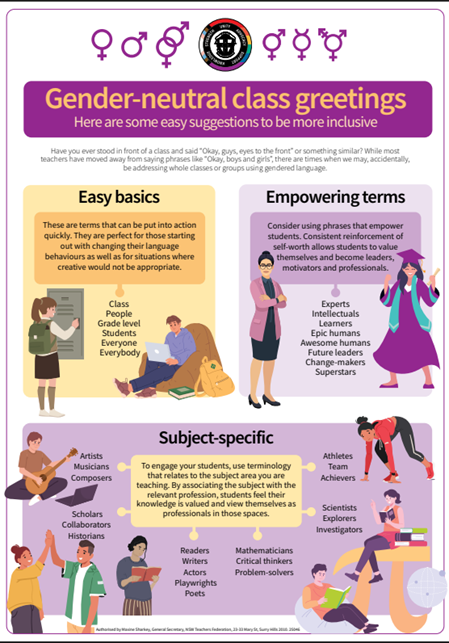
Pictured (NSW Teachers Federation, 2025) is a handy resource to help break some of these habits and create more safe, supportive, and fun schooling environments.
Purposeful, not tokenistic text/lesson/content selection, can increase inclusivity in your classroom. Allow for a wide variety of picture books in your book corner for students to engage with; feeling seen in the classroom allows students to feel comfortable to be their true selves and seek support when needed.
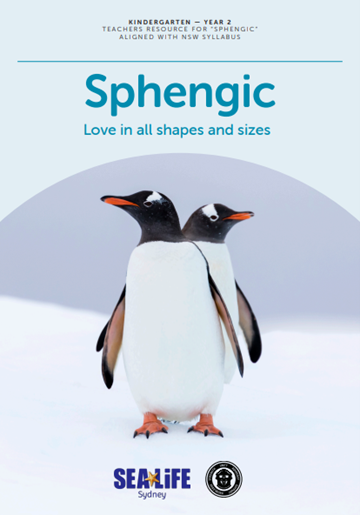
Thinking outside the classroom and partnering with external organisations such as the pictured ‘Sphengic’ resource (NSW Teachers Federation, 2023a) can link curriculum content and learning to real life. In 2023, Federation members came together to create a fun, engaging and relevant resources (NSW Teachers Federation, 2023b) to support K-2 learning. Sphengic is the story of SEA LIFE Sydney Aquarium’s same sex penguin couple, Sphen and Magic who began developing a strong bond in 2018 and became inseparable before breeding season. They were constantly seen waddling around and going for swims together in the Penguin Expedition. This resource allowed schools to engage in activities linked to an in-person or virtual excursion to SEA LIFE to bring purposeful learning for students.
The NSW Teachers Federation Library has an ever-growing catalogue of texts for students across primary and secondary to support connection and understanding. The Library is a great resource for teachers to tap into, to diversify their bookshelves and highlight a variety of voices through story to support inclusive dialogue within their classes.
Qtopia Sydney (2026) is a fantastic excursion destination and resource for schools to engage with to support student learning. It explores Sydney (and Australian) Queer history ensuring that stories aren’t lost but acknowledged, whilst platforming the voices of today.
What will it look like for you?
As public school teachers, it’s our responsibility to create positive, safe and respectful classrooms that accept and celebrate the diversity of each student.
How do you celebrate difference? Start the conversation today.
References
NSW Department of Education (2024a). Diversity, Inclusion and Belonging Strategy 2023-2026. https://education.nsw.gov.au/about-us/strategies-and-reports/diversity-inclusion-and-belonging-strategy-2023-2026 (accessed March 2026)
NSW Department of Education (2024b). Student Behaviour https://education.nsw.gov.au/policy-library/policies/pd-2006-0316 (accessed March 2026)
NSW Department of Education (2025). Student Health and Wellbeing. https://education.nsw.gov.au/policy-library/policies/pd-2004-0034 (accessed March 2026)
NSW Department of Education (2026a). Legal Issues Bulletin 55: Gender Diverse Students in Schools. https://education.nsw.gov.au/rights-and-accountability/legal-issues-bulletins/GenderDiverseStudentsinSchools (accessed March 2026)
NSW Department of Education (2026b). Gender Affirmation procedures. https://education.nsw.gov.au/policy-library/policies/pd-2024-0485-05 (accessed March 2026)
NSW Department of Education (2026c). Supporting LGBTQIA+ communities in schools. https://education.nsw.gov.au/inside-the-department/teaching-and-learning/communication-toolkit—supporting-safe–inclusive-and-respectfu (accessed April 2026)
NSW People Matter Employee Survey (2025). https://files.dcu.nsw.gov.au/dpc/pmes-2025/Education-Portfolio/NSW-PMES-2025-Education-(including-TAFE)-results.pdf (accessed April 2026)
NSW Teachers Federation (2020). Union walks the rights road with LGBTIQ members
NSW Teachers Federation (2023). Progress to be proud of Education Quarterly Issue 5
NSW Teachers Federation (2023a). Sphengic Teaching Resource K-2. https://members.nswtf.org.au/documents/sphengic-k-2/ (accessed April 2026)
NSW Teachers Federation (2023b). Sphengic (Teaching Resource) – Foundation to year 2. https://members.nswtf.org.au/documents/sphengic-foundation-to-year-2/ (accessed April 2026)
NSW Teachers Federation (2025). Gender-neutral class greetings. https://members.nswtf.org.au/documents/other-resources/ (accessed April 2026)
NSW Teachers Federation (2026). All about our magnificent Mardi Gras floats https://members.nswtf.org.au/documents/all-about-our-magnificent-mardi-gras-floats/
NSW Teachers Federation (2026). Changemaking is challenging, but worth the effort. Education Quarterly Issue 17 https://www.nswtf.org.au/wp-content/uploads/2026/03/EQM17.pdf
Qtopia Sydney. (2026). The home of Queer history and culture. https://qtopiasydney.com.au/ (accessed April 2026)
Twenty10. (2026). School Pride Groups – GSA Connect. https://twenty10.org.au/training-consulting/school-pride-groups/ (accessed April 2026)
About the Authors
Julie McMullen was elected as the NSW Teachers Federation Communications Officer in November 2024, having previously relived in the role 2022 and in 2023. As part of her role, she works closely with all officers to create and promote Federation content across all media.
As a secondary English and Drama teacher with more than ten years’ experience, and worked across regional and metro schools, she values building a solid understanding of the working conditions and needs of teachers. She has held roles as Federation Representative and Women’s Contact at school level and Association Secretary and Treasurer positions. She is also an elected member of the LGBTIQA+ restricted committee (2023-present).
John Skene was elected as the NSW Teachers Federation Disability Officer in November 2024. As part of this role, he is responsible for supporting students, staff and schools in the disability space from Early Childhood to TAFE. He works closely with Organisers, Professional Support, Trade Union Training and others to support Federation members.
With over fifteen years of experience as a teacher in special education, John has worked in schools for specific purposes (SSPs) and support units (SUs). He is an Assistant Principal Special Education. He has held roles as Federation Representative and Workplace Committee at school level and elected as Branch Representative on Federation Executive (2023-2024).