

Professor Jacqueline Ullman discusses how teachers can support students who identify as gender and sexuality diverse and to assist them to improve their sense of belonging…
Many schools recognise that, as our society becomes more open to and supportive of gender and sexuality diversity, numbers of gender and sexuality diverse students (e.g. those who might identify as lesbian, gay, bisexual, transgender, gender-diverse, or as another diverse gender or sexuality identity) have appeared to increase. The word ‘appeared’ is intentional, as experts in the field argue that the increase in young people identifying as gender and sexuality diverse (GSD) is attributable to the impact of rising social acceptance rather than an increase in actual numbers; in other words, GSD individuals have always existed in similar proportions, however – historically, and in some contexts still today – they have been compelled to hide their identities. In Australia in 2025, as parents/carers and peers are more accepting, more young people are able to be open about who they are.
It is part of the labour of teachers to ensure that all their students feel comfortable and supported to be their authentic selves and to be proud of their diverse identities. While this expectation of teachers is aligned with both federal[1] and state-based[2] guidance, at a more basic and relational level, this commitment to positive representation and inclusion of students’ diverse identities is typically aligned with teachers’ positive feelings towards the diverse range of students in their care. Put simply, most teachers like kids and want to support their self-acceptance and sense of belonging.
Talking about Gender and Sexuality Diversity
However, for a variety of reasons, including lack of relevant pre-service or in-service training, the curricular inclusion of gender and sexuality diversity can feel a bit more challenging than the inclusion of other diverse identities and backgrounds. Some teachers feel nervous about what they are and are not ‘allowed’ to say in the interests of inclusivity and – despite growing numbers of GSD students at all levels of education – teachers sometimes express concerns about whether or not gender and sexuality diversity-inclusive content is appropriate for the primary or secondary school classroom (van Leent, 2017). Even within the area of relationships and personal development education, which includes many suitable content areas where gender and sexuality diversity could easily be integrated, almost a third of Australian teachers do not include same-sex attraction or sexual orientation and a quarter do not include gender diversity (Ezer et al., 2018).
Recent survey research with Australian teachers shows that the large majority report positive feelings about gender and sexuality diverse people and a general sense of comfort engaging with related topics – answering questions, addressing name-calling, and providing a safe environment for GSD students (Burns et al., 2023). An important finding of this research is that, while participating teachers were almost uniformly supportive of inclusivity of gender and sexuality diversity at both the policy and curriculum levels, many reported that this was not enacted at their schools. Less than half reported having a gender and sexuality diversity-inclusive school enrolment policy and less than a third said that inclusive topics were featured in the curriculum in a positive way at their school (Burns et al., 2023).
NSW-Specific Supports for the Inclusion of Gender and Sexuality Diversity
As wise educator Emily Style penned back in 1988, the curriculum should function as “both window and as mirror” to validate students’ experiences of self within the public world of the school as a strong foundation for their lives as adults in broader society. For GSD young people, the majority of whom are raised by “straight”/heterosexual, cisgender[3] parents/carers, school-based validation is even more critical. The New South Wales (NSW) curriculum encourages inclusion of diverse identity characteristics both in the classroom and at the whole-school level and gender and sexuality diversity-inclusive content options exist within many curriculum areas, including PDHPE, English, History, Society and Culture, Community and Family Studies and Legal Studies. Further, the Department acknowledges that students who identify as LGBTQIA+ (or GSD) are at risk of experiencing lower levels of belonging and benefit from “targeted programs to boost their connectedness at school” via education/curriculum, inclusive language and through educators working to curate an inclusive physical environment[4]. Additional support is provided via the “Transgender students in schools” legal issues bulletin 55 (LIB55)[5] which reminds teachers to be “inclusive of all students’ individual learning identity” and acknowledges that gender identity can be discussed across many curriculum areas.
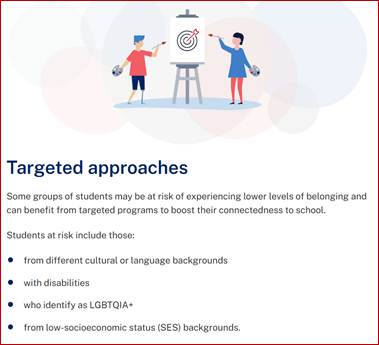
From: NSW Department of Education “What Works Best”, available here. © State of New South Wales (Department of Education), 2023.
Parents’ Attitudes to the Inclusion of Gender and Sexuality Diversity
One of the most commonly reported reasons for teachers’ and school leaders’ lack of engagement with gender and sexuality diversity is their concern about parental opposition and subsequent complaint. Recent Australian survey research has addressed this point head-on, finding that 86.5% of public-school parents in NSW support the introduction of gender and sexuality diversity-inclusive topics during K-12 schooling, with most wanting these introduced by the end of Stages 3 or 4 (Ferfolja et al., 2021). Conversely, just 13.5% preferred total exclusion of gender and sexuality diversity from relationships and sexuality education. NSW parents were more supportive of the inclusion of these topics than the national average (see Ullman et al., 2021 for full, nationally representative survey results).
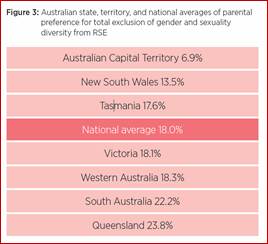
From: Gender and Sexuality Diversity in Schools: Parental Experiences and Schooling Responses, New South Wales Snapshot Report, available here.
Topics such as diverse romantic relationships and families; the negative impact of GSD bias-based discrimination; and understanding gender diversity were viewed by parents as necessary for creating a positive, safe and supportive school culture and preparing students for living well as adults in a diverse, socially cohesive society. Additionally, while media headlines might have us believe that gender diversity (or transgender identities) is a particularly divisive topic, 65% of public-school parents rated the “difference between biological sex and gender” as this relates to gender diversity and transgender individuals as of “moderate” or “high” importance, with just 19.5% viewing this as “not important” (Ullman et al., 2021).
Crucially, this research was nationally-representative, meaning that – rather than survey results being dismissible as the niche sentiments of those in particular locations or demographics – these findings are our closest reflection of the attitudes and preferences of the public-school parent population. While some communities might have an overrepresentation of vocal oppositional parents, most will have an abundance of supportive parents who may be far less likely to contact the school with positive feedback.
New Professional Learning Resource for Supporting GSD Students
Many teachers and school leaders want to support GSD students to feel visible and included within the school community and there are a plethora of easily-accessible online resources to support their efforts, including many offered by the NSW Teachers Federation. However, educators regularly ask for professional learning in this area, which is much more limited in availability and access.
To meet this need, Associate Professor Jacqueline Ullman and Professor Tania Ferfolja, both academic researchers in Western Sydney University’s School of Education, designed the “Teaching to Affirm Community Diversity” online short course (or ‘micro-credential’). This 10-hour short course is designed with the busy educator in mind – flexibly-available and self-paced, with asynchronous engagement with the academics, and able to be used to satisfy professional learning requirements in NSW and nationally.
The course draws from current Australian research and uses federal guidance and state-based education policy to support teachers seeking to create gender and sexuality diversity-inclusive environments in K-12 schools. Through five modules, each including interactive activities, teacher-learners explore legal and policy frameworks, best practice ideas, and strategies for fostering student belonging through a supportive, safe, and affirming school climate for GSD students.
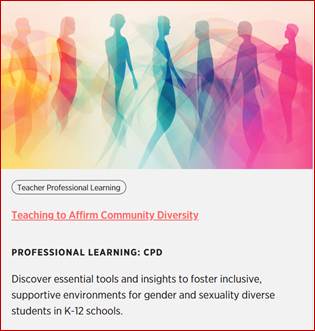
The “Teaching to Affirm Community Diversity” micro-credential is available through Western Sydney University and can be accessed here.
Drawing from empirical research with parents and GSD students, this short course bridges the gap between legal obligations, known best practices, and real-world application, and aims to increase educators’ awareness about how a positive school climate is related to GSD students’ wellbeing, academic success and sense of belonging.
By the end of the 10-hour short course, teachers and school leaders will be able to:
- Identify and understand the unique challenges and experiences faced by GSD learners in K-12 settings and their families;
- Apply relevant state and federal departmental policies to confidently implement inclusive pedagogical strategies and administrative practices that support GSD learners;
- Address and counteract gender-based violence and bullying, fostering a school environment that supports both GSD learners and educators;
- Critically reflect on and improve their own practices to create more inclusive and supportive classroom environments; and,
- Critically reflect on their school’s local-level policies and work with colleagues to reshape and enact these in line with their learnings.
Central to the micro-credential is a short film, shown in three parts, where learners are introduced to the real-life (word-for-word, verbatim) experiences of six public school mums, parenting GSD children attending primary and secondary schools. These parents’ experiences of working with public school teachers and school leaders to support their children, shared through short films using their spoken interview data as ‘performed’ by professional actors, expose what schools and educators are doing well and where practices could be improved. Their stories are at once emotional and inspirational and offer a unique backdrop for the ‘why’ of local school policy and pedagogical reform in this area.
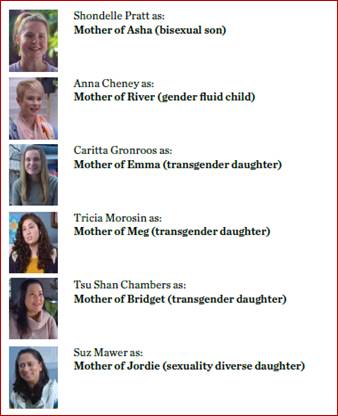
The six parents, as professionally acted, in the “What Parents Want: Talking about Gender and Sexuality Diversity” short film, featured in the micro-credential.
As with other areas of diversity and inclusivity, best-practice models for inclusivity of gender and sexuality diversity in schools advocate for whole-school approaches, bringing together both macro-level policy guidance documents and interpersonal, relational considerations for school community. Targeted professional learning in this area is an important, foundational element of such a shift. Importantly, it is evident that the large majority of parents want to see schools working to include GSD students – not just for the benefit of those young people, but to enhance cohesion and reduce bullying for the whole school community.
Want to Know More?
- The “Teaching to Affirm Community Diversity” micro-credential at Western Sydney University is available here (https://westernx.edu.au/courses/tacd/?cl=1) and open for rolling enrolment throughout the year. Participants receive a digital badge of recognition upon completion.
- Training can also be arranged in-person at the whole-school/team levels. For more information or to register your interest, please reach out to Associate Professor Jacqueline Ullman via j.ullman@westernsydney.edu.au
References
Burns, S., Saltis, H., Hendriks, J., Abdolmanafi, A., Davis-McCabe, C., Tilley, P.J., & Winter, S. (2023). Australian teacher attitudes, beliefs and comfort towards sexuality and gender diverse students. Sex Education, 23(5), 540-555. https://doi.org/10.1080/14681811.2022.2087177.
Ezer, P., Power, J., Jones, T., & Fisher, C. (2020). 2nd National Survey of Australian Teachers of Sexuality Education. Australian Research Centre in Sex, Health & Society, La Trobe University. https://opal.latrobe.edu.au/articles/report/2nd_National_Survey_of_Australian_Teachers_of_Sexuality_Education_2018_pdf/13207265.
Ferfolja, T., Ullman, J., & Hobby, L. (2021). Gender and Sexuality Diversity in Schools: Parental Experiences and Schooling Responses. New South Wales – Snapshot Report. Western Sydney University. https://doi.org/10.26183/tmjr-zj59.
Style, E. (1988). “Curriculum as Window and Mirror”, in Listening for All Voices, Oak Knoll School monograph. https://www.nationalseedproject.org/images/documents/Curriculum_As_Window_and_Mirror.pdf.
Ullman, J., Ferfolja, T., & Hobby, L. (2021). Parents’ perspectives on the inclusion of gender and sexuality diversity in K-12 schooling: Results from an Australian national study. Sex Education, 22(4), 424–446. https://doi.org/10.1080/14681811.2021.1949975.
van Leent, L. (2017). Supporting School Teachers: Primary Teachers’ Conceptions of Their Responses to Diverse Sexualities. Sex Education, 17(4), 440–453. https://doi.org/10.1080/14681811.2017.1303369.
About the author
Professor Jacqueline Ullman has a Bachelor of Science (English Education, Secondary) from New York University; a Master of Arts (Sociology and Education) from Teachers College, Columbia University; and a Master of Education (Research Methods) and PhD (Educational Psychology) from the University of Sydney. She began her career as a public high school English teacher in NYC before deciding to upskill with the goal of informing educational policy reform in the interests of making schools more equitable and inclusive. Professor Ullman has published more than 80 journal articles, book chapters, research reports and resources for educators’ professional learning since 2012, is in the top 1% of published academics worldwide in the field of sex education (ScholarGPS), and is a featured author on UNESCO’s Health and Education Resource Centre. Her research-based resources for classroom teachers and school leaders are featured by Australia’s federal Student Wellbeing Hub and within guidance documents for educators distributed by several other state/territory Departments of Education. Her extensive track record of consultation and professional development with schools across Sydney further attests to her understanding of the complexities of diverse school communities and the sensitivity required to successfully work with teacher, parent and student cohorts to conduct research in the areas of sexualities, gender and gender diversity, relationships and health.
[1] https://studentwellbeinghub.edu.au/educators/framework/
[2] https://education.nsw.gov.au/teaching-and-learning/multicultural-education/culture-and-diversity/cultural-inclusion
[3] Cisgender refers to when an individual’s biological sex aligns with their gender identity.
[4] See “Targeted Approaches” https://education.nsw.gov.au/about-us/education-data-and-research/what-works-best/student-belonging/making-sense-of-belonging#/asset3
[5] https://education.nsw.gov.au/rights-and-accountability/legal-issues-bulletins/transgender-students-in-schools#Curriculum_8