Skip to content

Join Today

Member portal

NSW Teachers Federation
  • Home
  • Courses
    • All Courses
    • All Conferences
    • Primary
    • Secondary
  • Journal
    • Journal Issue
    • For your Classroom
    • For your Staffroom
    • For your Future
    • For your Research
  • Podcast
  • About
    • Who we are
    • What we do
    • Our Presenters
    • FAQ
    • Contact Us
NSW Teachers Federation
  • Home
  • Courses
    • All Courses
    • All Conferences
    • Primary
    • Secondary
  • Journal
    • Journal Issue
    • For your Classroom
    • For your Staffroom
    • For your Future
    • For your Research
  • Podcast
  • About
    • Who we are
    • What we do
    • Our Presenters
    • FAQ
    • Contact Us

Subject: Professional development

Autonomy over what? Reclaiming intelligent professionalism in school leadership

Anna Hogan argues that the principle of autonomy for principals has not been as worthwhile or as empowering as promised. She suggests the use of “intelligent professionalism”…

In recent years, school leaders across Australia have been navigating intensifying demands. Principals are now routinely expected to manage not only teaching and learning, but also staffing, infrastructure, finances and community engagement, all within systems shaped by reform agendas that emphasise decentralisation and local autonomy. At the centre of these reforms lies a key question: autonomy over what, and for what purpose?

This essay reflects on the changing nature of professional autonomy in school leadership, drawing on research conducted across Australia, New Zealand, England, and Canada. It argues that while the principle of autonomy is often presented as empowering, in practice it has sometimes functioned to redistribute responsibility and delegate risk onto schools without the support required to realise its promise. In this context, an engagement with the concept of intelligent professionalism offers a useful framework for thinking about how school leaders might reclaim autonomy in ways that are professionally meaningful and educationally purposeful.

Autonomy as a policy ideal

Education reforms in many OECD contexts, including Australia, have positioned autonomy as a desirable policy goal. Initiatives such as Local Schools, Local Decisions (LSLD) sought to give principals greater control over staffing, budgets and other operational decisions. The underlying assumption is that decentralising authority to the school level enables leaders to respond more effectively to local contexts and community needs (Macdonald et al., 2021).

Many school leaders welcomed these changes. In research conducted with principals across four different states in Australia, school leaders frequently described the benefits of being able to tailor decisions to their communities (Niesche et al., 2023). In a different study, in Queensland, principals similarly highlighted autonomy as professionally affirming, offering opportunities to innovate, lead strategically and differentiate their schools within an increasingly competitive school choice landscape (Le Feuvre et al., 2023). For these leaders, autonomy was not only a matter of operational control, but also a way to enact their vision and build a strong, marketable culture within their schools.

This view was reinforced during the COVID-19 pandemic. When school closures occurred and rapid shifts to remote learning were required, many principals used their discretionary powers to reallocate funds, purchase digital devices and implement local strategies to ensure continuity of learning (Cuskelly et al., 2024). In these moments, autonomy enabled timely and responsive decision-making. It also contributed to a sense of professional agency that allowed school leaders to draw on their local knowledge and relationships to support students and staff.

The limits of autonomy in practice

Despite these examples, the practical enactment of autonomy has also raised concerns. In several studies, school leaders indicated that while autonomy was welcome in theory, in practice it was often accompanied by significant challenges (see Thompson et al., 2021; Keddie et al., 2022). A common concern was the absence of corresponding support and resourcing. Autonomy, in these contexts, did not always equate to greater professional freedom. Instead, it often meant managing increasing responsibilities in the face of declining resources.

A key example of this is how the financial responsibilities associated with autonomy have significantly reshaped the role of the principal. Research into school funding and the increasing reliance on private income in public schools has shown that principals are now required to engage in resource acquisition activities, including applying for grants, selling advertising space and partnering with external organisations in sponsorship arrangements (Hogan et al., 2023; Rowe & Di Gregorio, 2024).

While some school communities benefit from these opportunities, the process places additional expectations on school leaders to manage stakeholder relationships and align their goals with market-based principles. This shift signals a broader change in how educational leadership is understood: success is increasingly associated with financial management and market responsiveness, rather than solely with instructional leadership or community engagement.

These changes have placed considerable strain on principals, many of whom report working extended hours to meet operational and administrative demands. In recent research colleagues and I have undertaken in partnership with the Queensland Teachers’ Union, principals described long workdays followed by several hours of tasks completed after hours (Thompson et al., 2025). Time spent on teaching and learning, through classroom observations and mentoring was frequently reduced. For many, this led to a sense of disconnection from the core purposes of their role.

Rethinking professional autonomy

Given these challenges, it is important to reflect on what kind of autonomy is most valuable in public education. Autonomy itself is not inherently beneficial or detrimental. What matters is the nature of the autonomy being granted, the supports that accompany it and the purposes it serves. This is where the concept of intelligent professionalism (Thompson, 2021) offers a productive way forward.

Developed in the context of global advocacy for the teaching profession, intelligent professionalism resists the narrowing of autonomy to individualised managerial control. Instead, it positions autonomy as strategic, collective and grounded in shared responsibility, with teachers and school leaders actively shaping policy and practice. It recognises educators as insiders in education reform, whose expertise and contextual knowledge should drive decision‑making. This involves collaborative, profession‑led approaches to designing and enacting policies, supported by strong relationships between systems, schools and their communities.

From this perspective, autonomy is most valuable when directed toward the aspects of leadership and practice that have the greatest impact on student learning and school development. These include:

  • Instructional leadership: the ability to lead curriculum, pedagogy and assessment in ways that reflect the needs and strengths of local communities.
  • Staff development and team building: the capacity to mentor and retain staff, and to foster a strong, purposeful professional culture.
  • Responsive planning: the discretion to make strategic decisions in response to emerging challenges or opportunities, supported by clear frameworks and adequate resources.

At the same time, intelligent professionalism recognises that not all responsibilities are best devolved. Certain functions, particularly those related to infrastructure, core staffing, student support services, and data systems, may be more effectively managed through central coordination. When these are centrally resourced and equitably distributed, they reduce unnecessary burdens on school leaders and create the conditions for genuine professional agency. This enables educators to focus their autonomy on the work that matters most; improving teaching, learning and equity in their schools.

A professionally led system

As Australian education systems consider the next phase of reform, there is a timely opportunity to reflect on how leadership is understood and supported. Rather than continuing to devolve responsibilities without sufficient support, policymakers could invest in models of leadership that are sustainable, collaborative and grounded in professional expertise.

A professionally led system does not imply a return to rigid centralisation. Rather, it involves designing structures that balance flexibility with fairness, and that recognise the critical role of school leaders as both educational experts and system stewards. This means creating space for principals to lead learning, ensuring that baseline entitlements and infrastructure are guaranteed system-wide, and developing accountability systems that are transparent, collaborative and respectful of educators’ time and expertise.

The principle of autonomy remains important in public education. But autonomy must be supported. It should enable school leaders to lead with purpose, not just manage scarcity. By reclaiming intelligent professionalism, we can reframe autonomy not as a burden, but as a tool for advancing educational quality and equity, led by the profession, in partnership with the system and in service of all students.

References

Cuskelly, L., Hogan, A., & Thompson, G. (2024). Commercial triage in public schooling: COVID-19, autonomy and ‘within system’inequality. Journal of Educational Administration and History, 56(4), 448-464.

Keddie, A., MacDonald, K., Blackmore, J., Wilkinson, J., Gobby, B., Niesche, R., … & Mahoney, C. (2022). The constitution of school autonomy in Australian public education: Areas of paradox for social justice. International Journal of Leadership in Education, 25(1), 106-123.

Hogan, A., Gerrard, J., & Di Gregorio, E. (2023). Philanthropy, marketing disadvantage and the enterprising public school. The Australian Educational Researcher, 50(3), 763-780.

Le Feuvre, L., Hogan, A., Thompson, G., & Mockler, N. (2023). Marketing Australian public schools: The double bind of the public school principal. Asia Pacific Journal of Education, 43(2), 599-612.

MacDonald, K., Keddie, A., Blackmore, J., Mahoney, C., Wilkinson, J., Gobby, B., … & Eacott, S. (2023). School autonomy reform and social justice: A policy overview of Australian public education (1970s to present). The Australian Educational Researcher, 50(2), 307-327.

Niesche, R., Eacott, S., Keddie, A., Gobby, B., MacDonald, K., Wilkinson, J., & Blackmore, J. (2023). Principals’ perceptions of school autonomy and educational leadership. Educational Management Administration & Leadership, 51(6), 1260-1277.

Rowe, E., & Di Gregorio, E. (2024). Grant chaser and revenue raiser: public school principals and the limitations of philanthropic funding. The Australian Educational Researcher, 1-20.

Thompson, G. (2021). Improving the status of teachers through intelligent professionalism. Education International.

Thompson, G., Hogan, A., Mockler, N., Stacey, M., & Creagh, S. (2025). Time Use, Time Poverty and Teachers’ Work: Preliminary Report on Phase 3.

Thompson, G., Lingard, B., & Ball, S. J. (2021). ‘Indentured autonomy’: Headteachers and academisation policy in Northern England. Journal of Educational Administration and History, 53(3-4), 215-232.

About the author

Dr Anna Hogan is an Associate Professor in the School of Education at Queensland University of Technology. Her research interests broadly focus on education marketisation, and the related issues of privatisation and commercialisation in public schooling. She currently works on a number of research projects, including: philanthropy in Australian public schooling, teacher and school leader time poverty, and how commercial curriculum resources – including GenAI – impact teachers’ work. She works with education departments and teacher unions in relation to these issues. Anna has two recent books: Teaching and Time Poverty (2024) and Commercialising Public Schooling: Practices of Profit-Making (2025).


Anna HoganDownload

Reading Between the Syllabus: Searching for Women in the Secondary School History Curriculum

Jen Sonter, in the last of the 2025 In Focus articles on Women in History, explores how teachers can include more of the history of women into their teaching. Her analysis of the history syllabuses shows that women (and their complete stories) are underrepresented in the content…

Historically, on average, women have made up 50% of the population. In coeducational public schools, this statistic will continue to impact our decisions as teachers as we aim to design meaningful lessons to engage classes that are at least half female. Currently in 2025, women represent a significantly higher percentage of the public school teaching profession, with 81.8% in primary schools and 61% in secondary schools. Additionally, within the New South Wales Teachers Federation in 2025, 73.7% of members are also women, with 52.1% holding Executive positions and 55.8% of Associations electing female Presidents.

Unfortunately, these statistics are in stark contrast to the representation of women in the NSW secondary schools History Syllabi. A content analysis of the current History Syllabi found that, in my context, for a student who studies mandatory junior History and chooses Stage 5 Elective History from 7-10, as well as all three possible senior History subjects (Ancient, Modern and Extension), only 11.49% of the content dot points they will learn are explicitly about women. Interestingly, for this student, only 3% of the Modern History Years 11-12 syllabus specifically references women, whereas the Ancient History Years 11-12 syllabus has 25% more specific female content.

The new secondary History Syllabi, to be implemented in 2027, sees an improvement in the inclusion of women’s history in my teaching context, with a 12% increase in female content from 7-10, and an 8% increase for 11-12, for a combined total increase of almost 10% from 7-12.

The most significant improvement for women in the new syllabus is the inclusion of a Depth Study Option, titled ‘Rights and Freedoms of Australian Women (c. 1945 – c. 2012)’. This gives students an exciting opportunity to learn about the impact of women’s suffrage, their changing roles in politics and the workplace, as well as the ongoing impact of inequality and discrimination against women.

However, this data still demonstrates an alarming disparity between the number of female students in our classes and the amount of female content that we teach. That is why, as History teachers, we must read between the lines of the syllabus to reclaim women’s rightful place as equal contributors to the past.

Reading Between the Lines of the Syllabus

“There are brilliantly feisty women from history who have made an impact, and whose stories need to be told. For historians it’s our job to fill in the gaps in history. We need to actively look for women’s stories, and put them back into the historical narrative. There are so many women that should be household names but just aren’t.” (Bettany Hughes, Interview with English Heritage, 2016)

What teachers must do to more accurately reflect the contributions of women throughout History is to read between the lines of the syllabus. That is, as historian and presenter Bettany Hughes puts it, to “fill in the gaps” of the syllabus with our own expert and specialised knowledge of the people and times that we teach. 

Hughes also acknowledges the statistical inconsistencies of female representation of History, stating that despite being 50% of the population they “only occupy around 0.5% of recorded history”. Although, things have not always been this way. Hughes cites that between 40 000 BCE to 5000 BCE the archaeological record demonstrates that 90% of figurines made during this period are of women (such as the Venus of Willendorf, pictured below). These remains give evidence for the high status of women in religion, property ownership and the arts; however, expansion of civilisations through increased militarisation shifted the story of history from women to men, who were traditionally the arbiters of war and politics in most ancient societies. Consequently, the stories of men, war and power became the focus of the early written histories of figures such as Herodotus, Thucydides and Livy, which have been perpetuated in the written record ever since. This is a significant problem that historians and teachers alike face today when trying to increase the visibility of women in History. For example, the World Wars still dominate the Stage 5 and Stage 6 Modern History Syllabi, with women remaining as footnotes as either nurses, homefront workers or grieving mothers and widows. Reading between the lines of the syllabus aims to reclaim the real women at all levels of power and to attempt to mitigate the bias which has forced most women out of the written historical record.

The Venus (or Woman) of Willendorf, c. 24 000 – 22 000 BCE (Naturhistorisches Museum, Vienna; photo: Steven Zucker, CC BY-NC-SA 2.0) Source – https://smarthistory.org/venus-of-willendorf/

In doing this, teachers must look at the syllabus content dot points that relate to women even if they don’t explicitly reference them. An example of this is the content dot point of ‘Local political life, including magistrates and elections’ in the Ancient History 11-12 Core topic of Cities of Vesuvius: Pompeii and Herculaneum.

By teaching aspects of this dot point through the Building of Eumachia, a public priestess of the city, demonstrates the integral role elite women played in promoting the political careers of their male relatives. This is what is meant by reading between the lines of the syllabus. In applying this approach again to my own teaching context, teachers can reclaim a higher percentage of women’s history in the following areas:

  • An additional 27% of the syllabus for Stage 4, 28% for Stage 5 for a total increase of almost 24% across the junior school
  • Almost an additional 10% in the Stage 6 Modern History
  • 16% increase in Stage 6 Ancient History
  • Some interesting changes for History Extension, with more dot points explicit about the role of gender on historiography for an increase of over 20% of within the topic of Constructing History
  • Overall, for Stage 6, this means that there is almost a 15% increase.

And, if we are reading between the lines of the syllabus from 7-10, we can increase and reclaim over 18% for a total of over 40% of syllabus content dot points connected to women’s history. Reading between the lines of the syllabus in this way is getting us closer to the 50% mark!

Reading Between the Sources: Historiographical Rethinking

“Roman women – no cause about them or without them. To me they are an integral part of the story. Absence of evidence is not evidence of absence.” (Kathryn Welch)

As historians, sources are our greatest weapon and one of the most effective teaching tools in the classroom. However, the interpretation of these sources often read the social values and historical context of historians into the past thus creating problematic anachronisms for our students to unpack. This process of historiography is an essential part of History as an academic discipline, and is also identified at the top of all topics in the current Year 12 Ancient History Syllabus, providing teachers with the responsibility to teach this fundamental concept to our students. 

The reinterpretation of sources is the focus of historian, academic and former secondary school teacher, Kathryn Welch She wasalso a former Associate Professor in the Department of Classics and Ancient History at the University of Sydney. Welch advocates for a rethinking of how women are understood in History, specifically in the context of ancient Imperial Rome. Her work questions the accuracy of historical heavyweight Theodor Mommsen’s (German classicist, 1917 – 1903) belief that Roman women held only positions of domestic subjection, which clearly does not align with the available archaeological evidence. Welch believes that Mommsen removes women from history even more so than ancient writers such as Livy did. Whilst she acknowledges that much of Mommsen’s work is influential, it is his social and historical context’s attitudes towards women which either exaggerate or downplay their historical roles Their own cultural norms and values thus influence their writings of History 

Welch’s  specific rethinking of women asks where are women absent in the sources, and why? Was it men’s place to talk about women? Perhaps not. Are women always being belittled or ignored in the sources, or was it seen as improper for men to talk about women in this way? Perhaps. Her work reminds us that the silences in the sources are critical, but we should not be reductive about them. This approach teaches students to reconfigure their ideas of existing evidence and to factor women in, even when they initially appear invisible. It encourages them to read between the sources.

The edifice of the Building of Eumachia in the Forum of Pompeii, Italy. Source – https://www.planetpompeii.com/en/map/the-building-of-eumachia.html

An example of this rethinking is best illustrated through the archaeological remains of the Building of Eumachia in Pompeii, Italy. Eumachia was a public priestess of Venus who commissioned the most imposing building on the eastern side of the Forum in Pompeii. Many houses and streets had to be demolished to make way for its immense construction.

It was originally interpreted to have functioned as the warehouse or headquarters of the wool and fuller’s (laundry) guild, then later as an auction house for slaves. But how could this be considering its grand size, prize location and inscription?

 The inscription reads:

Eumachia, daughter of Lucius, a public priestess, in her own name, and in the name of her son, Marcus Numistrius Fronto, made the chalcidicum [portico/vestibule], the crypta [vault/underground chamber] and the porticus [covered walkway] with her own money and dedicated the same to Concordia Augusta and to Pietas.

Inscription from the Building of Eumachia. Source – https://www.drshirley.org/latin/inscription.html

Welch’s rethinking recontextualises this building into the era it was constructed (the early First Century CE), understanding that Concordia (harmony/concord) and Pietas (piety/devotion) are foundational elements of the new and highly experimental Augustan principate, or empire with which Eumachia is very clearly keen to be associated – as evidenced by both the visual and written elements of this building. The Latin grammar of this inscription is very specific – ‘in her own name’ – Eumachia is in the nominative case, she is active as the dedicator and financier, and her name is in much larger letters than her son’s. And perhaps most tellingly, her husband is never mentioned.

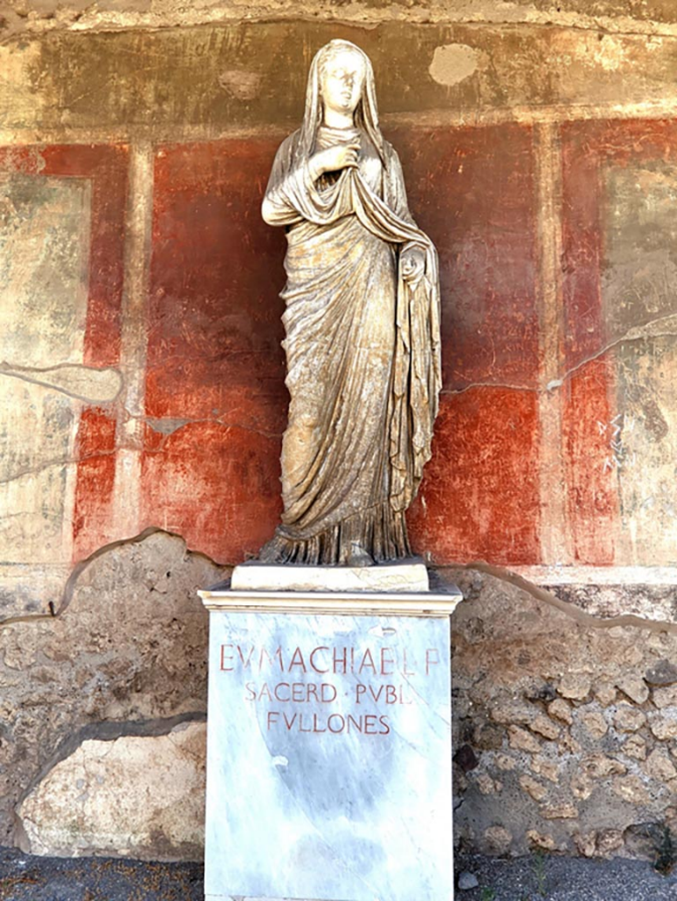
Confusion sets in with the interpretation of another inscription at the base of a statue dedicated to Eumachia within the complex by the fuller’s guild:

To Eumachia, daughter of Lucius, public priestess of Pompeian Venus, from the fullers.

Welch’s rethinking reads this as evidence of her patronage of the fullers and not the fact that any fullery or textile work occurred in the building. Here is a clear example of men being inserted into a building where they historically were not. This then opens the question for your students –  what was the building used for? Ongoing analysis and historiographical debate will only tell.

In the meantime, in the case of Eumachia, reading between the sources in this way gives us evidence of the significant economic, social, and therefore, political power that elite women occupied in imperial Rome.

VII.9.1 Pompeii. April 2022.
Broad niche 13 with the statue of Eumachia. Photo courtesy of Giuseppe Ciaramella.
Source – https://www.pompeiiinpictures.com/pompeiiinpictures/r7/7%2009%2001%20p4.htm 

Welch’s developing historiography of this one building reminds us that even though women could not vote or be elected to political office, they could still wield immense political influence.  They just had to find more ingenious ways of accessing it. Eumachia is a far cry from the domestic sphere to which Mommsen, and others like him, attempt to confine the women of history. This is an essential source to give students in the Core study: Cities of Vesuvius – Pompeii and Herculaneum to guide them on how to read between the sources, whilst simultaneously enhancing the syllabus content dot point on women within the social structure.

Other interesting sources being reinterpreted for women in both Pompeii and Herculaneum:

  • Julia Felix and her praedia (estate) which took up an entire insulae (block) in Pompeii, including a revealing inscription about her ability to rent out different parts of her estate
  • Eva Jakab’s work on wax tablets detailing the legal and economic agency of women in both Pompeii and Herculaneum
  • Vibidia Saturnina, a public priestess who began her life as a slave but eventually rose to a position able to erect a large marble inscription and donate large sums to the cult of Venus.

Making Women Visible in the New History Syllabi

As you and your colleagues plan for the new syllabus, consider the following to better incorporate women’s history into your classrooms and the lives of your students:

  • Choose women! In optional depth studies, case studies and site studies.
  • Take opportunities given by the syllabus – ‘Social impacts’, ‘differing perspectives’, ‘differing interpretation/experiences’… This equals women!
  • Women are already in (some of) the sources – ‘Nature/range of sources’, ‘limitations/gaps of sources’ – so take these opportunities to teach through female focused sources
  • Technological developments in archaeology – How can scientific developments reveal more detail about women’s lives? Especially those of the slaves and the lower classes.
  • Historiographical developments – How are women being reinterpreted by each new generation of historians and writers? How have early modern values of women impacted how ancient and/or medieval sources were interpreted? How is this currently being revised?

Further Reading

Other interesting authors who also write about reclaiming women’s history, with a particular focus on the ancient world, are:

  • Sarah B. Pomeroy – Goddesses, Whores, Wives and Slaves: Women in Classical Antiquity (1975); Spartan Women (2002)
  • Joyce Tyldersley – Hatshepsut: The Female Pharoah (1996)
  • Judith Ginsburg – Representing Agrippina: Constructions of Female Power in the Early Roman Empire (2005)
  • Mary Beard – Women and Power (2017)
  • Kara Cooney – When Women Ruled the World: Six Queens of Egypt (2018)
  • Bettany Hughes – Helen of Troy (2005); Venus and Aphrodite (2020)
  • Emma Southon – Agrippina: Empire, Exile, Hustler, Whore (2018); A History of the Empire in 21 Women (2023)

References

English Heritage. (2016, February 29). Why were women written out of history? An interview with Bettany Hughes. English Heritage. https://www.english-heritage.org.uk/visit/inspire-me/blog/blog-posts/why-were-women-written-out-of-history-an-interview-with-bettany-hughes/

Jakab, E. (2017, January 21). Sale and Community from the Roman World. Academia.edu. https://www.academia.edu/31024546/Sale_and_Community_from_the_Roman_World

NESA. (2021). History Elective 7–10 NEW | NSW Education Standards. Nsw.edu.au. https://educationstandards.nsw.edu.au/wps/portal/nesa/k-10/learning-areas/hsie/history-elective-7-10-2019

NSW Education Standards Authority. (2012). History K–10 | NSW education standards. NSW.edu.au. https://educationstandards.nsw.edu.au/wps/portal/nesa/k-10/learning-areas/hsie/history-k-10

NSW Education Standards Authority. (2024, October 28). Ancient History Stage 6 Syllabus (2017). NSW Government. https://educationstandards.nsw.edu.au/wps/portal/nesa/11-12/stage-6-learning-areas/hsie/ancient-history-2017/

NSW Education Standards Authority. (2025a, March 10). Modern History Stage 6 Syllabus (2017). NSW Government. https://educationstandards.nsw.edu.au/wps/portal/nesa/11-12/stage-6-learning-areas/hsie/modern-history-2017/

NSW Education Standards Authority. (2025b, March 11). History Extension Stage 6 Syllabus (2017). NSW Government. https://www.nsw.gov.au/education-and-training/nesa/curriculum/hsie/history-extension-stage-6-2017

Planet Pompeii. (2019). The Building of Eumachia – Planet Pompeii. Www.planetpompeii.com. https://www.planetpompeii.com/en/map/the-building-of-eumachia.html

Rollinson, D. S. (2017). Latin Inscriptions – Dr. Rollinson’s courses and resources. Drshirley.org. https://www.drshirley.org/latin/inscription.html

Smith, L. (2025). ANNUAL REPORT 2025 CONTENTS. https://conference.nswtf.org.au/wp-content/uploads/sites/5/2025/07/25053-AR25-Book_DigitalV3.pdf

Welch, K. (2022). Roman Women. Roman Women.

Zygmont, Dr. Bryan. (2015, November 21). Venus of Willendorf. Smarthistory.org. https://smarthistory.org/venus-of-willendorf/

(2014). Pompeiiinpictures.com. https://www.pompeiiinpictures.com/pompeiiinpictures/R7/7%2009%2001%20p4.htm


About the author

Jen Sonter began teaching in 2016 around the Central Coast, eventually landing at Terrigal High School in 2018. She has since been working full time at Pittwater High School on the Northern Beaches of Sydney, finally achieving permanent employment there in 2022. She has predominantly worked in mainstream classroom settings throughout this time, but has also worked in wellbeing roles such as Year Advisor. She is a passionate history teacher and takes up any opportunity to travel and experience historical sites from far and wide. She brings this passion into the classroom in the hopes of passing it on to her students.

Jen SonterDownload

Functional Behavioural Assessment in the Classroom

Functional Behavioural Assessment in the Classroom

With the increase in complexities within the classroom, come along to learn how to effectively and purposefully use Functional Behavioural Assessment to assess, break down and meet the diverse needs of learners in your classroom from K to TAFE.

Discovering the purpose and function of behaviour, which is a form of communication, will allow teachers to better support the needs of individuals in the classroom.

Learn practical skills and build understanding on how to positively support student engagement in their learning.

K-TAFE teachers interested in functional behavioural assessment

  • 16 March 2026 at NSW Teachers Federation, Surry Hills
  • 13 May 2026 at NSW Teachers Federation, Surry Hills
  • 25 November at NSW Teachers Federation, Surry Hills

All CPL courses run from 9am to 3pm.

$220

Please note, payment for courses is taken after the course takes place.

John Skene was elected as the NSW Teachers Federation Disability Officer in November 2024. As part of this role, he is responsible for supporting students, staff and schools in disability. He is working closely with the other areas in Federation (Organisers, Professional Support, Trade Union Training) to support Federation members.

With over fifteen years of experience as a teacher in special education, John has worked at Schools for Specific Purposes (SSPs) and Support Units (SUs). He has held roles such as Federation Representative and Assistant Principal Special Education. John was a Councillor and the Special Education Contact of Sutherland and Inner-City Teachers Association (across his time in school).

Teaching Peace – Integrating Peace Studies into the Syllabuses

Teaching Peace – Integrating Peace Studies into the Syllabuses

This new CPL course offers participants an exciting new way to integrate peace studies into the syllabuses they teach. In this course you participate in theory-based learning about current academic research about peace. Participants will also develop the knowledge and skills to feel confident to undertake the teaching of peace studies as well as investigating programming approaches and strategies in order to apply what they learn to the NSW syllabuses.

Please note that there is also a TUT course for those who have been elected as Association Peace Contacts (including Peace and Environment Contacts) which, whilst containing some crossover in content, is designed to complement this CPL course.

12 August 2026 – Surry Hills

$220

Teachers interested in implementing peace studies in their classrooms. Primary, Secondary and TAFE teachers are encouraged to apply to attend this course.

Margaret Vos

Margaret Vos is the Director of the Centre for Professional Learning and the Centre for Public Education Research.

Theo Bougatsas

Theo Bougatsas is a NSW Teachers Federation organiser. A long-time advocate for peace education, Theo heads the Sam Lewis Peace Prize committee.

Associate Professor Jake Lynch

Jake Lynch is Associate Professor in the Discipline of Sociology and Criminology. He has spent the past 20 years researching, developing, teaching and training in Peace Journalism. For this work, he was recognised with the award of the 2017 Luxembourg Peace Prize, by the Schengen Peace Foundation.

Scholarly publications include several books and over 50 book chapters and refereed articles. Jake’s latest monograph, A Global Standard for Reporting Conflict presents results from his Australian Research Council Linkage Project, with partnership by the International Federation of Journalists and the aid agency, Act for Peace. It includes data from original fieldwork in Australia, the Philippines, South Africa and Mexico. Jake served for nine years on the Executive Committee of the Sydney Peace Foundation, and for two years as Secretary General of the International Peace Research Association.

Before taking up an academic post, Jake enjoyed a 20-year career in journalism. He was a Political Correspondent for Sky News, at Westminster, and the Sydney Correspondent for the Independent newspaper, culminating in a role as an on-air presenter (anchor) for BBC World Television News.

Jake’s new novel, Mind Over Murder, is the first crime fiction to be set in the world of EMDR, or Eye Movement Desensitisation and Reprocessing: a powerful therapeutic technique for treating unprocessed trauma. The book is published by Next Chapter.

Melanie Morrison

Melanie Morrison is the Director of the Sydney Peace Foundation, a foundation of the University of Sydney. She is a human rights advocate who leads the Foundation’s governance, strategic initiatives, partner and stakeholder outreach and communications programs. With a Master’s Degree from the University of Sydney, she has led communications and research programs across the corporate, non-profit, government and university sectors. She is an award-winning journalist, researcher and producer for her work in Australia and overseas.

Early Career Teachers

Early Career Teachers

This course is designed for teachers in the earlier stages of their career. It will help Early Career Teachers in developing their practice, with an emphasis on their professionalism. The course will provide participants with practical strategies and deeper understanding of the theory and practice of good management and good teaching.

Further details to follow.

  • 4 March 2026 at Suite 1.04, 1 Lowden Square, Wollongong, NSW 2500
  • 19 March 2026 at NSW Teachers Federation, 23-33 Mary Street, Surry Hills
  • 19 August 2026 at NSW Teachers Federation, 23-33 Mary Street, Surry Hills

All CPL courses run from 9am to 3pm.

$220

Please note, payment for courses is taken after the course takes place.

Lila Mularczyk

Lila Mularczyk’s commitment to education was recognised by being honoured with the Order of Australia Medal (OAM). Lila has been contributing to public education for 40 years. She currently is undertaking a portfolio of work including leading or participating on multiple National and State Education Boards and Reference Groups and projects (including, PEF, ACE, UTS, UNSW, NSWTF and CPL.) tertiary professional experience officer, coach and mentor, UNSW Gonski Institute, State and Vice Chair ACE, supporting HALT’s, tertiary lecturer, work in and for schools, research, contract work, critical friend, innovation projects etc.

Prior, Lila was the Director, Secondary Education, at the Department of Education. Immediately prior to this, Lila was President of the NSW Secondary Principals’ Council (SPC) from 2012 to 2016. As President and as a school Principal, Lila represented Public Education around Australia, and frequently globally, at conferences over many years. Lila was Principal at Merrylands High School for 15 years until 2016.

Further presenters to be confirmed

Tell Me Your Story: Supporting EAL/D students in language and literacy development

Tell Me Your Story: Supporting EAL/D students in language and literacy development

Overview

The focus of this one day course presented by Kathy Rushton and Joanne Rossbridge is to develop understandings and strategies for participants who support EAL/D students in both small groups and mainstream classrooms.

Practical strategies will be provided to foster the use of English language while encouraging students to use all the linguistic resources that they bring to school, including the use of their first language. Consideration will be given to the wellbeing framework and supporting students in an inclusive environment which honours and confirms their identity, language, and culture.

Participants will:

  • Extend their knowledge, skills and understanding in the development of oral language with
    links to the mode continuum to support English as an Additional Language or Dialect (EAL/D)
    students.
  • Explore the relationship between spoken and written language through unpacking lexical
    density and grammatical intricacy
  • Engage in activities to expand their strategies to develop a reading sequence with
    consideration of Field, Tenor and Mode, vocabulary and language features
  • Engage in activities showcasing strategies in developing a ‘tanslanguaging space’ to support
    literacy.
  • Extend their understanding on the role of joint construction in the teaching and learning cycle.

4 September 2026 at NSW Teachers Federation, Surry Hills

All CPL courses run from 9am to 3pm.

$220

Please note, payment for courses is taken after the course takes place.

Joanne Rossbridge is an independent language and literacy consultant working in both primary and secondary schools and with teachers across Australia. She has worked as a classroom teacher and literacy consultant with the DET (NSW). Her expertise and much of her experience is in working with students from diverse linguistic and cultural backgrounds. Joanne is particularly interested in student and teacher talk and how talk about language can assist the development of language and literacy.

Kathy Rushton is interested in the development of language and literacy especially in disadvantaged communities. She has worked as a classroom teacher and literacy consultant and provides professional learning for teachers in the areas of language and literacy development. Her current research projects include a study of multilingual pre-service teachers and the impact that teacher professional learning has on the development of a creative pedagogical stance which supports translanguaging and student identity and wellbeing.

Primary and Secondary teachers who support EAL/D students in both small groups and mainstream classrooms.

Teacher Librarians

Teachers’ work and working conditions: Collaborating to drive change

Susan McGrath-Champ et al. introduce a series of articles on teachers’ work and working conditions. Their work provides an update to “Understanding work in schools, The Foundation for teaching and learning”, the 2018 report to the NSW Teachers Federation. The report examined the administrative demands that encroach on the work of teachers and impede their capacity to focus on tasks directly related to their teaching and to students’ learning. . . 

Across the globe, teachers’ workload is a concern. Internationally (OECD, 2022) and within Australia (Gavin et al., 2021) studies show that workload is having adverse effects on teachers’ health and wellbeing, and is negatively impacting teacher recruitment and retention. Via a series of projects facilitated and funded by the NSW Teachers Federation, our research over the past ten years has exposed the considerable challenges many teachers face in a schooling system that is increasingly segregated by policies that encourage ‘choice’ and inequitable funding schemes. Teachers, through all our research, have called for greater support and recognition from their employer, and wish to feel valued for the important work they do in schools. The hallmark, collaborative study Understanding Work in Schools: A Foundation for Teaching and Learning (McGrath-Champ et al., 2018) revealed the extent of long working hours by teachers, identified unceasing policy changes and demands as a key cause, documented the vast array of work activities carried out by teachers, and identified strategies that are needed to address this workload problem. This provided a basis for the landmark Gallop Inquiry (Gallop et al., 2020) which confirmed these findings and other pressures facing teachers in their work.

Teachers are the heart of students’ learning, and good conditions of work improve the learning conditions of students. It is teachers in NSW public schools who have been, and are, fundamental to our stream of research. The suite of short research summaries in this thematic collection shares with Federation members the key findings of this research so far, with access to full papers and reports made available where possible via reference hyperlinks.1

Partnership with Federation has been, and continues to be, key to quality research (McGrath-Champ et al., 2022). Collaboration ensures meaningful, well-informed findings and insights, and is a crucial step to driving needed change in government policy and in schools. Findings from this research have been actioned via Federation’s advocacy, negotiation and lobbying of various groups, as well as separately through the Work in Schools Research Team making written submissions to parliamentary (e.g. NSW Legislative Council, 2022) and government (e.g. Australian Government Productivity Commission, 2022) bodies.

This brand new section of the Journal of Professional Learning (JPL) consists of four summaries in broad thematic areas which collate and narrate research publications our team has produced via projects supported by the Teachers’ Federation. The first summary, ‘Teacher workload and intensifying demands’, documents work intensification and overload, and deploys a ‘tsunami’ analogy to describe the impact of escalating paperwork and administration which requires teachers to ‘triage’ components of their daily work. Devolution and the neo-liberal drive towards school autonomy are key causes of this workload, which are outlined in the second summary (‘The impact of devolutionary reform on teachers and principals’). Other impacts including growing job insecurity, ‘job scarring’ and increased use of temporary employment are profiled in the third summary (‘Temporary teachers and precarious work’). The final summary (‘Teachers’ voices and their unions’) discusses issues of unionism and professionalisation in teaching.


  1. In this introduction and the thematic summaries that follow, we have endeavoured, as much as possible, to cite open-access material for both our own and others’ research. Where this is our own work, we have usually linked to an institutional repository. This page will provide a link to the fully published version of the article and, often, a link to a freely-available ‘post-print’ version (where journal embargoes allow). Full publication details are also available in the reference lists provided.

Australian Government Productivity Commission. (2022). Review of the National School Reform Agreement. https://www.pc.gov.au/inquiries/completed/school-agreement/report

Gallop, G., Kavanaugh, P. & Lee, P. (2020). Valuing the teaching profession: An independent inquiry. https://www.nswtf.org.au/wp-content/uploads/2022/06/Valuing-the-teaching-profession-Gallop-Inquiry.pdf

Gavin, M., McGrath-Champ, S., Wilson, R., Fitzgerald, S., & Stacey, M. (2021). Teacher workload in Australia: national reports of intensification and its threats to democracy. In S. Riddle, A. Heffernan, & D. Bright (Eds.), New perspectives on education for democracy (pp. 110-123). Routledge.

McGrath-Champ, S., Gavin, M., Stacey, M., & Wilson, R. (2022). Collaborating for policy impact: Academic-practitioner collaboration in industrial relations research. Journal of Industrial Relations 64(5), 759-784. https://doi.org/https://journals.sagepub.com/doi/abs/10.1177/00221856221094887 

McGrath-Champ, S., Wilson, R., Stacey, M., & Fitzgerald, S. (2018). Understanding work in schools. https://www.nswtf.org.au/files/18438_uwis_digital.pdf

NSW Legislative Council. (2022). Great teachers, great schools: Lifting the status of teaching, teacher quality and teacher numbers in New South Wales. https://www.parliament.nsw.gov.au/lcdocs/inquiries/2882/Report%20No.48%20-%20PC%203%20-%20Teacher%20Shortages%20in%20NSW.pdf OECD. (2022). Teacher working conditions. https://gpseducation.oecd.org/revieweducationpolicies/#!node=41734&filter=all

Susan McGrath-Champ is Professor in Work and Organisational Studies at the University of Sydney Business School, Australia. She has a PhD from Macquarie University, Sydney and a Masters degree from the University of British Columbia, Canada. Her research includes the geographical aspects of the world of work, employment relations and international human resource management. Recent studies include those of school teachers’ work and working conditions.

Meghan Stacey is a former secondary school teacher and current Senior Lecturer in the School of Education at UNSW Sydney. Meghan’s research interests are in the sociology of education and education policy, with a particular focus on the critical policy sociology of teachers’ work. Her first book, The business of teaching: Becoming a teacher in a market of schools, was published in 2020 with Palgrave Macmillan.

Dr Scott Fitzgerald is an Associate Professor in the School of Management at Curtin Business School, Curtin University. His research interests are in the broad areas of industrial relations, human resource management, organisational behaviour and organisation studies. His research expertise also spans various disciplines: sociology, political economy and media and communication studies. A key focus of Scott’s recent research has been the changing nature of governance, professionalism and work in the education sector. 

Mihajla Gavin is a Senior Lecturer in the Business School at the University of Technology Sydney, and has worked as a senior officer in the public sector in Australia across various workplace relations advisory, policy and project roles. Mihajla’s research is concerned with analysing the response of teacher unions to neoliberal education reform that has affected teachers’ conditions of work.

Rachel Wilson is Professor, Social Impact at the University of Technology Sydney. Her research takes a system perspective on design and management of education systems and their workforce. She has expertise in educational assessment, research methods and programme evaluation, with broad interests across educational evidence, policy and practice. She is interested in system-level reform and has been involved in designing, implementing and researching many university and school education reforms.

Susan-McGrath-Champ-et-al-JPL-18Download

Teachers’ voices and their unions

Mihajla Gavin et al. address the importance of teacher unions as the collective voice of teachers to counter policies that worsen teacher working conditions and student learning environments. . .

The neoliberal reform wave in education

Teachers are one of the most highly unionised professions in Australia and globally. This is despite a challenging industrial, political and legal environment marked by repeated attempts to weaken the power of trade unions.

Over recent decades, teachers and their unions have felt the impact of ‘neoliberal’ policies in education. David Harvey describes neoliberalism as “a theory of political economic practices that proposes that human well-being can best be advanced by liberating individual entrepreneurial freedoms and skills within an institutional framework characterised by strong private property rights, free markets, and free trade” (Harvey 2005). Essentially this means pursuing policies which privilege individualism, choice and competition, and see the state as a constraint on this freedom.

In the state of NSW, we have seen such policies manifest in school education over the last 30-odd years. Some key examples include the now-defunct Local Schools Local Decisions devolutionary reform, and school ‘dezoning’ policies from the 1980s which expanded parental choice.

Market-based and competition style policies have had clear impacts on teachers’ work. As we have described elsewhere in this suite of articles, and as expanded upon in a recent article (Gavin & Stacey, 2023), despite the promise of devolutionary reform in helping to ‘reduce red tape’, in fact, the level of bureaucracy and paperwork has worsened in schools. Teachers’ workload and work hours have exploded and are considered ‘very high’ by international standards. Evidence shows teachers have felt a loss of professional respect (Mockler, 2022). And this is while teachers have worked under a decade-long ‘cap’ on salaries and went to extraordinary lengths to continue students’ learning during the COVID-19 pandemic (Gavin & Stacey, 2022).

Teacher unions are setting the agenda

Asserting the voice of teachers against policies that worsen their conditions and affect public education is important. Unions use a range of tactics and strategies to protect and improve both teachers’ working conditions and students’ learning environments.

Looking beyond Australia, we’ve seen vivid examples of teachers being fed up with current policy environments and demanding better conditions and professional respect. In the USA, educators led an historic upsurge in work stoppages in the #RedforEd strikes in 2018-19 (Blanc, 2020). Teachers across mainly Republican-dominated states – some even with bans on public sector strikes – pushed back against austerity and privatisation agendas that were negatively impacting public schools. Educators were successful in winning many key improvements on pay, conditions, and school funding. This activism was mirrored in the NSW Teachers’ Federation ‘More Than Thanks’ campaign where NSW teachers took historic strike action to fight against workload burdens and declining professional salaries.

At other times, other strategies may be more necessary or effective to defend teachers’ work and public education. In a chapter looking at changes to professional accreditation in NSW, we examined how governments have used professional standards to hold teachers accountable for the quality of education systems (McGrath-Champ et al., 2020). We explored how the NSW Teachers’ Federation used a strategy of ‘professional unionism’ in working with government and Department to support a standards-based accreditation system at a time when we have seen credentialism and professionalism under threat. An interview with a senior officer for this research described how introducing a standards-based system in NSW would make it “more difficult for governments to come after qualified teachers” and help to prevent a “race to the bottom”. This is important given examples witnessed in other countries where lower paid ‘teaching assistants’ have increasingly replaced the work of teachers.

A great example of this ‘professionalisation’ strategy has also been building the work of the NSW Teachers’ Federation in other areas, such as the Centre for Professional Learning, which helps to provide high-quality training for teachers, as well as this very journal which shares key resources and articles for teachers to enhance their learning across topics. This kind of work by unions is critical and reflects an important way that teachers can build their knowledge and skills about unions and issues in their profession.

Elsewhere, we see examples of unions using evidence from academic research as a platform to campaign for better working conditions for teachers and improvements to public education. In an article on academics collaborating with teacher unions to drive policy impact, we showed how a collaborative research project on teacher workload with the NSW Teachers Federation established an evidence base to draw attention to the work demands on teachers and campaign for better conditions (McGrath-Champ et al., 2022). Unions have also supported influential independent public inquiries into public education, such as the Gallop Inquiry (Gallop et al., 2020).

Another key strategy of teacher unionism has been striving for social justice and equality – not only in public education but across society more broadly. In an article on women-activists’ participation in teacher unions, we wrote about the importance of unions advancing gender equality by elevating the voice of women in union decision-making and representation (Gavin et al., 2022). Unions, like the NSW Teachers’ Federation, have been forerunners in promoting women’s participation in the union through initiatives such as the annual Women’s Conference and the Anna Stewart Program. But activism is challenging, and our article highlights a number of strains that women continue to face not only in their union work, but in the labour market and broader society. One union officer for this research explained how ‘women still carry the bulk of caring responsibilities, teaching full-time…while balancing teaching and family.’ With women now more highly unionised than men in Australia than ever before, striving for the goal of gender equality remains ever important – not only for unions but across the fabric of society. 

Let’s continue to raise teachers’ voices

Teachers work in one of the world’s most important professions globally, helping to educate and prepare children for their future lives and to be good citizens for a democratic society. But they are working in challenging and increasingly demanding times, marked by a distinct lack of professional respect. Unions play a vital role in continuing to advance and advocate not only for teachers, but for students and public education more broadly.

Blanc, E. (2020). The Teachers’ “Red for Ed” Movement Is Far From Dead. https://jacobin.com/2020/10/red-for-ed-movement-teachers-unions-covid-19

Gavin, M., McGrath-Champ, S., Stacey, M., & Wilson, R. (2022). The ‘triple burden’ in teaching: implications for women’s work as teachers and unionists. Economic and Industrial Democracy 43(2), 830-852.https://doi.org/10.1177/0143831X20958481   

Gavin, M., & Stacey, M. (2023). Enacting autonomy reform in schools: the re-shaping of roles and relationships under Local Schools, Local Decisions. Journal of Educational Change 24 (501-523). https://doi.org/10.1007/s10833-022-09455-5 

Gavin, M., & Stacey, M. (2022). Why we never want to be in Kansas. https://www.aare.edu.au/blog/?p=11725

Gallop,G., Kavanagh, T., Lee, P. (2020) Valuing the teaching profession ( an independent Inquiry) NSW Teachers Federation. https://www.nswtf.org.au/wp-content/uploads/2022/06/Valuing-the-teaching-profession-Gallop-Inquiry.pdf

Harvey, D. A Brief History of Neoliberalism (2005) Oxford: Oxford University Pres

McGrath-Champ, S., Gavin, M., & Stacey, M. (2020). Strategy and policy: the case of an Australian teachers’ union. In R. Lansbury, A. Johnson, & D. Van den Broek (Eds.), Contemporary issues in work and organisations: An integrated approach (pp. 110-126). Routledge.

McGrath-Champ, S., Gavin, M., Stacey, M., & Wilson, R. (2022). Collaborating for policy impact: Academic-practitioner collaboration in industrial relations research. Journal of Industrial Relations 64(5), 759-784. journals.sagepub.com/doi/abs/10.1177/00221856221094887 

Mockler, N. (2022). No wonder no one wants to be a teacher: world-first study looks at 65,000 news articles about Australian teachers. https://theconversation.com/no-wonder-no-one-wants-to-be-a-teacher-world-first-study-looks-at-65-000-news-articles-about-australian-teachers-186210

Mihajla Gavin is a Senior Lecturer in the Business School at the University of Technology Sydney, and has worked as a senior officer in the public sector in Australia across various workplace relations advisory, policy and project roles. Mihajla’s research is concerned with analysing the response of teacher unions to neoliberal education reform that has affected teachers’ conditions of work.

Dr Scott Fitzgerald is an Associate Professor in the School of Management at Curtin Business School, Curtin University. His research interests are in the broad areas of industrial relations, human resource management, organisational behaviour and organisation studies. His research expertise also spans various disciplines: sociology, political economy and media and communication studies. A key focus of Scott’s recent research has been the changing nature of governance, professionalism and work in the education sector. 

Susan McGrath-Champ is Professor in Work and Organisational Studies at the University of Sydney Business School, Australia. She has a PhD from Macquarie University, Sydney and a Masters degree from the University of British Columbia, Canada. Her research includes the geographical aspects of the world of work, employment relations and international human resource management. Recent studies include those of schoolteachers’ work and working conditions.

Meghan Stacey is a former secondary school teacher and current Senior Lecturer in the School of Education at UNSW Sydney. Meghan’s research interests are in the sociology of education and education policy, with a particular focus on the critical policy sociology of teachers’ work. Her first book, The business of teaching: Becoming a teacher in a market of schools, was published in 2020 with Palgrave Macmillan.

Rachel Wilson is Professor, Social Impact at the University of Technology Sydney. Her research takes a system perspective on design and management of education systems and their workforce. She has expertise in educational assessment, research methods and programme evaluation, with broad interests across educational evidence, policy and practice. She is interested in system-level reform and has been involved in designing, implementing and researching many university and school education reforms.

Mihalja-Gavin-et-al-JPL-18Download

Temporary teachers and precarious work

Meghan Stacey et al. provide a historical context to the introduction of the temporary teacher category and its implications of precariousness of work and the impact on workload and career expectations. . .

Recently, around 5500 temporary teachers and support staff in NSW accepted a conversion to permanent status (NSW Government, 2023). This announcement represents new gains in the effort to address what we refer to below as the ‘recommodification’ of the teaching profession over the past twenty years, through growing work insecurity. In this article, we explore the origins and effects of the ‘temporary’ category of teaching work in NSW public schools.

The rise of temporary teaching work in NSW

In a recent journal article (McGrath-Champ et al., 2022), we used historical case and contemporary survey data to explore how the category of temporary teaching work has grown since its creation.

Established in 2001, the temporary teaching category was initially introduced in response to the ‘commodification’ of teaching labour that was taking place through a growth in casual work throughout the 1980s and 1990s, when the proportion of casual employment grew to 20%. This had considerable implications for teachers, and especially women teachers, with women engaged in childbearing effectively forced to resign from their permanent roles and return as casual teachers when their caring responsibilities allowed. There were, additionally, concerns that long-term casuals were completing very similar work to that of permanent teachers, but without appropriate recompense. The temporary teaching category presented a clear improvement on this situation.

Fast-forward to 2017, however, and while the casual proportion of the workforce had remained relatively stable since the introduction of the temporary category, at around 10%, analysis of union membership figures indicated that temporary teachers had grown to account for around 20% of the workforce, while permanent positions had declined from around 85% to about 70%. According to the NSW Government, the proportion of permanency has since been even lower, sitting at around 63% (NSW Government, 2023). The introduction of the temporary category, initially established in an effort to ‘decommodify’ the teaching profession, had instead led to an overall increase in precarity across the workforce, through what we describe as a process of ‘recommodification’.

The union has taken a range of actions over the past twenty years to manage this recommodification of work. This has included negotiations with the Department to achieve or maintain provisions under the three-yearly Staffing Agreement; monitoring of, and court action to ensure, the appointment of teachers to permanent instead of temporary positions; and efforts to secure professional development provisions for early career teachers in temporary roles. The announcement of the conversion of a further 5500 teachers and support staff to permanent status so far this year, and with more slated to come, represents but the latest response to a series of efforts made in this area by the union.

Impacts of temporary work on job quality and career progression

In a second recent article on this topic (Stacey et al., 2022), we conducted a deep-dive analysis of our survey data to explore the impacts of fixed-term contract work for temporary teachers.

Workload data indicates that teachers employed in a fixed-term capacity (i.e. in a ‘temporary engagement’) undertake a similar nature and amount of work to those in permanent roles, especially when compared with teachers working in a casual capacity. For example, while 72% of permanent teachers and 70% of temporary teachers felt their work ‘always’ requires them to ‘work very hard’, only 58% of casual teachers felt this way. Similarly, while 36% of permanent and 37% of temporary staff felt their work required ‘too great an effort’, this was true for only 27% of casual staff.

Yet interestingly, although temporary teachers were undertaking similar amounts of work to permanent teachers, they sometimes felt as though they were actually working harder. We understand this reflects a perception that they needed to ‘do more’ than permanent employees to keep their jobs. As one respondent explained, “there is a huge expectation that teachers put their hand up for extra roles … which adds to the pressure [teachers] (particularly temp teachers as we do more) feel”. Teachers’ careers were felt to be “at the whim of principals who pick and choose according to who toes the line … jumping through hoops to retain their position and add to their CV in order to gain permanency”. This loss of control over work negatively impacts job quality, as teachers described having to “take whatever is handed to you” as “workload rules go out the window”.

Overall, respondents expressed a frustration that they were not “deemed worthy of permanent employment”. Indeed, only 27% of respondents in fixed-term contract positions indicated that they were in these roles by choice. There are also gendered implications here, with women respondents much more likely to be temporary than men, suggesting potential, gendered ‘scarring’ effects on women teachers’ career progression. 

The future of employment security in teaching

It has been heartening, in recent months, to see that the NSW Government is working with the Federation to continue to address the concerns raised by fixed-term contract work in teaching. Promoting the attractiveness of teaching as a career is a particularly important priority today, and employment security is a key part of what has, historically, made school teaching a high-quality job. Protecting this feature of the profession is essential if the workforce is to be effectively supported moving forward. 

McGrath-Champ S, Fitzgerald S, Gavin M, Stacey M and Wilson R. (2023) Labour commodification in the employment heartland: Union responses to teachers’ temporary work. Work, Employment and Society, 37(5): 1165-1185. Published online 8 March 2022.DOI: 10.1177/09500170211069854

NSW Government. (2023). Almost 5500 teachers and support staff accept permanent roles as government acts to address workforce crisis in schools. https://www.nsw.gov.au/media-releases/5500-school-staff-made-permanent#:~:text=Almost%205500%20teachers%20and%20support%20staff%20have%20accepted%20offers%20to,tackle%20the%20teacher%20workforce%20shortage

Stacey, M., Fitzgerald, S., Wilson, R., McGrath-Champ, S., & Gavin, M. (2022). Teachers, fixed-term contracts and school leadership: toeing the line and jumping through hoops. Journal of Educational Administration and History 54(1), 54-68. doi.org/10.1080/00220620.2021.1906633

Meghan Stacey is a former secondary school teacher and current Senior Lecturer in the School of Education at UNSW Sydney. Meghan’s research interests are in the sociology of education and education policy, with a particular focus on the critical policy sociology of teachers’ work. Her first book, The business of teaching: Becoming a teacher in a market of schools, was published in 2020 with Palgrave Macmillan.

Rachel Wilson is Professor, Social Impact at the University of Technology Sydney. Her research takes a system perspective on design and management of education systems and their workforce. She has expertise in educational assessment, research methods and programme evaluation, with broad interests across educational evidence, policy and practice. She is interested in system-level reform and has been involved in designing, implementing and researching many university and school education reforms.

Dr Scott Fitzgerald is an Associate Professor in the School of Management at Curtin Business School, Curtin University. His research interests are in the broad areas of industrial relations, human resource management, organisational behaviour and organisation studies. His research expertise also spans various disciplines: sociology, political economy and media and communication studies. A key focus of Scott’s recent research has been the changing nature of governance, professionalism and work in the education sector. 

Mihajla Gavin is a Senior Lecturer in the Business School at the University of Technology Sydney, and has worked as a senior officer in the public sector in Australia across various workplace relations advisory, policy and project roles. Mihajla’s research is concerned with analysing the response of teacher unions to neoliberal education reform that has affected teachers’ conditions of work.

Susan McGrath-Champ is Professor in Work and Organisational Studies at the University of Sydney Business School, Australia. She has a PhD from Macquarie University, Sydney and a Masters degree from the University of British Columbia, Canada. Her research includes the geographical aspects of the world of work, employment relations and international human resource management. Recent studies include those of schoolteachers’ work and working conditions.

Meghan-Stacey-et-al-JPL-18Download

Teacher workload and intensifying demands

Rachel Wilson et al. provide insights into teachers’ work through research, including interviews, workshops and questionnaires. . .

It won’t be news to teachers, or anyone with family or friends who are teachers, that teachers work long hours under heavy and intensifying demands. However, some facts and figures speak loudly and help effect policy shifts to address the work challenges facing teachers in schools and related professional shortages.

Our research group focuses on teachers’ work. In this summary, we show how we collaborated with the NSW Teachers Federation to give teachers a voice about their workload through research, including a series of interviews, workshops and questionnaires.

We highlight here three important points. First, the almost universally high work hours of teachers across Australia which threaten our education system and democracy. Second, teachers report that workload has intensified in recent years, with a ‘tsunami’ of paperwork. A third, and important, point is that teachers are using strategies like triaging, to deal with rising and competing demands, and this has important implications for how teachers’ workload may impact upon students.

Unsurprising news – teachers have a heavy (and heavier!) workload

We reviewed Australian surveys of teachers’ work and workload across five states, covering a total sample of 48,741 Australian public-school teachers (Gavin et al., 2021). The surveys were conducted between 2014 and 2019 and all were ‘pre-COVID’, yet they show independently assessed, but consistently high, work hours (See Table 1). These statistics put Australian teachers in the ‘very high’ workload category, and many spend substantial ‘out-of-school’ hours working.

Although rising teacher workload, and teacher shortages, are a concern internationally, we also know, from international surveys, that Australian teachers work longer hours than the OECD average— almost 20% more (OECD, 2019).

Table 1: Teachers’ work hours from five state surveys.

 Total average hours per week (Primary, FT)Total average hours per week (Secondary, FT)Hours within total undertaking work activities at home or on the weekend
NSW555511
WA535310
Vic52.853.211.5 hours for primary teachers. 13 hours for secondary
Tas45.846.290% of primary teachers work 5 hours. 70% of secondary teachers work 3 hours
Qld4444Teachers report spending between 1 and 7 hours ‘outside rostered duty time’, including weekends, each week

Source: State surveys (Gavin et al., 2021)

Significantly, the data in Table 1 are also consistent with three earlier government ‘Staff in Australia’s Schools’ surveys showing teachers had high and increasing work hours. These were conducted by the Australian Federal Department of Education, Employment and Workplace Relations—carried out over 2006, 2010, and 2013—and show that the average total hours worked increased slightly for both primary and secondary teachers over these periods (McKenzie et al., 2014). International OECD data also shows growing work hours, with the average working week for Australian teachers having increased by 2.1 hours between 2014 and 2018 (OECD, 2019).

This clear increase in teachers’ work intensified still further during COVID, when many teachers became stretched to breaking point, as we highlighted in a further publication (Wilson et al., 2020).

A tsunami of paperwork and data

The now well-documented high, and increasing, workload of teachers has coincided with new government policies, increasing accountability and devolved responsibility for student outcomes and school performance to the school level. These policies brought heavy demands, data and paperwork. See the resounding voice of teachers on how this happened in Figure 1.

Figure 1: Teachers’ report on changes in their work 2013 to 2018 (McGrath-Champ et al., 2018)

Teachers described how this intensification felt via in-depth, qualitative research interviews. As early as 2015, teachers described experiencing an increased and unmanageable workload, manifest especially in piles of paperwork. As one teacher put it:

             “the pile just grows and grows and grows and then, so then you start a new pile … I’ve got a             pile on this side of my desk and then when that pile started to get too big there’s a new pile on that side. And now there’s a pile growing on my computer table as well. And it’s all of this paperwork that I have to get through.“

These ‘piles’ of increasing administrative, technological and data-based requirements were reported in increasing levels alongside so-called ‘autonomy’ initiatives which many teachers pointed out occurred when the central education department support services were cut. The tsunami of new administrative work was felt acutely in public schools because it occurred alongside diminished support, and increasing demands, as schools became more and more segregated, residualising some public schools catering to an ever-wider range and depth of student need.

Teachers now do triage

Importantly, the intensification of teachers’ work, primarily driven by increasing compliance, paperwork and datafication, has also decreased the proportion of time that teachers have available to focus on matters perceived as more core to the job of teaching.

Our survey data reveal that teachers—by and large— still retain their primary focus on matters directly related to working with students in teaching and learning. In other words, they have taken the work intensification burden upon their own shoulders, working faster, for longer hours, and in out-of-school hours, to protect the time they spend with students and retain professional integrity.

One of the strategies teachers are now compelled to use to protect their core work is triage. About two-thirds of participants in our interview study (Stacey et al., 2022) reported that because of expansion of demands, some tasks could not be completed satisfactorily; for these teachers, the impossibility of completing their work “properly” meant that decisions had to be made regarding “what to let go”. Just as in the emergency room where nurses triage, prioritising the most pressing, time-critical and needy cases, many teachers are having to prioritise particular aspects of their work.

As one participant described it, data collection and accountability requirements meant they were “too busy proving that I’m doing what I should be doing”. Another related how they “have to tell students ‘I’m sorry, I can’t talk now, I’ve got to go to a meeting’, and that’s not fair to my students. I’m paid to teach; I’m not paid to run off to meetings”.

As noted above, teachers’ work intensified still further during COVID-19 with complexity of work and administrative tasks being particularly demanding, as shown in Figure 2, which is drawn from a publication reporting on a separate workload survey we conducted (Wilson et al., 2020). Although lesson preparation time also increased, teachers asked for support through alleviating the administrative burden, not through having others undertake lesson planning.

Figure 2: Increases in work demands after the shift to remote teaching and learning due to COVID in 2020 (Wilson et al., 2020)

The research data on teachers’ work, from a range of sources, including international and government reports, as well as from independent academic researchers like our team, clearly shows increasing demands on teachers that threaten important teaching work with students and educational productivity. In addition, teachers in our studies attributed these new demands largely to  government policies, as we highlight in Stacey et al. (2023). If trends persist these will have knock-on effects to the economy, and egalitarian and democratic values.

Fixing the evolving teacher workload problem

COVID-19 pushed many teachers toward the brink, and since then a range of factors have conspired, producing national and international teacher shortages which are at once both a response to, and exacerbate, increasing teacher workload. Although recent policy shifts are attempting to address these matters, ongoing analysis will be required to ensure that teachers are effectively supported in the valuable work they do.

Gavin, M; McGrath – Champ, S; Wilson, R; Fitzgerald, S & Stacey, M (2021) Teacher workload in Australia; National reports of Intensification and its threat to democracy.  In S. Riddle, A. Heffernan, & D. Bright (Eds.), New perspectives on education for democracy: Creative Responses to Local and Global Challenges (pp. 110-123). Routledge.

McGrath-Champ, S., Wilson, R., Stacey, M., & Fitzgerald, S. (2018). Understanding work in schools. https://www.nswtf.org.au/files/18438_uwis_digital.pdf

McKenzie, P., Weldon, P., Rowley, G., Murphy, M., & McMillan, J. (2014). Staff in Australia’s schools 2013: Main report on the survey. https://research.acer.edu.au/tll_misc/20/

OECD. (2019). TALIS 2018 results: Teachers and school leaders as lifelong learners, Volume 1. Retrieved from: http://www.oecd.org/education/talis-2018-results-volume-i-1d0bc92a-en.htm

Stacey, M., McGrath-Champ, S. & Wilson, R. (2023). Teacher attributions of workload increase in public sector schools: Reflections on change and policy development. Journal of Educational Change, online first. https://link.springer.com/article/10.1007/s10833-022-09476-0

Stacey, M., Wilson, R., & McGrath-Champ, S. (2022). Triage in teaching: the nature and impact of workload in schools. Asia Pacific Journal of Education 42(4), 772-785. https://doi.org/10.1080/02188791.2020.1777938  

Wilson, R., Stacey, M., & McGrath-Champ, S. (2020). Teachers’ work during the COVID-19 pandemic: Shifts, challenges and opportunities. Centre for Strategic Education, 169.

Rachel Wilson is Professor, Social Impact at the University of Technology Sydney. Her research takes a system perspective on design and management of education systems and their workforce. She has expertise in educational assessment, research methods and programme evaluation, with broad interests across educational evidence, policy and practice. She is interested in system-level reform and has been involved in designing, implementing and researching many university and school education reforms.

Susan McGrath-Champ is Professor in Work and Organisational Studies at the University of Sydney Business School, Australia. She has a PhD from Macquarie University, Sydney and a Masters degree from the University of British Columbia, Canada. Her research includes the geographical aspects of the world of work, employment relations and international human resource management. Recent studies include those of schoolteachers’ work and working conditions.

Dr Scott Fitzgerald is an Associate Professor in the School of Management at Curtin Business School, Curtin University. His research interests are in the broad areas of industrial relations, human resource management, organisational behaviour and organisation studies. His research expertise also spans various disciplines: sociology, political economy and media and communication studies. A key focus of Scott’s recent research has been the changing nature of governance, professionalism and work in the education sector. 

Mihajla Gavin is a Senior Lecturer in the Business School at the University of Technology Sydney, and has worked as a senior officer in the public sector in Australia across various workplace relations advisory, policy and project roles. Mihajla’s research is concerned with analysing the response of teacher unions to neoliberal education reform that has affected teachers’ conditions of work.

Meghan Stacey is a former secondary school teacher and current Senior Lecturer in the School of Education at UNSW Sydney. Meghan’s research interests are in the sociology of education and education policy, with a particular focus on the critical policy sociology of teachers’ work. Her first book, The business of teaching: Becoming a teacher in a market of schools, was published in 2020 with Palgrave Macmillan.

Rachel-Wilson-et-al-JPL-18Download

Posts navigation

Older posts

Recent Posts

    Recent Comments

    No comments to show.

    Archives

    No archives to show.

    Categories

    • No categories

    QUICK LINKS

    QUICK LINKS

    Join The Union

    Courses

    Journal

    Podcast

    Contact Us

    Share this page

    About

    Who we are

    What we do

    Presenters

    FAQ

    Professional Learning

    Courses

    Journal

    Podcast

    Policy and Guidelines

    Privacy Policy

    Social Media Guidelines

    Our Ethics

    Useful Links

    About

    Head Office Details

    Member Portal

    Media Releases

    Become a member today

    NSW Teachers Federation

    Connect with us

    © 2025 New South Wales Teachers Federation. All Rights Reserved. Authorised by Maxine Sharkey, General Secretary, NSW Teachers Federation, 23-33 Mary St. Surry Hills NSW 2010.