Australian education systems have long recognised that the most valuable outcomes of schooling extend well beyond narrow measures of achievement. The Alice Springs (Mparntwe) Declaration reinforces this by emphasising the development of confident, creative, and actively engaged learners who can think critically, collaborate effectively, and contribute positively to their communities. Yet attributes such as reasoning, creativity, collaboration, conceptual understanding, engagement, are often the very ones teachers find hardest to assess, monitor, and communicate with confidence.
This professional learning course responds directly to that challenge. It supports teachers and leaders to foreground the attributes that matter most for students’ long‑term success and wellbeing, and to build assessment practices that honour the full breadth of the curriculum.
This course will deepen your understanding of the attributes emphasised in the Alice Springs Declaration; offering practical ways to capture growth in complex attributes without reducing them to simplistic checklists or proxies; strengthening task and rubric design, and considering how assessments can be used to reinforce the learning schools (and school communities) value. During this course you will reflect on curriculum intent, and provide students with clear pathways for improvement.
You will be empowered to take ownership of assessment, shifting the narrative from compliance to professional agency and build your confidence in communicating the importance of broader learning outcomes to colleagues, leaders, parents, students, and policymakers.
This course aims to promote values‑aligned assessment practices that reduce over‑reliance on narrow, high‑stakes measures and support fairer, more holistic judgments for all learners, and reinforces teacher professionalism, enhances school‑level decision‑making, and ensures that assessment serves as a tool for growth rather than a constraint on meaningful learning.
Prof Jim Tognolini
Professor Jim Tognolini is Director of The Centre for Educational Measurement and Assessment (CEMA) which is situated within the University of Sydney School of Education and Social Work. The work of the Centre is focused on the broad areas of teaching, research, consulting and professional learning for teachers.
The Centre is currently providing consultancy support to a number of schools. These projects include developing a methodology for measuring creativity; measuring 21st Century Skills; developing school-wide practice in formative assessment. We have a number of experts in the field: most notably, Professor Jim Tognolini, who in addition to conducting research offers practical and school-focused support.
20 August 2026 at NSW Teachers Federation, Surry Hills
Professor Jacqueline Ullman discusses how teachers can support students who identify as gender and sexuality diverse and to assist them to improve their sense of belonging…
Many schools recognise that, as our society becomes more open to and supportive of gender and sexuality diversity, numbers of gender and sexuality diverse students (e.g. those who might identify as lesbian, gay, bisexual, transgender, gender-diverse, or as another diverse gender or sexuality identity) have appeared to increase. The word ‘appeared’ is intentional, as experts in the field argue that the increase in young people identifying as gender and sexuality diverse (GSD) is attributable to the impact of rising social acceptance rather than an increase in actual numbers; in other words, GSD individuals have always existed in similar proportions, however – historically, and in some contexts still today – they have been compelled to hide their identities. In Australia in 2025, as parents/carers and peers are more accepting, more young people are able to be open about who they are.
It is part of the labour of teachers to ensure that all their students feel comfortable and supported to be their authentic selves and to be proud of their diverse identities. While this expectation of teachers is aligned with both federal[1] and state-based[2] guidance, at a more basic and relational level, this commitment to positive representation and inclusion of students’ diverse identities is typically aligned with teachers’ positive feelings towards the diverse range of students in their care. Put simply, most teachers like kids and want to support their self-acceptance and sense of belonging.
Talking about Gender and Sexuality Diversity
However, for a variety of reasons, including lack of relevant pre-service or in-service training, the curricular inclusion of gender and sexuality diversity can feel a bit more challenging than the inclusion of other diverse identities and backgrounds. Some teachers feel nervous about what they are and are not ‘allowed’ to say in the interests of inclusivity and – despite growing numbers of GSD students at all levels of education – teachers sometimes express concerns about whether or not gender and sexuality diversity-inclusive content is appropriate for the primary or secondary school classroom (van Leent, 2017). Even within the area of relationships and personal development education, which includes many suitable content areas where gender and sexuality diversity could easily be integrated, almost a third of Australian teachers do not include same-sex attraction or sexual orientation and a quarter do not include gender diversity (Ezer et al., 2018).
Recent survey research with Australian teachers shows that the large majority report positive feelings about gender and sexuality diverse people and a general sense of comfort engaging with related topics – answering questions, addressing name-calling, and providing a safe environment for GSD students (Burns et al., 2023). An important finding of this research is that, while participating teachers were almost uniformly supportive of inclusivity of gender and sexuality diversity at both the policy and curriculum levels, many reported that this was not enacted at their schools. Less than half reported having a gender and sexuality diversity-inclusive school enrolment policy and less than a third said that inclusive topics were featured in the curriculum in a positive way at their school (Burns et al., 2023).
NSW-Specific Supports for the Inclusion of Gender and Sexuality Diversity
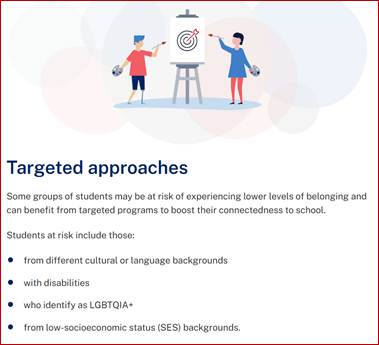
As wise educator Emily Style penned back in 1988, the curriculum should function as “both window and as mirror” to validate students’ experiences of self within the public world of the school as a strong foundation for their lives as adults in broader society. For GSD young people, the majority of whom are raised by “straight”/heterosexual, cisgender[3] parents/carers, school-based validation is even more critical. The New South Wales (NSW) curriculum encourages inclusion of diverse identity characteristics both in the classroom and at the whole-school level and gender and sexuality diversity-inclusive content options exist within many curriculum areas, including PDHPE, English, History, Society and Culture, Community and Family Studies and Legal Studies. Further, the Department acknowledges that students who identify as LGBTQIA+ (or GSD) are at risk of experiencing lower levels of belonging and benefit from “targeted programs to boost their connectedness at school” via education/curriculum, inclusive language and through educators working to curate an inclusive physical environment[4]. Additional support is provided via the “Transgender students in schools” legal issues bulletin 55 (LIB55)[5] which reminds teachers to be “inclusive of all students’ individual learning identity” and acknowledges that gender identity can be discussed across many curriculum areas.
Parents’ Attitudes to the Inclusion of Gender and Sexuality Diversity
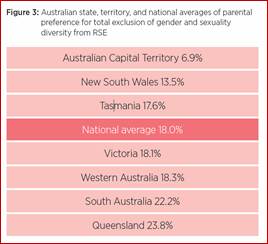
One of the most commonly reported reasons for teachers’ and school leaders’ lack of engagement with gender and sexuality diversity is their concern about parental opposition and subsequent complaint. Recent Australian survey research has addressed this point head-on, finding that 86.5% of public-school parents in NSW support the introduction of gender and sexuality diversity-inclusive topics during K-12 schooling, with most wanting these introduced by the end of Stages 3 or 4 (Ferfolja et al., 2021). Conversely, just 13.5% preferred total exclusion of gender and sexuality diversity from relationships and sexuality education. NSW parents were more supportive of the inclusion of these topics than the national average (see Ullman et al., 2021 for full, nationally representative survey results).
From: Gender and Sexuality Diversity in Schools: Parental Experiences and Schooling Responses, New South Wales Snapshot Report, available here.
Topics such as diverse romantic relationships and families; the negative impact of GSD bias-based discrimination; and understanding gender diversity were viewed by parents as necessary for creating a positive, safe and supportive school culture and preparing students for living well as adults in a diverse, socially cohesive society. Additionally, while media headlines might have us believe that gender diversity (or transgender identities) is a particularly divisive topic, 65% of public-school parents rated the “difference between biological sex and gender” as this relates to gender diversity and transgender individuals as of “moderate” or “high” importance, with just 19.5% viewing this as “not important” (Ullman et al., 2021).
Crucially, this research was nationally-representative, meaning that – rather than survey results being dismissible as the niche sentiments of those in particular locations or demographics – these findings are our closest reflection of the attitudes and preferences of the public-school parent population. While some communities might have an overrepresentation of vocal oppositional parents, most will have an abundance of supportive parents who may be far less likely to contact the school with positive feedback.
New Professional Learning Resource for Supporting GSD Students
Many teachers and school leaders want to support GSD students to feel visible and included within the school community and there are a plethora of easily-accessible online resources to support their efforts, including many offered by the NSW Teachers Federation. However, educators regularly ask for professional learning in this area, which is much more limited in availability and access.
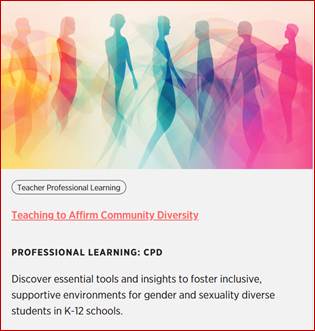
To meet this need, Associate Professor Jacqueline Ullman and Professor Tania Ferfolja, both academic researchers in Western Sydney University’s School of Education, designed the “Teaching to Affirm Community Diversity” online short course (or ‘micro-credential’). This 10-hour short course is designed with the busy educator in mind – flexibly-available and self-paced, with asynchronous engagement with the academics, and able to be used to satisfy professional learning requirements in NSW and nationally.
The course draws from current Australian research and uses federal guidance and state-based education policy to support teachers seeking to create gender and sexuality diversity-inclusive environments in K-12 schools. Through five modules, each including interactive activities, teacher-learners explore legal and policy frameworks, best practice ideas, and strategies for fostering student belonging through a supportive, safe, and affirming school climate for GSD students.
The “Teaching to Affirm Community Diversity” micro-credential is available through Western Sydney University and can be accessed here.
Drawing from empirical research with parents and GSD students, this short course bridges the gap between legal obligations, known best practices, and real-world application, and aims to increase educators’ awareness about how a positive school climate is related to GSD students’ wellbeing, academic success and sense of belonging.
By the end of the 10-hour short course, teachers and school leaders will be able to:
Identify and understand the unique challenges and experiences faced by GSD learners in K-12 settings and their families;
Apply relevant state and federal departmental policies to confidently implement inclusive pedagogical strategies and administrative practices that support GSD learners;
Address and counteract gender-based violence and bullying, fostering a school environment that supports both GSD learners and educators;
Critically reflect on and improve their own practices to create more inclusive and supportive classroom environments; and,
Critically reflect on their school’s local-level policies and work with colleagues to reshape and enact these in line with their learnings.
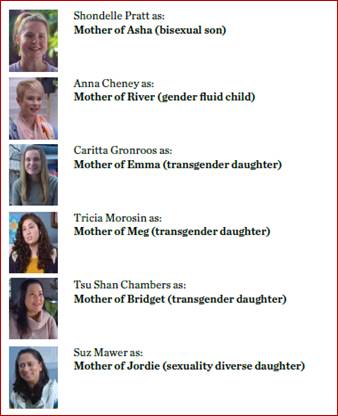
Central to the micro-credential is a short film, shown in three parts, where learners are introduced to the real-life (word-for-word, verbatim) experiences of six public school mums, parenting GSD children attending primary and secondary schools. These parents’ experiences of working with public school teachers and school leaders to support their children, shared through short films using their spoken interview data as ‘performed’ by professional actors, expose what schools and educators are doing well and where practices could be improved. Their stories are at once emotional and inspirational and offer a unique backdrop for the ‘why’ of local school policy and pedagogical reform in this area.
The six parents, as professionally acted, in the “What Parents Want: Talking about Gender and Sexuality Diversity” short film, featured in the micro-credential.
As with other areas of diversity and inclusivity, best-practice models for inclusivity of gender and sexuality diversity in schools advocate for whole-school approaches, bringing together both macro-level policy guidance documents and interpersonal, relational considerations for school community. Targeted professional learning in this area is an important, foundational element of such a shift. Importantly, it is evident that the large majority of parents want to see schools working to include GSD students – not just for the benefit of those young people, but to enhance cohesion and reduce bullying for the whole school community.
Want to Know More?
The “Teaching to Affirm Community Diversity” micro-credential at Western Sydney University is available here (https://westernx.edu.au/courses/tacd/?cl=1) and open for rolling enrolment throughout the year. Participants receive a digital badge of recognition upon completion.
Training can also be arranged in-person at the whole-school/team levels. For more information or to register your interest, please reach out to Associate Professor Jacqueline Ullman via j.ullman@westernsydney.edu.au
References
Burns, S., Saltis, H., Hendriks, J., Abdolmanafi, A., Davis-McCabe, C., Tilley, P.J., & Winter, S. (2023). Australian teacher attitudes, beliefs and comfort towards sexuality and gender diverse students. Sex Education, 23(5), 540-555. https://doi.org/10.1080/14681811.2022.2087177.
Ferfolja, T., Ullman, J., & Hobby, L. (2021). Gender and Sexuality Diversity in Schools: Parental Experiences and Schooling Responses. New South Wales – Snapshot Report. Western Sydney University. https://doi.org/10.26183/tmjr-zj59.
Ullman, J., Ferfolja, T., & Hobby, L. (2021). Parents’ perspectives on the inclusion of gender and sexuality diversity in K-12 schooling: Results from an Australian national study. Sex Education, 22(4), 424–446. https://doi.org/10.1080/14681811.2021.1949975.
van Leent, L. (2017). Supporting School Teachers: Primary Teachers’ Conceptions of Their Responses to Diverse Sexualities. Sex Education, 17(4), 440–453. https://doi.org/10.1080/14681811.2017.1303369.
About the author
Professor Jacqueline Ullman has a Bachelor of Science (English Education, Secondary) from New York University; a Master of Arts (Sociology and Education) from Teachers College, Columbia University; and a Master of Education (Research Methods) and PhD (Educational Psychology) from the University of Sydney. She began her career as a public high school English teacher in NYC before deciding to upskill with the goal of informing educational policy reform in the interests of making schools more equitable and inclusive. Professor Ullman has published more than 80 journal articles, book chapters, research reports and resources for educators’ professional learning since 2012, is in the top 1% of published academics worldwide in the field of sex education (ScholarGPS), and is a featured author on UNESCO’s Health and Education Resource Centre. Her research-based resources for classroom teachers and school leaders are featured by Australia’s federal Student Wellbeing Hub and within guidance documents for educators distributed by several other state/territory Departments of Education. Her extensive track record of consultation and professional development with schools across Sydney further attests to her understanding of the complexities of diverse school communities and the sensitivity required to successfully work with teacher, parent and student cohorts to conduct research in the areas of sexualities, gender and gender diversity, relationships and health.
Professor Tony Moore (Monash University)) gives us an update on what is currently happening with the international digital history project ‘Conviction Politics’…
Conviction Politics is a digital history project funded by the Australian Research Council and industry partners as part of the Linkage scheme. The NSW Teachers Federation, through its Centre for Professional Learning, is a major Partner Organisation in this project joining with the ACTU’s Trade Union Education Foundation, the Australian Manufacturing Workers Union and the UK Trades Union Congress.
Our project re-conceptualises convict transportation as one of the great forced global labour migrations of history, continuous with the slave trade, used to build settler capitalist colonies in Australia. It flips the narrative of a downtrodden criminal class by revealing the agency of the coerced workforce in collectively resisting this system. At the same time its focus on the transported political prisoners reveals Australian colonies vitally connected to the revolutions, ideas, movements and media innovations sweeping the Atlantic world. Harnessing the latest data mapping technologies, Conviction Politics, reveals how from the earliest days of settlement, Australia’s first work force resisted exploitation through inventive solidarity in the face of coercion, while a vanguard of transported rebels, liberal pamphleteers, industrial protesters, trade unionists, Chartists, Irish independence fighters, and radical agitators changed the political direction of the colonies.
New Book Unfree Workers reveals extent of convict resistance
Chief Investigators Professor Hamish Maxwell-Stewart (University of New England) and Emeritus Professor Michael Quinlan (University of NSW) researched and published a new book that engages a key focus of Conviction Politics: Unfree Workers: Insubordination and Resistance in Convict Australia 1788-1860 (Palgrave Macmillan, London):
It explores the role that penal transportation played in the development of capitalism in Australia as well as exploring the many ways in which the active resistance of convicts shaped both workplace relations and institutions. Drawing on two unique ‘big datasets’, the book provides both a quantitative and qualitative assessment of convict-worker resistance from the moment of their embarkation on ships bound for the Australian colonies of New South Wales and Van Diemen’s Land to their arrival and deployment into various categories of state and private employment.
The book reveals the terrain and scale of resistance by convicts. Between 1788 and 1860 there is evidence of over 11,000 collective protests (including strikes, mass absconding, go-slows and riots). Michael and Hamish conservatively estimate that in excess of 43,000 convicts participated in these actions. Using data for the entire nineteenth-century, the book places the scale of dissent by convicts in the context of later non-union and union organised industrial action by free workers.
It demonstrates that convicts dominated workplace dissent prior to 1850. This included the 1804 Castle Hill rebellion in which nearly 10 percent of the transported workforce participated. The book also reveals a marked prolonged crisis of dissent that occurred between 1822 and 1834. This was a direct response to the abolition of convict wages and the introduction of more intense work regimes in road gangs and on rural estates. The book argues that this wave of resistance eroded the cost-savings that accrued to those who sought to hire unfree labour over free, contributing to the demise of convict transportation.
Michael and Hamish show the extent to which convict actions informed subsequent struggles over working hours and other conditions of employment by free workers. Nothing in Australian history comes close to matching this activism until the titanic maritime and pastoral strikes of the early 1890s.
British Irish/Documentary shoot 2022
The ending of Covid lockdowns allowed Roar Film’s Steve Thomas and Lead Chief Investigator Tony Moore, assisted by our man in London Paul Smith, to embark on an extensive interview, location and archive shoot of the UK and Ireland in 2022.
Interviews included Trade Union Congress (TUC) General Secretary Paul Nowak, in London; Secretary South West TUC Nigel Costley (head of the Friends of Thomas Muir) in Glasgow; Dr Tim Causer from the Bentham Centre at University College London; convict author Katharine Quarmby; and leading Irish, Scottish and English historians. With help of freelance documentary crews, we captured locations across the British Isles associated with convict transportation or where democratic and labour movement activism occurred, and digitally photographed the rare collections of the People’s History Museum in Manchester.
This overseas field trip climaxed in a special presentation on Conviction Politics led by Tony Moore at the Menzies Australia Institute, Kings College London chaired by its Director Dr Agnieszka Sobocinska, and smaller presentations on the project at University College Cork and sat the Tolpuddle Martyrs Festival summer school.
Melbourne and Sydney Shoots 2021-23
The Conviction Politics team (Roar’s Steve Thomas and Aaron Wilson, Tony Moore, and Kyle Harvey) undertook extensive shoots in Melbourne and Sydney in 2023, making use of stunning locations provided by our collaborators, including Trades Hall in Melbourne, Unions NSW ‘banner’ museum in Sydney, the Hyde Park Barracks, and Cockatoo Island UNESCO convict heritage site on Sydney Harbour Sydney interviewees included Geoff Gallop, Tom Keneally, Noelene Timbery, Margaret Vosand John Dixon from the NSW Teachers Federation, Peter Lewis from Essential, John Jeremy (former CEO of Cockatoo Island dockyard), Libby Bennett (Sydney Harbour Trust), Warren Fahey from Larrikin Records, Neal Towert from Unions NSW and Prof. Nick Carter from Australian Catholic University.
Melbourne interviewees included economist Alison Pennington, Steve and Andrew Vizard, Research Fellow Dr Monika Schwarz, PhD student Daisy Bailey, and Profs. Gordon Pentland, Mark Andrejevic, Judith Brett and Andrew Reeves.
NSW Teachers Federation – Friday Forum and Other Presentations
The discoveries and media by the Conviction Politics project were unveiled on the evening of May 5, 2023 at the Federation’s Friday Forum, opened by the union’s General Secretary Maxine Sharkey, chaired by Margaret Vos with closing remarks by Kate Ambrose. This full house heard from Tony Moore, Steve Thomas, Hamish Maxwell-Stewart and Monika Schwarz, about the project’s reconceptualising of the convicts as an unfree workforce that collectively resisted exploitation and impacted both the development of Australian democracy and the early labour movement.
The audience was treated to a sample of the project’s short documentaries, its online Hub, and heard how these resources can be deployed in the classroom.
Tony’s opening speech on the project’s significance can be read here:
( See Appendix One – 2023 Friday Forum: Introductory remarks by Tony Moore)
Other Project presentations include
• The ACTU Congress Fringe Festival, June 2024
• Moreton Bay Bicentennial Symposium, Brisbane, September 2024
• at the official opening of IndustriALL, the international congress of 1,000 trade union leaders from around the world, held at Sydney’s Darling Harbour Convention Centre from 4 to 7 November 2025.
Canadian Research Trip 2023
The Conviction Politics team of Tony, Monika and Daisy presented papers and documentaries at the International Association for Media and History conference (20-22 June 2023), which was held at Université du Québec à Montréal, Canada.
The team hosted a panel discussion and screened microdocumentaries in a communal conference space. The panel demonstrated the transnational history of a shared struggle to advance democracy across various parts of the British Empire, and how the ambitious linking of digitised and analogue archives through international institutional partnerships has revealed the political agency of prisoners who had long been obscured as recidivists in individual records.
Tony then embarked on a road tour with Canadian-Australian filmmaker maker, Deke Richards, researching and photographing sites of the Canadian revolutions of 1837-38. Deke has made a major documentary Land of a Thousand Sorrows Revisited about the Québécoise rebels transported as political prisoners to Sydney, in the early 1840s.
They also met with museums in Montreal, Ottawa and Toronto and the Australian High Commission to commence discussions about Canada potentially hosting a tour of the Conviction Politics exhibition.
In 2022 Tony had joined Deke and the Canadian Consul-General André François Giroux, and Marie-Anne Alepin, President of the Saint-Jean-Baptiste Society of Montréal, in the unveiling of a series of plaques to the Canadian prisoners at the burial sights of those who did not return to their homeland, including the Dapto grave of revolutionary Joseph Marceau, who married a local girl and became a farmer and grocer in the Illawarra.
Conviction Politics Hub – Check it out
With over 80 short documentaries, combined with long and short reads, original songs, timeline, podcasts, songs, data visualisations and rich image archive the Conviction Politics Hub is now live to the public and available for use in schools and by our Partner Organisations. Go to:
A trailer about the Conviction Politics documentaries can be viewed here:
The Hub was test driven with the help of the Centre for Professional Learning. Under the guidance of Margaret Vos, in 2024 teachers undertaking the CPL course Teaching Conviction Politics learned from Steve Thomas and Professors Hamish Maxwell-Stewart and Tony Moore about the project’s academic discoveries. They also discovered how the Hub could be used in the classroom as a resource for parts of the NSW History syllabuses. During the course, in real time, Roar Film garnered valuable feedback from teachers that helped us tweak the Hub ahead of it doing public.
Please explore the Hub and provide any feedback directly to Margaret Vos at cpl@nswtf.org.au
Conviction Politics’ Unshackled Exhibition launches in Hobart
‘Unshackled: The True Convict Story’ is Conviction Politics’ culminating research
output, that launched on the 12th of March 2024 at the Tasmanian Museum and Art Gallery (TMAG). It had over 40,000 visitors in its four month run. Unshackled is a ground-breaking, multimodal experience melding traditional museum presentation with engaging storytelling, short documentaries, data-visualisation, innovative technology, original music and soundscapes with traditional museum objects. The creative approach and visitor experience has been described as ‘surprising, immersive and moving’. Its video trailer can be viewed here:
It features curated collections of key objects and images including selections from the magnificent Dempsey portraits of British working-class women and men, a collection of radical tokens, reproductions of radical posters and cartoons from Britain, Ireland and Australia.
A highlight of the exhibition is a life size reproduction of the portable solitary ‘box’ used on the female convict transport ships. Interactive screen-based media, large projections and augmented reality lead the visitor through the exhibition themes: Repression, Exploitation, Resistance & Redemption. These media installations are complemented by real objects to provide a truly unique museum experience.
Please see here the professional photographs of the Unshackled exhibition and launch provided by Tasmanian Museum and Art Gallery available at this URL:
Here’s link to the exhibition web app visitors use on their smart phones while at the exhibition that provides more information about the solid objects, accesses the short documentaries by theme that appear on screens in the exhibition, and provides images and information on characters and events, including AI generated talking portraits:
The exhibition shows how one of the nineteenth century’s largest forced migrations of unfree workers was preserved in time by a remarkable set of records and demonstrates that far from being a downtrodden, supplicant workforce, convict men and women fought back against tyranny and exploitation and changed Australia for the better.
Unshackled is designed, curated, and built by the project through its principal exhibiting Partner Organisation, Roar Film, working closely with TMAG. Thanks Steve Thomas, Matt Daniels Tony Moore, Daisy Bailey and Hamish Maxwell-Stewart. As well as the generous support to the project from NSW Teachers Federation and the ACTU, the exhibition has been made possible by generous sponsorship from the Mining and Energy Union, its Mineworkers Trust and Maurice Blackburn Lawyers, with the later becoming a new partner of Conviction Politics.
A travelling ‘pop up’ version of Unshackled that can be assembled in a day has also been produced, and the plan is for it to be assembled at the NSW Teachers Federation building in tandem with a suitable conference event in 2026.
Unshackled will tour from 2025-2027 to Sydney, Brisbane, Melbourne, Queensland’s Bowen Basin, the Hunter, Illawarra, North Tasmanian and overseas to Dorchester, London and Cork.
A Stitch in Time
A different bespoke exhibition focused on resistance by Tasmanian female convicts called a ‘A Stitch in Time’, was ‘created by Conviction Politics research fellow Monika Schwarz and was launched at the Penitentiary Chapel in Hobart in June 2023. The exhibition features 18 ‘data embroideries’ created by Monika of 21 convict women chosen for their participation in protest and resistance, especially in the Female Factories.
This project uses data embroidery, a new form of data physicalisation, to display historical life courses of Australian female convicts. The source of the data includes the female convict records of Van Diemen’s Land kept by the British Bureaucracy, including their trial and voyage, their colonial offences and sentences, their marriages and births or their official status like receiving a Certificate of Freedom. These data titbits inspire the sketches for the data embroideries, focusing on acts of resilience or resourcefulness. The data is integrated in the form of a lifeline with the inspiring data points highlighted in colour. The embroideries try to capture moments where the women’s personality is shining through the records, showing that these women weren’t so different from us. Here are two examples.
Daisy Baily Awarded Doctorate
In early 2025 Conviction Politics’ Monash PhD student Daisy Bailey submitted her Thesis: Emotions of Activism and Exile: A study on Chartist and Young Ireland political prisonerstransported to the Australian colonies in the nineteenth century
The work was praised for its originality, discoveries and writing by the two examiners, and accordingly passed by Monash. The project congratulates Dr Baily and looks forward to the thesis being published as a book.
Unshackled: The Convict Memorial
In partnership with the National Trust of Tasmania, Professor Hamish Maxwell-Stewart, Steve Thomas and Roar Film’s creative technologist Matt Daniels installed the digital convict memorial in Hobart Penitentiary Chapel Historic Site in October last year. Sharing the brand name Unshackled, the memorial links to, and visualises, the UNESCO Heritage Listed Tasmanian convict records held by project partner Libraries Tasmania.
Powered by the Digital History Tasmania convict dataset, the digital memorial tells the stories of 75,000 convicts through a four-metre interactive obelisk that performs a role not unlike the honour wall of a war memorial. Hamish Maxwell-Stewart reports that “feedback from data visualisation, tourism and heritage experts has been overwhelmingly positive and the descendants of convicts report that the experience is respectful and deeply moving.”
New funded ARC Project: Making Crime Pay
Building on, and enhancing, the memorial this new 2023 project includes Monash academics Prof. Jon McCormack (SensiLab), Prof. Tony Moore and Research Fellow Dr Monika Schwarz who worked on Conviction Politics, as well as Dr Jenny Wise, Associate Prof. David Roberts and Prof. Martin Gibbs from the University of New England. The project aims to create digital tools to allow visitors to experience Australian convict sites and historical big data in new and novel ways. The successful grant awarded to Making Crime Pay enables further analysis and public engagement with convict records and colonial history, the longevity of Unshackled and the continued collaboration with Roar Film and National Trust Tasmania.
Appendix 1 – 2023 May 5 Friday Forum: Introductory remarks by Tony Moore
Thanks Margaret Vos, Kate Ambrose and Maxine Sharkey and the NSW Teachers Federation for inviting us.
The NSW Teachers Federation has been a generous and energetic partner in this project, and shares with our other union partners (the ACTU, TUC and the AMWU) a commitment to retrieving the contribution of the convicts to the early development of democracy and the labour movement in this country. Also Principals Conference.
What the project is
Conviction Politics is a digital history project funded by the Australian Research Council and industry partners as part of the Linkage scheme. It investigates how Britain’s Australian colonies – beginning as some of the most unfree and unequal jurisdictions on earth – became some of the first polities to give all working men the vote by the 1850s and in quick time earned a reputation as the social laboratory of the world.
The answer is to be found in newly digitised convict records, which reveal a very different story of the empire-wide struggle for political and human rights and the unlikely victory of Britain’s reformers and radicals in their place of exile. Harnessing the latest data mapping technologies, Conviction Politics, reveals how from the earliest days of settlement, Australia’s first work force resisted exploitation through inventive solidarity in the face of coercion, while a vanguard of transported rebels, liberal pamphleteers, industrial protesters, trade unionists, Chartists, Irish independence fighters, and radical agitators changed the political direction of the colonies.
Our project re-conceptualizes convict transportation as one of the great forced global labour migrations of history, continuous with the slave trade, used to build settler capitalist colonies in Australia. It flips the narrative of a down – trodden criminal class by revealing the agency of the coerced workforce in collectively resisting this system. At the same time its focus on the transported political prisoners reveals Australian colonies vitally connected to the revolutions, ideas, movements and media innovations sweeping the Atlantic world. To put it in Star Wars terms, there’s not just an evil empire, but a rebel alliance too, and its exiled leaders and foot soldiers make quite a mark in Australia and back in Britain and Ireland. The project reveals this new take on convict Australia through an array of media that we will sample tonight.
Indigenous People:
Notwithstanding the role of convicts in the seizure and occupation of the First Nations’ land in Australia, there is also a shared experience here, between Indigenous people and the transported convicts. Unrest in Britain, Ireland, and throughout the empire was triggered by capitalist commodification, land enclosure, colonialism within the British Isles and the destruction and disenchantment of traditional ways of life. The invasion of the Australian continent brought the same dislocating forces to bear on the Indigenous people of Australia, who fought against this dispossession, with many internally exiled into the convict system, from where they continued to resist. There was violence and death, with convicts used to dispossess. Indigenous land was stolen for the land hungry of Britain and Ireland, that helped the rulers avoid a revolution back home. However, our project reveals some remarkable acts of recognition and solidarity between Indigenous people and European convicts.
Developing the project’s application, we took heart from the Sally McManus’ comments in March 2017 that sometimes it is necessary to resist unfair and unjust laws. It is a key proposition of Conviction Politics that political and social democracy was not simply ceded to the Australian colonies by a caring mother country, but had to be fought for by brave, principled and persecuted people, first in their home countries and then again as convicts.
The project looks at 2 groups. At least 3600 protestors, reformers, radicals and revolutionaries sacrificed their own liberty, and sometimes their lives, for the freedoms and rights we take for granted. Meanwhile the 160,000 convicts who composed our first workforce undertook collective action to resist exploitation of its unfree labour through insubordination, absconding, uprisings, refusals to eat, strikes, and forming union -like combinations from at least the 1820s. Conviction Politics examines both these groups.
So often in the period we’re examining we find that it was new laws buttressing a new economic system that created the crimes. While many such as the United Irishmen took up arms in revolution against the Crown, both at home and then in Castle Hill, Sydney, others were transported simply for what they wrote, said or published. So many British workers, known to history by colourful names like Luddites, Swing Rioters, Tolpuddle Martyrs and Daughters of Rebecca, smashed the machines that were taking or automating their jobs, or demolished the tolls and turnpikes that heralded the privatization of the roads and commons they had travelled free for centuries. Still others were transported simply for coming together in a trade union.
Conviction Politics puts into practice the powerful injunction of media scholar Raymond Williams that drawing a new line with the past can inform contemporary social change. To that end, the scholars and partners in this project mobilise history to speak to our present moment. We consider the persistence from the colonial period of problems that drove our convicts to resist: precarious, insecure, and coerced work; decline in wages: our current cycle of automation: privatisation; our use surveillance and facial recognition; threats to freedoms in speech, media, and assembly; and the ease with which we incarcerate the marginalised. Most importantly we look at the unfinished work of decolonisation in Australia, not just for Indigenous people, but of us all.
We will now watch the first of our short documentaries about the Indigenous Convicts
About the author
Dr Tony Moore is Professor of Communications and Media Studies at Monash University and former Director of its National Centre for Australian Studies. Tony is author of the critically acclaimed Fringe to Famous: Cultural Production in Australia After the Creative Industries (Bloomsbury 2024) Dancing with Empty Pockets: Australia’s Bohemians since 1868 (2012), Death or Liberty: Rebels and Radicals Transported to Australia 1788 – 1868 (2010), adapted as an ABC TV documentary (2015) and The Barry McKenzie Movies (2005). Tony is lead investigator on the ARC the ARC Linkage Projects Conviction Politics: the convict routes of Australian democracy (2019-2025): https://www.convictionpolitics.net and Comedy Country: Australian Performance Comedy as an Agent of Change (2022 – 2027)
He is a former ABC TV documentary maker and commissioning editor at Pluto Press and Cambridge University Press and worked in youth policy and advocacy for the Education Commission of NSW, International Youth Year and Youth Affairs Council of NSW. His documentaries include Bohemian Rhapsody: Rebels of Australian Culture, TimeFrame history of ASIO, Lost in Space: Australians in their Cities and Nobody’s Children.
In this course you will develop a practical understanding of modern assessment theory and look at strategies for promoting and assessing higher order thinking skills in your students. We will focus on two assessment formats: multiple choice, and performance-based items, and consider the purpose and design of rubrics. We will look in depth at the advantages, disadvantages, tricks, and pitfalls of these different styles, emphasising the interrelationship between learning and assessment.
Professor Jim Tognolini and Dr Sofia Kesidou from the University of Sydney’s Centre for Educational Measurement and Assessment lead an interactive and content-driven professional learning day. Completing this course will consolidate your expertise in helping your students develop analytical, evaluative, and creative skills.
Please note this course was formerly called Modern Assessment Theory and Assessment Strategies for Higher Order Thinking: K-12.
Tuesday 11 August 2026 at NSW Teachers Federation, Surry Hills
Wednesday 26 August 2026, online via Zoom
Wednesday 11 November 2026 at Blacktown
All CPL courses run from 9am to 3pm.
Prof Jim Tognolini
Professor Jim Tognolini is Director of The Centre for Educational Measurement and Assessment (CEMA) which is situated within the University of Sydney School of Education and Social Work. The work of the Centre is focused on the broad areas of teaching, research, consulting and professional learning for teachers.
The Centre is currently providing consultancy support to a number of schools. These projects include developing a methodology for measuring creativity; measuring 21st Century Skills; developing school-wide practice in formative assessment. We have a number of experts in the field: most notably, Professor Jim Tognolini, who in addition to conducting research offers practical and school-focused support.
Dr Sofia Kesidou
Sofia Kesidou is an executive leader and academic researcher with close to 30-years’ experience in international educational assessment, curriculum and research.
Sofia has taught courses in assessment to undergraduate and graduate students, and has conducted numerous professional-development sessions related to standards-based curriculum and assessment as well as assessment and data literacy internationally.
Completing Modern Assessment Theory and Assessment Strategies for Higher Order Thinking: K-12 will contribute 5 hours of NSW Education Standards Authority (NESA) Accredited PD in the priority area of Delivery and Assessment of NSW Curriculum/EYLF addressing standard descriptors 5.1.2 from the Australian Professional Standards for Teachers towards maintaining Proficient Teacher Accreditation in NSW.
K-12 teachers
$220
Please note, payment for courses is taken after the course takes place.
“Great learning to empower teachers to be better professionals and create better outcomes for students, strengthen the profession.”
“A very practical course to use for the planning and implementation of classes with the intention of improving assessments/evaluating/testing for the students.”
“Every aspect of this course was informative and useful. I’ve had an opportunity to think about what has been presented and engage in collegial discussion.”
This course is designed for teachers who are interested in building practical skills around differentiation and inclusive planning for a mainstream context K-TAFE. Participants will look at the timeline of disability within the school context and see how over time changes have taken place (or not). Teachers will expand their strategies and skills in meeting the needs of students with disabilities in various settings to support positive and successful learning and engagement.
K-TAFE teachers who are interested in unpacking their understanding of inclusion and increase their strategies and skills in supporting a wide range of students with disability in their classroom.
25 February 2026 at NSW Teachers Federation, Surry Hills
5 March 2026 at Suite 1.04, 1 Lowden Square, Wollongong, NSW 2500
26 March 2026 at Wagga Wagga RSL
6 May 2026 at Tamworth
16 June 2026 at Broken Hill
6 August at Canberra
5 November 2026 at Newcastle
All CPL courses run from 9am to 3pm.
$220
Please note, payment for courses is taken after the course takes place.
John Skene was elected as the NSW Teachers Federation Disability Officer in November 2024. As part of this role, he is responsible for supporting students, staff and schools in disability. He is working closely with the other areas in Federation (Organisers, Professional Support, Trade Union Training) to support Federation members.
With over fifteen years of experience as a teacher in special education, John has worked at Schools for Specific Purposes (SSPs) and Support Units (SUs). He has held roles such as Federation Representative and Assistant Principal Special Education. John was a Councillor and the Special Education Contact of Sutherland and Inner-City Teachers Association (across his time in school).
Bianca Bertalli considers the ‘media minefield’ and the benefits of collaborative teaching to facilitate students’ media literacy. . .
The internet has revolutionised the way people seek and use information. It has enabled faster and easier communication, facilitated the global trading of goods and ideas, and integrated access to information with everyday life. These rapid changes are reflected in classroom practice, where technology has transformed the tools available to teachers and students (Haleem et al., 2022). However, as access to information has grown, so has the proportion of misinformation available to consumers. Fake news, algorithm powered bots and organised troll groups are some of the common channels of misinformation likely to be encountered by today’s students.
Classroom teachers and teacher librarians play a key role in teaching students how to critically evaluate information. By developing collaborative practices in inquiry learning, teacher librarians can align learning with this need and support colleagues through an unprecedented era of online content creation and consumption (Australian School Library Association [ASLA], 2019; NSW Department of Education, 2022).
Misinformation vs disinformation
The term ‘misinformation’ infers an overarching invalidity of information, however other fundamental components are also at play in online content. Misinformation can be shared or spread unwittingly, or it can be categorised as ‘disinformation’ and deliberately circulated for financial gain or political advantage (Australian Communications and Media Authority, 2023; Harrison and Leopold, 2021). Ranked by severity, in terms of the negative social, economic, and environmental impact, mis/disinformation ranked 16th out of 32 imminent global risks identified by the World Economic Forum (2023). Worryingly, when considered in a long-term 10-year projection, mis/disinformation advances to 11th position. While the impact on young people has not yet been widely examined, the prospect of mis/disinformation as a global threat is particularly concerning, given that it ranks well ahead of dangers such as terrorist attacks or the use of weapons of mass destruction (World Economic Forum, 2023, p 11).
The media: fusion of fact and opinion
The emergence of ‘alternative facts’ and the recurrent sharing of unchecked information throughout the COVID-19 pandemic highlighted the prevalence of misinformation in the media. It also increased concern globally on the cause and effect this may have on young people (Howard, Neudert and Prakesh, 2021). False news and media bias have the potential to undermine confidence in political personalities and influence democratic processes (Hobbs and McKnight, 2014; Nettlefold and Williams, 2018). The way news media is framed can underrepresent, misrepresent or purposefully exclude specific groups of people (Meehan et al., 2015; Moyer, 2022).
Mis/disinformation can also ignite and spread polarising ideas and threaten ‘social cohesion’ (World Economic Forum, 2023, p 24). Harrison and Leopold (2021) acknowledge that while political agendas are often the driving force behind media, financially incentivised click-bait headlines also make it tempting for media to give precedence to content that will draw readers in, rather than present accuracy.
The often-imperceptible fusion of fact and opinion across news media, combined with the reach and saturation of a small number of news corporations, places Australian school students at risk of information overload without a way to critically evaluate their way out (Nettlefold and Williams, 2018).
In a study of 1,000 Australians aged 8-16 years, Notley and Dezuanni (2020) found that despite an 8% increase in news consumption since 2017, there was only a 2% increase in the number of students who felt they could distinguish fake news from real news. Even though the broad consensus of teachers agreed that engaging with news in a critical way is important for students, only 1 out of 5 Australian students said that they had been taught how to decide whether a news story was credible (Nettlefold and Williams, 2018; Notley and Dezuanni, 2020).
Beware the bots
Through carefully created algorithms, internet ‘bots’ (originating from the word ‘robot’) have changed the way information is curated for search engines and can deliberately alter the way in which information is prioritised for viewing (Head et al., 2020; Nettlefold and Williams, 2018; Rogers-Whitehead et al., 2022). Bots and algorithms are neither good nor evil, as their function and impact are determined by those who designed them (Head et al., 2020; Lutkevich and Gillis, 2022). They do, however, have the power to alter the flow of data and influence an internet user’s experience (Alemanno, 2018; Rogers-Whitehead et al., 2022).
It has been estimated that bots make up more than two-thirds of internet traffic (Barracuda, 2021; Rogers-Whitehead et al., 2022). For example, over a 6-month period in 2020, COVID-19 related tweets were collected and analysed. Carnegie Mellon University (CMU) researchers found that 82% of the 50 most influential retweeters were in fact bots (CMU, 2020). This inundation of mis/disinformation and polarising messaging spread by bots can have alarming consequences, including risks to public debate and democracy or increased hostility, violence or crime (CMU, 2020; Howard et al., 2021).
While students prefer search engines, such as Google, as their primary source of research information, they often have a misplaced trust in it, believing that search results are provided, or fact checked, by a human employee (Dring, 2014; Lane and Van Bergan, 2018; The Office of Communications [OFCOM], 2017). Instead, web-crawler bots provide a curated list of website suggestions in response to search queries and, although students may believe sources are listed in order of validity, bots order results based on other factors, such as the frequency of visits to a site or the quantity of pages that link to a site (Cloudflare, n.d.). Google also lists paid search results that can be difficult for students to distinguish (OFCOM, 2017).
Complex algorithms further construct an individual’s online experience from data harvested through each engagement. The way in which algorithms present increasingly extreme viewpoints through ‘Watch Next’ suggestions on YouTube (Moyer, 2022) or other algorithm-driven content, such as personalised news feeds, advertisements or friend suggestions, makes it difficult for students to separate fact and fiction online (UNICEF, 2021). Rogers-Whitehead et al. (2022) warn that, as children grow and more seamlessly engage with technology, they will become ‘even more accustomed to outsourcing their information seeking and “truth” to devices’ (p 7).
Crossing the troll bridge
The internet dominates the channels that humans use to communicate and share information, and while propaganda is not a new concept, content specifically created to propagate ideologically-driven conflict has grown exponentially. When a student views an idea or message frequently, they often misinterpret this as an indicator of truthfulness (Moyer, 2022; Howard et al., 2021). At times, these messages are created by trolls, people who intentionally initiate hostility and conflict, often using mis/disinformation as their chosen weapon (Bradshaw and Howard, 2017; Howard et al., 2012).
The efficacy of organised troll groups in gaining political influence was investigated in an Oxford University study by Bradshaw and Howard (2017), who coined the phrase ‘cyber troops’ to describe ‘government, military or political party teams committed to manipulating public opinion over social media’ (p 3). They found that, across at least 28 countries, coordinated efforts were made to engage in social media platforms to sway or stifle discussions or consciously spread disinformation.
Practical solutions: a collaborative approach
Inquiry learning, including media literacy, is fundamental to the Australian Curriculum (ACARA, n.d). The rationale in the Media Arts learning area, for example, states that: ‘students learn to be critically aware of ways that the media are culturally used and negotiated, and are dynamic and central to the way they make sense of the world and of themselves’ (para. 3). More specifically, subject content descriptions provide scaffolds to assist students’ deep learning. For example, the content for Year 4 HASS (Humanities and Social Sciences) is driven by a number of ‘inquiry questions’ and divided into two strands: ‘knowledge and understanding’, and ‘inquiry and skills’. In particular, the ‘researching’ and ‘analysing’ skills require students to ‘locate and collect information and data from different sources,’ and ‘identify different points of view and distinguish facts from opinions.’ In various iterations that differ in complexity, the same questions and skills drive student learning in HASS from Foundation to Year 7.
In NSW, across the range of syllabuses, and at all stages, students are required to independently research and analyse information in various online and offline contexts, making it crucial that they are given the opportunity to develop skills that enable them to critically engage with information. The Stage Statements for Geography K–10 (NESA, n.d.), for example, provide a continuum of learning focused on inquiry and students’ ability to effectively consume and produce information. Lane and Van Bergen (2018) note that, as students compare, contrast and critically evaluate sources through the inquiry process, they become more adept at identifying mis/disinformation.
Despite universal recognition of the importance of media literacy, the current combined responsive efforts of media policy, regulation and educational practices to facilitate media literacy are predicted to fall short in addressing the projected global threat of mis/disinformation (World Economic Forum, 2023). However, with information technology acting as the ‘primary driving force behind education reform’ (Haleem et al., 2022, p 1), the need to increasingly assess the validity of information presents teachers and teacher librarians with a powerful, collaborative opportunity.
Teacher librarians can support classroom teachers and help bridge the knowledge gap to teach students media literacy skills (Nettlefold and Williams, 2018) by providing both in-context instruction shaped around the Information Fluency Framework (NSW Department of Education, n.d., PDF 900 KB) and curriculum-aligned resources. Britannica Education (2024), for example, offers a freely available online Media Literacy Guide, which unpacks media literacy metalanguage and provides helpful activities to encourage students to develop their critical information literacy across various platforms. Similarly, the ABC Education’s (2024) Media Literacy online hub of videos and interactive activities covers a broad range of topics, including social media, news bias, media ethics and fact checking.
Misinformation presents a ubiquitous threat for our young people. It is essential that classrooms and school libraries operate as spaces where information, innovation, and inclusion are deeply valued and fabrications, alternative facts and fake news are widely challenged. Working together, teachers and teacher librarians have a responsibility to cultivate students’ media literacy skills, develop inquiry-based models of learning, and foster practices that continuously build the information fluency of students.
Abu Kausar, M., Dhaka, V. & Singh, S. (2013). Web crawler: a review. International Journal of Computer Applications, 63, 31–36. https://doi.org/10.5120/10440-5125
Australian Curriculum and Reporting Authority. (n.d.). Structure.
Alemanno, A. (2018). how to counter fake news? A taxonomy of anti-fake news approaches. European Journal of Risk Regulation, 9(1), 1-5. https://doi.org/10.1017/err.2018.12
Australian Communications and Media Authority. (2023, March 29). Online misinformation.
Bauer, A. J., Nadler, A. & Nelson, J. L. (2022). What is Fox News? Partisan journalism, misinformation, and the problem of classification. Electronic News, 16(1), 18–29. https://doi.org/10.1177/19312431211060426
Haleem, A., Javaid, M., Qadri, M. A. & Suman, R. (2022). Understanding the role of digital technologies in education: a review. Sustainable Operations and Computers, 3, 275–285. https://doi.org/10.1016/j.susoc.2022.05.004
Hobbs, M. & Mcknight, D. (2014). “Kick this mob out”: the Murdoch media and the Australian Labor government (2007 to 2013). Global Media Journal: Australian Edition, 8, 1–13.
Kammer, J., Donahay, A., King, M. & Koeberl, H. (2021). Understanding what makes school librarian-teacher collaboration successful. Knowledge Quest, 50(1), 50-52.
Rogers-Whitehead, C., Milstead, A. O. & Farris-Hill, L. (2022). Advocating digital citizenship: resources for the library and classroom. Libraries Unlimited.
Bianca Bertalli is currently a NSW Department of Education Specialist Teacher Scholarship recipient, completing her post-graduate Masters of Education (Teacher Librarianship), and working as Teacher Librarian K-6, at Gol Gol Public School in the Rural Far West. Bianca began teaching in 2010, as a classroom teacher in the inner city of Sydney, where she previously served as an elected government school representative on the Quality Teaching Council. Bianca has presented at courses and conferences to support early career teachers to develop skills in classroom management, planning/ programming and the accreditation process. She has been an active member of the NSW Teachers Federation for the past 16 years.
Fiona Beasley shares her research into trauma informed practice…
More and more, schools are recognising the need to support both students who have experienced trauma as well as the teachers who work with them every day. Research shows that children who go through tough experiences like abuse, neglect, or family struggles often face challenges in learning, behaviour, and relationships. They may struggle with focus, managing emotions, or getting along with others, and some may develop anxiety, depression, or other mental health concerns. Without the right support, these difficulties can lead to school suspensions or even expulsions.
Being trauma-informed means understanding how these experiences affect students and learning how to create a supportive, safe environment where they can thrive. This article covers ten important things teachers should know about trauma-informed practices to help every student feel understood, valued, and ready to learn.
1. What is trauma?
The most commonly used definition of trauma is that from the Substance Abuse and Mental Health Services Administration (Trauma and Violence – What Is Trauma and Its Effects?, n.d.) SAMHSA recognises trauma as an event, or set of circumstances, that is experienced by an individual, resulting in physical, emotional and/or life-threatening harm. The event may be an accident, long term illness or natural disaster that results in someone feeling unsafe and unstable. It could be a one-time event, such as a car accident, on an ongoing event, such as prolonged neglect. Ongoing trauma, over a long period of time, creates toxic stress. Chronic or toxic stress, brought on by trauma, is the long term-activation of the body’s stress response.
2. How prevalent is trauma?
Australian Child Maltreatment Study (Haslam et al., 2023) found more than 2 in five Australians (39.4%) have experienced childhood maltreatment, including physical abuse, sexual abuse, emotional abuse, neglect, and exposure to domestic and family violence. The NSW Governments DCJ Quarterly Statistical Report on Services for Children and Young People – July – September 2024 (NSW Department of Communities and Justice, n.d.) identified:
A total of 104 687 child and young person concern reports were received. Of these 58.1% met the risk of significant harm (ROSH) threshold.
A total of 527 children and young people entered Out of Home Care (OOHC). This is an increase of 8.2%.
As of 30 September 2024, a total of 13 889 children and young people were in OOHC in NSW.
There were 351 children and young people in High Cost Emergency Arrangements (HCEA) at the end of September 2024.
It is important to note that this data relates to circumstances of harm that have been reported. It does not take into account other events identified as contributing to trauma. We can also make assumptions that these statistics are lower than the real number of children who may be experiencing maltreatment or abuse as a result of under-reporting.
3. What does trauma look like in schools
Our brains are developed to help us respond to threat. Children who have experienced trauma, perceive the world as a dangerous place. Their brains are on high alert and may appear to overreact to what may seem to those around them, as unthreatening stimuli, resulting in behaviours that can be characterised as fight, flight, freeze or fawn. These automatic responses can be defined as reacting to a perceived threat through:
Fight – responding aggressively
Flight – trying to flee
Freeze – an inability to move or act
Fawn – trying to please in order to avoid the threat.
Children who have been exposed to traumatic events resulting in experiencing toxic stress are at far greater risk of difficulties in school. Notably, the impact that trauma can have on brain development, particularly that resulting in toxic stress, leads to cognitive and social-emotional difficulties.
Downey et al. (2013), in the resource developed for the Victorian Child Safety Commissioner identified the most recognisable impacts on education under two intertwining categories.
Impacts on academic performance
Impacts on social relationships
Reduced cognitive capacity
Need for control
Sleep disturbance
Attachment difficulties
Difficulties with memory
Poor peer relationships
Language delays
Unstable living situation
4. Self-regulation can be challenging for students who have experienced trauma
For students who have been through trauma, self-regulation can be especially tough. Their struggles with schoolwork and social interactions are often made worse by difficulties managing their emotions and deep feelings of shame.
Emotional Dysregulation: Hyperarousal vs. Dissociation
Kids dealing with trauma often show emotional dysregulation in one of two ways—hyperarousal or dissociation.
· Hyperarousal means being on high alert all the time. These kids may see neutral situations as dangerous, reacting with fear or defensiveness. Even though their bodies are geared up for danger, they’re not always good at recognizing real threats, which can lead to risky behaviours. Plus, being in this constant state of alertness makes it incredibly hard to focus or pay attention in class.
· Dissociation is the opposite—these kids may seem zoned out, distant, or emotionally unreachable. Sometimes, they might even appear defiant or oppositional when, in reality, they’re just mentally shutting down as a coping mechanism.
The Weight of Shame
For children who have experienced trauma, feelings of shame can be overwhelming. A small mistake or a simple disciplinary action can make them feel like failures or even like they’re inherently “bad.” This shame can fuel emotional outbursts and make it even harder for them to regulate their emotions, sometimes leading to aggression as a way to cope.
Understanding these challenges is key to helping trauma-affected students navigate school and social situations with the support they need.
5. Kids who have experienced trauma are not going out of their way to push your buttons.
Children who have experienced trauma can develop maladaptive strategies as a means of maintaining personal safety. Dr Ross Greene puts it very simply as, “Kids do well if they can.” (2008) He identifies that rather than taking the view that kids do well if they want to, suggesting a lack of motivation, we should take the view that if a kid could do well, they would. Kids who struggle, who are challenging, are lacking the skills required to do so. Dr Greene goes on to say that challenging behaviour is most likely to occur when the expectations being placed on them outweigh the skills they have to respond adaptively.
6. We don’t always know what is happening when kids are not at school.
We don’t always know what experiences children bring to school. A child who runs late to school may be met with a reprimand and questions for why they are late. What about the child who rarely seems organised and never has the right equipment or fails to bring back excursion notes on time. Consider the iceberg analogy. We can see the tip of the iceberg, but what is hiding beneath the surface? The child who is reprimanded for being late spent the morning getting siblings ready for school and trying to scrounge together food for their breakfasts and lunches while their parent remained in bed, unable to get up due to the debilitating depression they are experiencing. Rather than reprimanding the student for being late, consider responding with compassion and empathy. This child has managed to get themselves to school despite the challenges they may be facing.
7. Build relationships
Understanding the impact that traumatic events can have on the developing brain helps us to understand what children need to heal. Although negative early experiences such as poor attachment have a negative impact on the brain, conversely, relationships can have a protective and reparative impact. The importance of relationships in healing cannot be understated. Whilst therapeutic interventions may be essential, genuine relationships resulting in micro moments of positive regard can be transformational for a child’s healing. It is the countless relational experiences that kids experience at school on a daily basis, both intentional and unintentional that have the greatest impact. (Australian Childhood Foundation, 2018; Ludy-Dobson & Perry, 2010)
“The more healthy relationships a child has, the more likely he will be to recover from trauma and thrive. Relationships are the agents of change, and the most powerful therapy is human love.” (Perry, 2007)
8. Use restorative practices rather than punitive discipline
Punitive discipline results in kids feeling shame and isolation for making mistakes as well as perpetuating the idea that they are bad. For students who have experienced trauma this can be particularly damaging and potentially re-traumatising. This type of discipline relies on control over care with an over-reliance on compliance, rather than understanding.
Restorative practice promotes a safe school culture and environment by helping to build positive relationships. Restorative practices are not about giving kids a free pass. “It recognises that a variety of factors influence behaviour and seeks to address the underlying influences through empathy, relationship-building, communication, social and emotional learning and finding ways to respectfully hold one another accountable”. (NSW Department of Education Wellbeing, 2025)
A new professional learning course developed in collaboration with leading experts in the field is now available on-demand from the NSW Department of Education. (Wellbeing, 2024)
9. Take care of your own wellbeing first.
The most important point to remember when working with children who have experienced trauma is the demands of this work. This can take its toll on the wellbeing of teachers in the form of compassion fatigue as a result of working day after day with children who may be aggressive or withdrawn and do not respond as quickly to the usual positive regard shown by teachers. They cannot continue to support the wellbeing of others unless individually and collectively we consider the wellbeing of the teachers themselves.
Downey et al. (2013) suggests three strategies for self-care, being reminded by the three R’s: Reflection, Regulation and Relaxation
Reflection – be realistic about working with students who have experienced trauma as it can be very difficult to like and relate to them. Consider reflecting on their behaviour in light of what you know about trauma and try to understand the behaviour from the perspective of what has happened to them rather than what is wrong with them. Think about what you may need to continue to work and connect with the student. Ensure you have a trusted colleague you can debrief with.
Regulation – Be mindful of how this work may trigger your own dysregulation. Reflect on what it is you need to self-regulate. You cannot support the regulation of students if you are dysregulated. Be aware of your own triggers and the reactions and emotions they may invoke. You have probably heard the quote by L. R. Knost “When little people are overwhelmed by big emotions, it’s our job to share our calm, not join their chaos.” We cannot help children learn to self-regulate if we add our emotions to the mix.” (Kansas, 2023).
It is important that there is a culture of safety within your school that means you can tap out when needed, no questions asked. You need to be able to ask for help without judgement. It is not a reflection on your abilities as a teacher, but more how hard this work really is.
Relaxation – just as important as reflection and regulation is being able to relax. Having the time and space to engage in activities or past times that refresh and renew your energy. Ensure that you are engaging with things that are of interest to you, the things that bring you joy. Engage in Yoga, mindfulness, read a book, go for a hike, binge watch a favourite show, get a massage. Whatever you do, it is what brings you peace and joy.
Most importantly, remember to be patient and forgiving of yourself. Children who have experienced trauma and have disrupted attachment require time to change and being kind to yourself is necessary within a culture of safety and social support in your school.
End note
This JPL article is based upon Fiona’s 2024 Eric Pearson report entitled Trauma Informed Practice: An Observation of the Elements Required to Sustain Practice.
Federation members can access this document through the Member Portal :
Greene, R. W. (2008). Lost at School: Why Our Kids with Behavioral Challenges are Falling Through the Cracks and How We Can Help Them. https://ci.nii.ac.jp/ncid/BB18318146
Kansas, C. C. a. O. (2023, August 21). When Little People are Overwhelmed by Big Emotions. Child Care Aware. https://ks.childcareaware.org/when-little-people-are-overwhelmed-by-big-emotions/
Perry, B. D. (2007). The Boy Who Was Raised As a Dog: And Other Stories from a Child Psychiatrist’s Notebook. https://openlibrary.org/books/OL17210964M/The_boy_who_was_raised_as_a_dog
Fiona Beasley began teaching as an Itinerant Support Teacher (Hearing) in 1996 in Mudgee. Since then, she has worked in both mainstream and special education settings in primary schools in rural and remote areas from Broken Hill to the far south coast as a teacher, Assistant Principal and relieving Principal.
She has also worked in and out of corporate roles as a Non-School Based Teacher since 2007. Prior to her current role, as Wellbeing Systems Support Advisor, she worked in the Nationally Consistent Collection of Data on Students with Disabilities in Schools (NCCD) team and substantively holds the position of Assistant Principal Learning and Support for the Batemans Bay Network of schools.
Fiona is an experienced presenter of the Department of Education’s Trauma Informed Practice for improved learning and wellbeing professional learning.
She completed an Eric Pearson Study Grant report on Trauma-Informed Practice: An Observation of the Elements Required to Sustain Practice in 2024.
In addition, she presented her work at the Trauma Aware Education Conference in Brisbane Queensland in 2024 and will undertake QUT’s new Microcredential in Trauma Aware Education as part of the first intake in July.
Denis Fitzgerald reflects on why it is wonderful to be a public school teacher . . .
Being a public school teacher today is more demanding that at any time in history. The workload is intense. The needs of our students are more complex than ever. Parental expectations are sometimes unreasonable and contradictory. Media commentary is oftentimes loud, derogatory, and ill-informed. Change is a constant. Praise is not.
Yes indeed, what is so great about being a public school teacher?!
We might step back into the past to begin to examine this question.
In the western tradition formal learning is understood to have begun with the Ancient Greeks. Teachers such as Isocrates and Plato launched their private academies with exceedingly small and selective intakes. Education was to be predominantly for males and non-slaves. Peasants commonly had an extremely limited education. Girls stayed in the home to prepare themselves for a lifetime of subordination. The curriculum in the academies was narrow and tended to emphasise what were regarded as the masculine virtues and attributes along with a smattering of Mathematics.
The Athenian school had tinges of what we might describe as liberalism in their guiding thought and practice. The purpose of such education was to prepare sons of the elites to take their place as leaders in society – to create a stratum of philosopher princes. Or warrior princes. The Romans tended to follow in this Greek tradition relying heavily on Greeks as teachers and exemplars.
Formal western education was even more limited in the medieval period. Learning was largely dominated by the church and the monastic systems. Any spirit of open, intellectual enquiry or critical method was frowned upon or suppressed. The fields of learning were focussed on sacred texts, “great” religious thinkers, theology, the establishment and reinforcement of spiritual orthodoxy, the perpetuation of social hierarchies, and the reinforcement of the unquestionable authority of the Church and its leaders. Latin was the language of intellectual discourse, and this had the additional benefit of excluding the huge bulk of the population who were illiterate in both Latin and their native tongues. Education was still overwhelminglyfor male, self-perpetuating, intersecting elites of a religious or worldly nature.
Very little of this was to change until the coming of the printing press. This revolutionary development began the slow process of breaking the Church’s monopoly on learning. It led to a wider range of sources of thought and fields of study. It also led to the eventually irresistible urge for printed texts to be in the language of the common people and, hence, for the first time in history, opened up the opportunity for the mass of the population to become literate. This process however was to take centuries to achieve,
Church and State were to fiercely resist these developments and schooling for the many simply did not exist. Scientific investigation became more possible however, but the various Church Inquisitions were highly effective in quashing the inculcation of scientific understandings of how the world truly operated. Most famously Galileo was forced to formally recant his teaching that the Earth was not the Centre of the Universe. The Church militantly opposed this teaching as clerics saw quite clearly what the spiritual and intellectual implications this had in store for them. Most people continued to live in ignorance, illiteracy, with brief lifespans, governed by superstition and fear.
Slowly however, the new technologies and trading networks spread and with them a broadening of intellectual and human possibility became manifest.
By the eighteenth century doubt, pluralism, heterodoxy, evidence and reason became more prominent elements of human thought and exchange. The philosophical movements associated with The Enlightenment spread widely and rapidly. The historian, Eric Hobsbawm, in The Age of Revolution, describes its impact most tellingly:
“A secular, rationalist and progressive individualism dominated ‘enlightened’ thought. To set the individual free from the shackles which fettered [them] was its chief object: from the ignorant traditionalism of the Middle Ages, which still threw their shadow across the world, from the superstition of the churches, from the irrationality which divided [humans] into a hierarchy of higher and lower ranks according to birth or some other irrelevant criterion.” (Hobsbawm, 1962 pp34 – 35)
Inevitably, such thinking found its way into the practice and organisation of schooling. By the nineteenth century governments increasingly recognised that they had responsibilities for the provision of schooling based on an assumption that this was a human right for all young people.
In the Australian colonial period, as Manning Clark (1968 pp212-242) chronicles, this was acknowledged by Governor Bourke who set aside three thousand pounds in 1833 to establish a network of schools, “for the general education of colonial youth” similar to the Irish system of education then developing. The students in these schools, “would have their religion in textbooks which were Christian in context but free of dogma”.
Such an initiative was fiercely opposed by the forces of the old order. As Clark describes this backlash:
“The children of the respectable, they thundered, should not have to associate at school with those who would corrupt and destroy their morals.” (Clark, 1968)
Bourke had been long convinced that education should be based on the principle of equality of opportunity. Bourke wondered why government should be subsidising elite schools while neglecting the great bulk of the young population.
Manning Clark (1968) describes the way in which Governor Bourke saw the inconsistencies:
“One was the privileged position of The King’s School at Parramatta, conceived … as a school where the sons of landholders, professional people and merchants would be steeped in Christian apologetics, and in a study of those classical texts which had been found in the mother country to be an excellent schooling for a governing class. Why, Bourke asked, should government subsidise a school for the sons of wealthy colonists and civil servants of the government when the children of the poor were being educated in mere hovels under convict schoolmasters?”
However, the voice and power of the privileged remained dominant and by 1848 there was only one public school in the colony of NSW teaching a grand total of 50 students. It was not until the latter stages of the nineteenth century as the spirit of The Enlightenment eventually prevailed that broad systems of public schooling were established and funded under the various Public Instruction Acts.
The guiding principles of these Acts were that education provided by the state was to be, “Free, Secular and Compulsory.” This was the historic breakthrough aimed to reset the course of education. For thousands of years schooling had been a privilege and sole birthright of elites. The establishment of public systems of education sought to change that.
The principle of free education was a recognition that it was the role of government to provide educational opportunity for all youngsters. The secular provision sought to establish the basis for freedom of personal belief so that no one belief system was given privileged access to the minds of school children. It was recognised that freedom of religion and personal belief was based on freedom from a particular religion. The compulsory provision identified the necessity for all children to have an education to achieve all that life might offer.
The architect of the NSW Public Instruction Act, Sir Henry Parkes, drove the formulation of this legislation and added the underlying goal of ensuring that all children from all backgrounds would learn and grow together, “side by side” as he put it. All state aid to private schools was withdrawn via this legislation as the newly created public system was open to all.
By the time of Federationin 1901, there were over 2,700 public schools in NSW serving almost every community in the state with over 280,000 students. (NSW Department of School Education, 1993)
***
So given this historical and ethical backdrop we can begin to reflect on what is so great about being a public school teacher. (Yet none of this is to disregard the huge and daunting difficulties under which we as public educators carry out our daily responsibilities).
We might however consider the following:
1.The ethical and moral basis of public education is of the highest order. It stems from a recognition of the equality of humankind and the consequent right of all young people, regardless of background, means, personal belief, gender, personal orientation or geographical location to have an excellent, intellectually profound, nurturing and broad education. It is inconceivable that our public schools would ever seek any exemption from anti-discrimination provisions
2. The NSW public education system has endured and flourished despite decades of criticism, ignorant media commentary, occasionally unwise policy emphases and insufficient resourcing. NSW public education is one of the largest systems of schooling in the world. It reaches into just about every community in the state from large secondary schools to remote specks on the map wherein the local public schools might have fewer than a dozen kids. Despite generations of ignorant critique, public schools still educate a significant majority of the NSW student population. The Catholic share of enrolments is similar to what they were a century ago as is the enrolment share of elite, private schools. The growth in private schooling has been almost entirely in the “low-fee” schools that have attracted huge taxpayer subsidies.
3.This sturdiness can be viewed after over three decades of official bipartisan policies of privatisation which has deliberately attempted to remove the role of the state in public provision. Other social supports have also been wound back as governments have used multiple forms of privatisation – including outsourcing, divestment, withdrawal and public-private partnerships – to remove themselves from public responsibilities. This has included the fields of banking, transport, telecommunications, health, aviation, insurance, employment services, energy generation and distribution along with scores of local community support services. The one glaring exception in this sad litany is public education which was certainly in the gunsights of policy “leaders” of the recent past. But public education’s deep community support prevented this from unfolding. One can walk through a small country town or village today and see the consequences. So many of the public services and institutions that existed throughout these communities are gone, never to return. The only certainties to be still standing there now are the Digger at the end of the road and the local public school.
4.The profound ethical and moral principles of public education that have existed since its foundation are vindicated by modern developments in science. Some decades ago, the Harvard biologist, Stephen Jay Gould, was able to observe from his own work on genetics that human equality is a scientific fact. Gould was able to conclude that:
5.“Human equality is a contingent fact of history … human races are not separate species or ancient divisions …” and attempts to have assumed or declared natural hierarchies are scientifically false, “an account of barriers and ranks erected to maintain the power and hegemony of those at the top”. (Gould, 1985 p186)
More recently, the global Human Genome Project (1990 -2003) (has provided incontrovertible proof of the equality of all peoples regardless of background. The findings of this massive enterprise established that all humans are 99.9% genetically identical. And that the human genome is the common heritage of humanity. As the project was able to conclude – there is one race, the human race.
The great comfort in this for public educators is the fundamental ethical basis for our system – the right of all children to have equal access to high quality education – is matched by the scientific reality of the equality of humankind and the capacity of all youngsters to flourish given the right opportunities.
6.It also gives us pause to reflect that if one were to invent a system of education today where, in a globalised world, youngsters must be best prepared to flourish in the changing reality – to meet, understand, respect and cherish other peoples and cultures, to travel, to adapt to change, to pursue careers, relationships and possibilities across the land and across the planet, to explore all of the possibilities that globalisation provides – then one would establish a warmly inclusive public education system quite like the one that public school teachers work in right now.
7.Public schools are highly effective intellectually. During the school years and after, the deeply positive effects of public education have been proven in a succession of academic studies. The view that private schools outperform public schools is simply a myth. Numerous academic studies comparing similar socioeconomic backgrounds across systems during the school years are quite clear. The most recent, published in 2022 in the Australian Educational Researcher [Volume 50, January 3, 2022] found that there is:
“No significant difference between the academic performance of private and public school students”.
These conclusions have been further reinforced by studies of PISA results (conducted by the Gonski Institute at the University of NSW in 2019) and analysis of NAPLAN results across systems. (Baker, January 2 2022)
Once students get to university there are indeed differences. Public school students outperform private school students. Trevor Cobbold (2015) in his comprehensive review of the academic research concluded that:
“Six studies have analysed the impact of school sector attendance on first year university grades in the last ten years and all found that students from public schools achieved higher grades than Catholic and Independent schools”.
8.The public school system, since its inception, is inclusive of every child – from the academically gifted to those needing extra support and guidance.
9.The facts are that despite the pressures that public school teachers work under we produce outstanding results during the years of schooling, and we equip our students with superior capacities to succeed in their years beyond the school gates.
10.Over the course of a career a public school teacher will impact and improve the lives of countless students and will have the opportunity to teach in a range of communities and schools settings. The teacher will be remembered fondly for decades by their former students though this respect and appreciation might remain unrevealed to the teachers themselves. Such is a teaching life.
11.Public school teachers welcome every child regardless of their background or life story. In a time of uncertainty, conflict and change we seek to bring their worlds together and equip each child with the intellectual and personal capacities they will need to thrive across this century. We seek to build a better world, one child at a time.
References
Baker, Jordan (2022) “NAPLAN analysis shows no difference between public, private schools” Sydney Morning Herald
Clark , M A (1968) History of Australia Volume 2, Melbourne University Press
Cobbold, T., (2015) SOS Education Research Brief “A Review of Academic Studies of Public and Private School Outcomes in Australia”
Denis Fitzgerald holds a 20 Year Teaching Certificate from the NSW Department of Education having taught in a range of government high schools across the state. Denis has taught extensively in Western Sydney including in several senior positions. His most recent role was as Deputy Principal (National Partnerships).
Denis has served on every statutory board in NSW since the late 1980’s encompassing:
NSW Board of Secondary Education
Board of Studies
Board of Studies Teaching and Education Standards
NESA
At NESA, in addition to being a senior Board member he has served as the Chair of the Curriculum and Assessment Committee that oversaw and helped lead the implementation of the Curriculum Reform process arising from Professor Masters’ review of curriculum in NSW. He also served on the NESA Covid Committee for its duration and has chaired the Board committees that have developed the History and Geography syllabuses.
Denis has also been:
Director, Aboriginal Education and Equity, NSW Department of Education
Member, McGaw Review of the HSC
Member, Board of the Curriculum Corporation of Australia
President, NSW Teachers Federation
Federal President, Australian Education Union
Founding Director, Centre for Professional Learning
Founding Editor, Journal of Professional Learning
Denis has been published widely on educational matters over many decades. His work has appeared in a broad spectrum of academic and popular outlets including the Australian College of Educators, History Today, Sydney Morning Herald, the ABC, Education, The Australian, Education Review, Times Educational Supplement and Parent and Citizen. The University of NSW Press published his history of education in NSW, Teachers and Their Times, in 2011.
Michael Sciffer highlights the issues related to school segregation in Australia and challenges us to commit to the development of an Australian education system in which education exists for the common good, not individual advancement...
In May 2007 Prime Minister John Howard said that public education was a “safety net” for families who could not afford private school fees. The Howard federal government (1996-2007) transformed the structure of the Australian schooling system such that school segregation is increasing at the second-fastest rate in the OECD (O’Brien et al., 2023) to make us the 7th most segregated system (Gutiérrez, 2023). The Howard government’s four policies to shift enrolments from public to private schools were:
Very large increases in federal government funding to private schools
Deregulating the creation of low-fee private schools
Starting a culture war against the values of public education
Targeting parental anxieties to pressure families to believe “school choice” is a requirement of good parenting
The outcome was to accelerate the shift of middle-income families from public to low-fee, government-dependent, private schools. This has changed the enrolment composition of public schools, residualising many traditional neighbourhood public schools.
In the years since the Howard government NSW public schools have shown very little growth, resulting in the public education system shrinking in relative size compared to independent schools. This has undermined the authority and prestige of the public system in educational decision-making.
In recent years, a concerning new trend has emerged of NSW public primary schools losing enrolment numbers as shown in Figure 1. From 2020 public primary schools have lost 27858 students while public secondary schools have only gained 3626 students (ABS, 2025). At the same time, Catholic and independent primary and secondary schools have increased by 16394 and 32605 students respectively.
Figure 1. Enrolment changes in NSW schools 2014-2024.
What is school segregation?
School segregation is the separation of students into different schools based on social characteristics such as socioeconomic status (SES) or class. Segregation is often measured by how unevenly socially disadvantaged students are enrolled across schools within an area or school system. In Australia, school sectors have very different socioeconomic enrolment profiles as shown in Figure 2. The public system over enrols low-SES students, systemic Catholic schools over enrol middle-SES students, independent schools over enrol high SES students, while selective schools enormously over enrol high SES students. As no school sector is representative of the community Australia’s schooling system is educating children with a skewed perception of society.
Figure 2. The 2019 socioeconomic profile of Australian secondary schools
Why does school segregation matter?
School segregation matters because it multiplies social disadvantages. The Alice Springs (Mparntwe) Education Declaration (Education Council, 2019) sets Australia’s schools the twin goals of educational excellence and equity. But research shows that segregation diminishes the capacity of schools to achieve academic excellence for socially disadvantaged students. The socioeconomic status of a student’s peers, measured as the average SES of a school, is just as important to their learning as the SES of their parents in predicting academic achievement. This is called the school compositional effect.
The school compositional effect is shown in Figure 3 from our research (Sciffer et al., 2022). It shows that both the SES of a student’s family and their school predicts academic achievement. Our research found that a low SES student in a low SES school was two times less likely to achieve minimum NAPLAN benchmarks than the same type of student in a high SES school.
Figure 3. Proportion of students achieving all NAPLAN benchmarks by family and school socioeconomic status
School composition influences more than academic achievement. It has negative effects on high school graduation and access to university (Chesters, 2019; Palardy, 2013, 2015) and social cohesion (Molina & Lamb, 2022).
What causes school segregation?
International research has shown a range of factors are associated with school segregation. In the US where most students attend public schools, neighbourhood segregation largely drives school segregation. This is less of a factor in Australia because of lower rates of income segregation and a much higher degree of school competition. Thus in Australia, more relevant factors are parental decision making, school marketisation reforms, and the enrolment practices of schools.
Parental choice is often identified as the cause of school segregation in Australia (Larsen, 2024; Munro, 2018). Blaming parents for school segregation makes sense in a free-market society that views people as consumers free to make decisions in their own self-interest. An alternative explanation is that Australian parents are driven by anxiety to protect their own children from the harms of a hyper-individualistic society. Where once the education of children was part of the common good guaranteed by government, it has been privitised to an artificially limited commodity (Astin, 1992). Many parents who “choose” private schools report they would prefer neighbourhood public schools but feel compelled to purchase private schooling because of the inadequate resourcing of public schools (Campbell et al., 2009).
School marketisation reforms have caused segregation in every country in which they have been implemented (Lubienski et al., 2022; Zancajo & Bonal, 2022). Governments have argued that school competition and choice will raise quality as it does for consumer products like cars and mobile phones. But school markets fail because they are constrained (Astin, 1992). When consumer products are popular, production is expanded to increase sales and profit, allowing more consumers to benefit from the product. Otherwise, a competitor will take market share. But when schools are popular, they cannot substantially increase enrolments because of physical and geographical constraints. Instead, they put up fees or drive up nearby housing prices. Popular schools are thus able to entrench their privilege over generations.
School market reforms increase the power of popular schools to choose their students. Enrolment and exclusion practices allow schools to select high achieving compliant students who are cheap to teach. This enables the marketing of high academic achievement and orderly learning environments without investing resources into teaching quality nor student wellbeing. The outcome is that Australian schools compete based on enrolment profiles, not teaching quality. This is exemplified in the media’s annual reporting of HSC results which predictably follow socioeconomic enrolment profiles. Selective schools come first, followed by high fee private schools, then low fee and comprehensive public schools. The only insight this reporting provides is as a class analysis of metropolitan Sydney.
Where to next?
Substantial reforms to the structure of Australia’s schooling system are required if we are to achieve the goals of academic excellence and equity. While low SES students are excluded from academic excellence, Australia’s schooling system will continue to languish by international standards. To address school segregation requires confronting the fundamental contradiction at the heart of Australian education policy, between equity and competition. Segregation can only be addressed if there is a shared commitment to the education of all children and young people. That is, education for the common good, not individual advancement. Such a commitment would require:
Every school being resourced from all income sources according to need, and
Every school contributing to the learning of all social groups.
In such a system, there would be no need for families to jostle for schools. Families enjoy such a right with schooling systems in countries like Finland and Canada. These countries prioritise the common good in education. It will take a substantial and sustained struggle from public education supporters, in particular from the union movement, to refashion the schooling system to serve the effective functioning of a democratic society.
Astin, A. W. (1992). Educational ‘Choice’: Its Appeal May be Illusory. Sociology of Education, 65(4), 255–260. https://doi.org/10.2307/2112768
Campbell, C., Proctor, H., & Sherington, G. (2009). School Choice: How Parents Negotiate the New School Market in Australia. Allen & Unwin.
Chesters, J. (2019). Alleviating or exacerbating disadvantage: Does school attended mediate the association between family background and educational attainment? Journal of Education Policy, 34(3), 331–350. https://doi.org/10.1080/02680939.2018.1488001
Gutiérrez, G. (2023). Privatisation, School Markets and Socioeconomic Segregation: An International Overview. In V. Dupriez, J. P. Valenzuela, M. Verhoeven, & J. Corvalán (Eds.), Educational Markets and Segregation: Global Trends and Singular Experiences From Belgium and Chile (pp. 103–126). Springer International Publishing. https://doi.org/10.1007/978-3-031-36147-0_6
Lubienski, C., Perry, L. B., Kim, J., & Canbolat, Y. (2022). Market models and segregation: Examining mechanisms of student sorting. Comparative Education, 58(1), 16–36. https://doi.org/10.1080/03050068.2021.2013043
Molina, A., & Lamb, S. (2022). School segregation, inequality and trust in institutions: Evidence from Santiago. Comparative Education, 58(1), 72–90. https://doi.org/10.1080/03050068.2021.1997025
Palardy, G. J. (2013). High School Socioeconomic Segregation and Student Attainment. American Educational Research Journal, 50(4), 714–754. https://doi.org/10.3102/0002831213481240
Palardy, G. J. (2015). High school socioeconomic composition and college choice: Multilevel mediation via organizational habitus, school practices, peer and staff attitudes. School Effectiveness and School Improvement, 26(3), 329–353. https://doi.org/10.1080/09243453.2014.965182
Sciffer, M. G., Perry, L. B., & McConney, A. (2022). The substantiveness of socioeconomic school compositional effects in Australia: Measurement error and the relationship with academic composition. Large-Scale Assessments in Education, 10(1), 21. https://doi.org/10.1186/s40536-022-00142-8
Zancajo, A., & Bonal, X. (2022). Education markets and school segregation: A mechanism-based explanation. Compare: A Journal of Comparative and International Education, 52(8), 1241–1258. https://doi.org/10.1080/03057925.2020.1858272
About the author
Michael Sciffer is a school counsellor in Armidale, having taught and counselled across many public schools in the Riverina and Northern Tablelands. He is a PhD candidate of Murdoch University and has published a range of research papers across diverse international journals. His research interests are in school segregation and compositional effects. In particular, the role of public policy settings in determining the social contexts of schools.
Dr Katitza Marinkovic Chavez, Phoebe Quinn, Nathaniel Barker and Prof Lisa Gibbs discuss new research and co-designed resources to support teacher wellbeing in the face of climate change…
Climate change is a wellbeing issue for students and teachers. In this article, we share insights from research into the challenges teachers face and what can help support their ‘climate wellbeing’, while also supporting student wellbeing and learning. We also introduce the Teacher Climate Superpowers resources, which have been co-developed with Australian teachers, to support them, their students and the planet in the face of climate change.
Climate change is a wellbeing issue for students and teachers
There is growing awareness of climate distress among students, with teachers playinga vital role in helping them navigate it. However, teachers’ own climate wellbeing is often overlooked, with limited research and resources to promote it.
We approach the notion of ‘climate wellbeing’ from a holistic perspective to better understand how people experience their wellbeing in the face of the various challenges presented by climate change. Teacher climate wellbeing is important in its own right, as well as being necessary for teachers’ ability to support students and promote sustainable practices in schools.
Building on a Strength-Based Approach: Your Climate Superpowers
In 2022, we collaborated with over 70 young people to develop a resource to support young people’s climate well-being (Marinkovic Chavez et al, 2023). The resulting website, www.climatesuperpowers.org, centres on the idea of ‘climate superpowers’ that enhance personal and collective resilience.
There are seven superpowers: social, natural, cultural, political, built, financial, and human (Quinn & Marinkovic Chavez, 2022). The website includes a fun quiz to help students discover their main superpowers. Based on their personal strengths and interests (superpowers), students are invited to engage in different actions for climate learning, self-care, and social transformation. The website’s content and its design, including the interactive quiz and striking illustrations, were all shaped by co-designers aged between 12 and 25 years over a series of workshops (Marinkovic Chavez et al, 2023).
Climate Superpowers in the Classroom
After the Climate Superpowers website launched, we heard from many teachers interested in using it to support their conversations with students about climate change. However, given the many demands on teachers’ time, there was a clear need for classroom-ready resources to facilitate this uptake.
So, along with teacher and student co-designers, we created lesson plans, curriculum guides, and activity materials to discuss climate change in the classroom. These resources were aligned with the Australian Curriculum and made freely accessible via the existing website (see the Classroom Resources section of the website). This is an evolving set of resources, which is being refined and grown as passionate teachers and students experiment with activity formats in classrooms.
Throughout this process, we have encountered many dedicated teachers going above and beyond in their efforts to support students and sustainability in schools, often with very little recognition or resourcing. This highlighted an important area for further attention and support: teacher climate wellbeing.
New Insights on The Emotional Weight of Climate Change for Teachers
Previous research has shown evidence of teachers dealing with their personal concerns about climate change and experiencing feelings of anxiety, helplessness, guilt, and frustration (Hermans, 2016; Pihkala, 2020). Many have reported feeling unsure or underprepared to manage climate discussions without distressing students (Bleazby et al., 2023; Hopman, 2022) due to a lack of knowledge or access to information about the topic. However, research on teacher climate-related experiences is scant, and often narrowly focused on impacts on student learning.
With support of the Teachers Health Foundation and the Melbourne School of Population and Global Health, we have been conducting further research to deepen understandings of current experiences of teachers in Australia, including challenges they are facing, strategies they find helpful, and changes they want to see in relation to climate wellbeing (students’ and their own). This project, called Teacher Climate Superpowers, aims to develop strategies to support teachers, school leaders, and the education system in holistically supporting climate wellbeing.
Across 14 qualitative interviews and four workshops with 56 teachers, we have heard about a wide range of wellbeing challenges, relating to teachers’ own thoughts and feelings relating to climate change, difficulties relating to student climate distress (e.g. anxiety, anger, hopelessness) or disengagement, systemic and resourcing issues, (e.g. curriculum and time constraints), tensions within some school communities (e.g. interactions with colleagues or parents, political disagreements), and environmental events such as bushfires, floods, storms, drought and extreme heat.
Teacher Climate Superpowers: a professional development resource co-developed with Australian teachers
Through the workshops and interviews described above, we have also been collaborating with Australian teachers to create a strengths-based, practically useful online resource. This Teacher Climate Superpowers professional development resource is specifically designed to support teacher climate wellbeingwhile continuing to develop the student-focused resources. The aim is to empower teachers by providing a structured space to explore, plan, and act on their climate wellbeing alongside their efforts to support students and the environment.
The Teacher Climate Superpowers resource is being piloted from May 2025. It is a choose-your-own-adventure kind of resource, with multiple possible modes of engaging with the content depending on each teacher’s preferences. This includes:
webinars (live and recorded)
a quiz, teachers can discover their personal strengths (superpowers) relevant to climate action and well-being.
a guided reflection ‘action plan’ tool to help teachers promote their wellbeing, student wellbeing and learning, and planetary health. For each one of these three topics, teachers are invited to explore their personal challenges, existing strengths/resources/practices/successes, and plans for action going forward.
interactive, self-paced modules that provide evidence-based strategies for addressing climate anxiety and stress, and opportunities for connecting with other teachers.
Teacher Climate Superpowers aims to be a useful professional development resource for teachers to connect to the latest evidence on student and teacher climate wellbeing. It is meant to serve as a practical tool to deal with everyday challenges and promote in-depth reflection.
Invitation to participate in the Teacher Climate Superpowers pilot
We invite teachers working across Australia to join the Teacher Climate Superpowers pilot study between Terms 2 and 3, 2025. Participation is open to individuals as well as groups of teachers who want to engage as part of a school or teacher network.
Based on your feedback, we will continue refining the platform as a living and growing resource so it can effectively help teachers feel confident to discuss climate change with students and manage the impacts of climate change on their wellbeing. Listening to teachers is crucial for this resource to meet the needs of both teachers and students effectively. Tailoring resources to teachers’ needs is essential to foster resilience and wellbeing within the education sector amid growing environmental challenges.
The Teacher Climate Superpowers has components based on the Australian Curriculum, which can be used directly by a number of States and Territories. The NSW Teachers Federation and the Centre for Professional Learning are in discussions with the University of Melbourne to develop a NSW curriculum focus.The program is up and running but certain parts of the platform are still under construction.
Reference list
Bleazby, J., Burgh, G., Thornton, S., Graham, M., Reid, A., & Finefter-Ronsebluh, I. (2023). Teaching about climate change in the midst of ecological crisis: Responsibilities, challenges, and possibilities. Educational Philosophy and Theory, 55(10), 1087-1095. DOI: 10.1080/00131857.2023.2211260
Hermans, M. (2016). Geography Teachers and Climate Change: Emotions about Consequences, Coping Strategies, and Views on Mitigation. International Journal of Environmental and Science Education, 11(4), 389-408.
Marinkovic Chavez, K., Quinn, P., Gibbs, L., Block, K., Leppold, C., Stanley, J., & Vella-Brodrick, D. (2023). Growing up in Victoria, Australia, in the midst of the climate emergency. International Journal of Behavioral Development, 0(0). https://doi.org/10.1177/01650254231205239
Katitza Marinkovic Chavez is a psychologist and Research Fellow in Participatory Methods at the Disaster, Climate and Adversity Unit in Melbourne School of Population and Global Health. Her research focuses on empowering children and young adults to articulate their strengths in advocating for climate action, and has co-developed with young people the Your ClimateSuperpowers website. With Phoebe Quinn, Katitza led the Young People’s Climate Superpowers project, and co-leads the Intergenerational Justice Stream of the Climate Collaborative Action for Transformative Change in Health and Healthcare (CATCH) Lab.
Phoebe Quinn
Phoebe Quinn is a Research Fellow in Disaster Recovery at the Melbourne School of Population and Global Health. Her work focuses on disaster resilience, community wellbeing and social justice, and the development of strengths-based resources relating to disasters and climate change. Phoebe’s research is firmly oriented towards informing policy and practice, and exploring how democratic innovations using digital technologies can support community decision-making around disasters and climate change. With Katitza Marinkovic Chavez, Phoebe led the Young People’s Climate Superpowers project, and co-leads the Intergenerational Justice Stream of the Climate Collaborative Action for Transformative Change in Health and Healthcare (CATCH) Lab.
Professor Lisa Gibbs
Lisa Gibbs is a Professor of Public Health and Director of the Disaster, Climate and Adversity Unit in Melbourne School of Population and Global Health and Academic Lead for Community Resilience and Public Health in the Centre for Disaster Management and Public Safety. Her research focuses on disaster recovery and resilience particularly relating to the interplay between individual and community level outcomes. Professor Gibbs also leads a range of research studies relating to child health, wellbeing, and citizenship. Prof Gibbs also leads the Teacher Climate Superpowers project, to co-develop resources with and for teachers to promote teacher wellbeing in the context of climate change.
Nathaniel Barker, MPH
Nate, an educator and holder of a Master’s in Public Health, is deeply committed to climate education. In his role, he has been part of the Teacher Climate Superpowers project, collaborating with fellow educators to co-create effective and tailored resources informed by evidence and lived experiences. Nate’s research has focused on exploring teachers’ experiences of well-being in the face of climate change, a crucial aspect of equipping educators to address this pressing issue.